
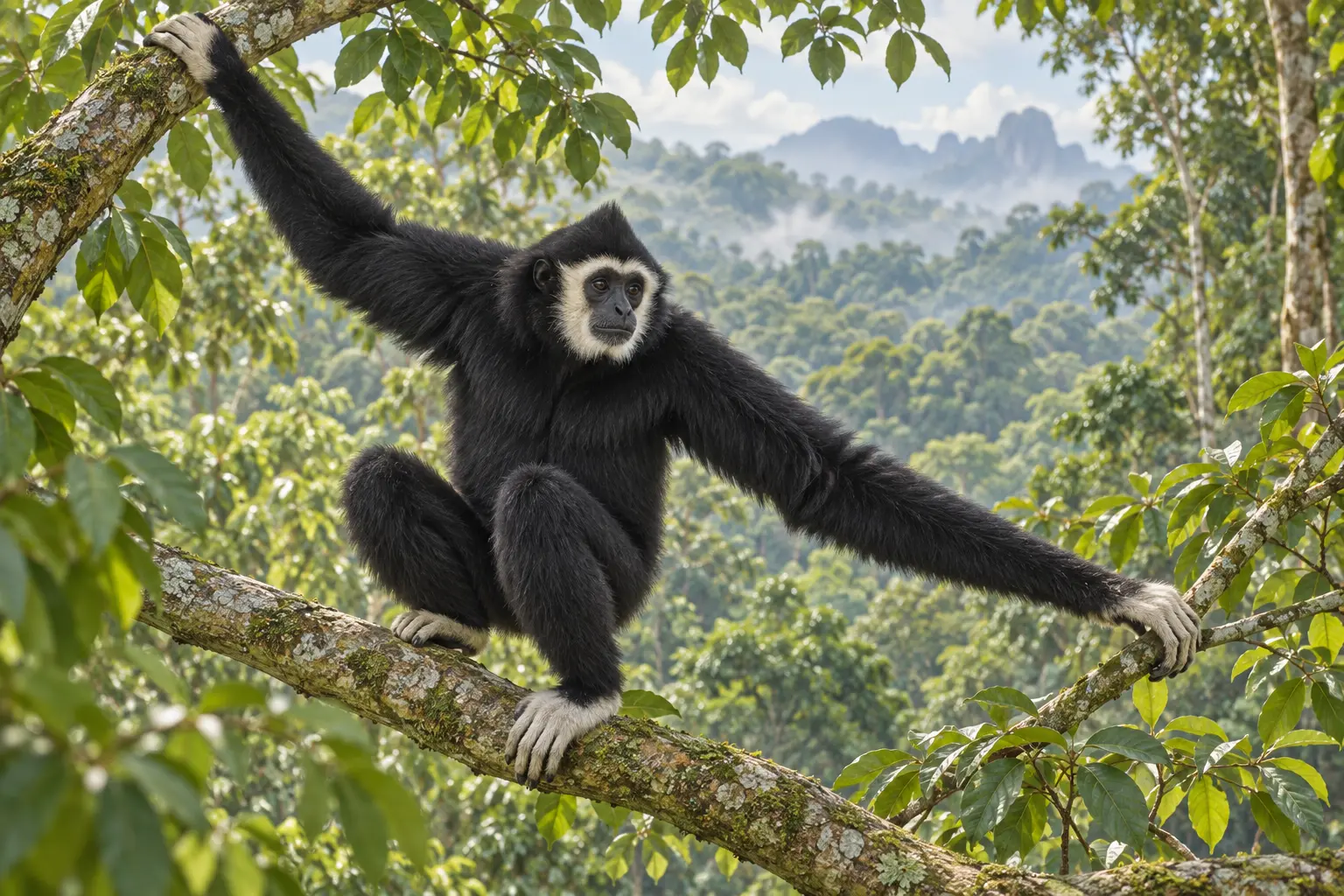
Now recorded mainly in south-eastern Thailand, western Cambodia and a very small area of south-western Laos, in deciduous monsoon, evergreen and moist montane forest to about 1,500 m. [1,2]
Head–body length is about 45–64 cm and mass about 4–8 kg. The sexes average similar size but develop strongly contrasting adult coat colours. [1]
Adult males are almost entirely black with narrow white facial and crown rings plus pale hands and feet; females are buff-grey with black ventral and crown areas. Both sexes are tailless. [1]
Long arms, mobile shoulders and curved fingers enable efficient brachiation; when on the ground, upright walking with raised arms aids balance. Species-specific duets help maintain spacing between groups in dense forest. [1]
Behaviour and ecology
Diurnal, living in small family groups and travelling mainly by arm-swinging brachiation. Pairs duet in the morning for species recognition and territorial advertisement; canopy crossings can span gaps of up to about 9 m. [1]
Diet
Predominantly frugivorous, including many figs, supplemented by young leaves, shoots, insects, eggs and small vertebrates. Proportions vary by season and site; figures from one population are not a universal diet formula. [1]
Reproduction and life cycle
Usually one infant follows a gestation of about 193–225 days. Young nurse for roughly 12–24 months and remain with the family for years; females mature at about 7.5 years, contributing to slow population recovery. [1]
Ecosystem role
Fruit feeding and long movements within a home range make pileated gibbons important seed dispersers; gut passage may improve germination. This is an ecological function, not the sole measure of conservation value. [1]
Threats & conservation
Forest loss and fragmentation, hunting for food and capture of young are principal pressures. Appendix-I status and slow reproduction mean any managed-care programme must prioritise primate welfare, biosecurity, provenance and an authorised conservation purpose. [1–3]
Reviewed 21 September 2026: IUCN records EN; Hylobates spp. are in CITES Appendix I. Legal status for any movement must be checked against the individual record, purpose and countries involved.5 sourced facts
Species in five facts
Pileated gibbons have no tail despite spending nearly all their time in trees. [1]
Adult males and females carry strikingly different coat patterns. [1]
A pair commonly performs a species-specific duet in the morning. [1]
Recorded gestation is about 193–225 days and usually produces one infant. [1]
Cambodia, Thailand and Laos retain the species' present native range. [1,2]
Sources
[1] Animal Diversity Web — Hylobates pileatus[2] IUCN Red List species search[3] CITES Appendices effective 5 March 2026