
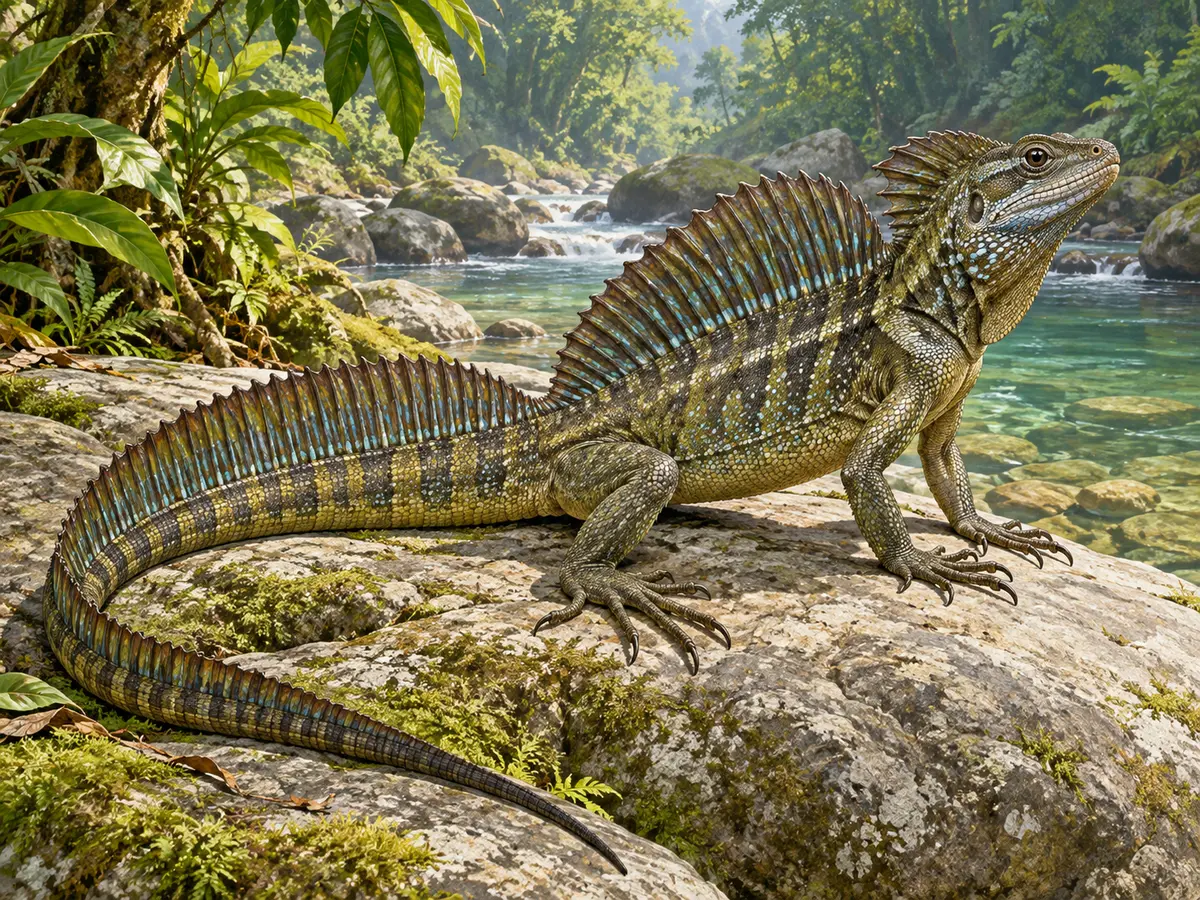
Endemic to the Philippines and recorded on most major islands except Palawan. It is associated with rivers, streams and riparian forest from lowlands to at least several hundred metres, and can persist in some disturbed settings where suitable river microhabitat remains. [1,2]
Large males may approach 1 m in total length, much of it tail. Size varies with sex, age and population, so total length alone is not a body-condition measure. [1,2]
A robust body, relatively high head, nuchal-dorsal spines and a large male tail-base sail are diagnostic. Colour is often olive, brown or grey with darker patterning; it is an agamid, not a Varanus monitor lizard. [1,2]
A deep, laterally compressed tail acts as a paddle; strong limbs and long toes grip rock, mud and branches. The male sail is a visual signal, while diving provides rapid escape from terrestrial predators. [1,2]
Behaviour and ecology
Diurnal, basking on branches or rocks beside water and diving when threatened. Juveniles move agilely on low vegetation; larger animals are strong swimmers and may submerge to escape. [1,2]
Diet
Omnivorous, taking leaves, flowers and fruit as well as insects and small animals. The plant-animal balance varies with age and food availability; diets should not be built from one locality record. [1,2]
Reproduction and life cycle
Oviparous, depositing eggs in diggable soil or banks. Reviewed sources are not consistent enough for one fixed clutch and incubation value across all populations; breeding management must retain individual, locality and thermal-humidity records. [1,2]
Ecosystem role
It links riparian food webs by consuming plants, fruit and small animals while feeding raptors, snakes and mammals. Protecting its riverbanks also retains habitat corridors for many aquatic and terrestrial species. [1]
Threats & conservation
Threats include riparian habitat loss and fragmentation, pollution, hunting for food and collection for pets. Despite LC status, a decreasing trend and the Philippine export prohibition make lawful-origin records a minimum requirement; DinoJura does not source undocumented wild animals. [1,3]
The 2022 IUCN assessment lists the species as Least Concern (LC) with a decreasing population trend. Hydrosaurus pustulatus was not located in the CITES Appendices effective 5 March 2026; IUCN notes that export from the Philippines has been prohibited since 1991. Absence from CITES is not export or trade permission. [1,3,4]5 sourced facts
Species in five facts
It is an agamid, not a monitor lizard in Varanidae. [2]
The species is naturally confined to the Philippines. [1]
The dorsal and tail sails are most developed in males. [1,2]
The laterally compressed tail supplies propulsion in water. [2]
IUCN records a decreasing trend despite the LC category. [1]
Sources
[1] IUCN Red List — Hydrosaurus pustulatus (2022)[2] Reptile Database — Hydrosaurus pustulatus[3] Philippine sailfin lizard trade and conservation study[4] CITES Appendices effective 5 March 2026