
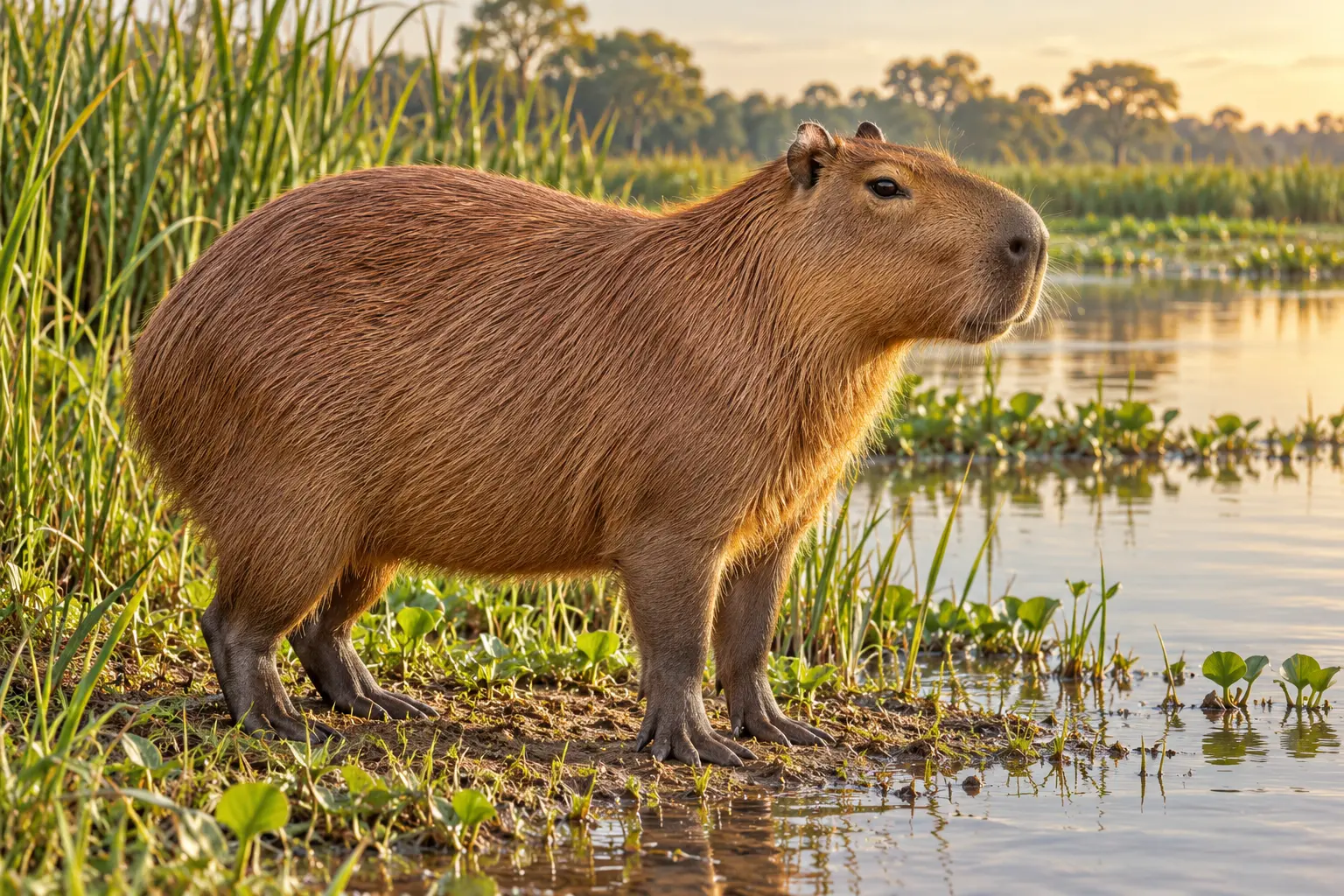
Widespread in South America east of the Andes and naturally absent from Chile; always associated with water such as marshes, estuaries, rivers and streams bordered by grazing habitat. Water provides escape, cooling and mating space, while banks supply much of the food. [1]
Body length is about 107–134 cm and mass commonly 35–65 kg; females may exceed males. The low, heavy build means shoulder height alone understates body size. [2]
Barrel-shaped body, coarse reddish-brown coat, broad blunt muzzle, small rounded ears and almost no external tail. Eyes, ears and nostrils sit high on the head; hindlimbs are longer than forelimbs and the toes are partly webbed. [1–3]
Toe webbing, a streamlined body and high-set eyes, ears and nostrils support swimming with most of the body submerged. Nostrils and ears close during dives; sparse fur offers limited insulation, making mud, shade and water important for thermoregulation. [1–3]
Behaviour and ecology
Social groups usually contain 2–30 animals, with one dominant male plus females, young and subordinate males. Whistles, barks, squeals and scent maintain contact; when alarmed, the group may rush into water and expose only the upper head. [1]
Diet
Feeds mainly on grasses and aquatic vegetation, with seasonal plant selection. Like other cavies, capybaras re-ingest nutrient-rich soft faeces to recover vitamins and fermentation products; continuously growing incisors are worn by fibrous food. [1–3]
Reproduction and life cycle
Mating usually occurs in water. Gestation may reach about 120 days; IUCN reports an average near 3.5 young, with a range of 1–7 per litter. Young are well developed, follow the group and graze early while continuing to nurse. [1]
Ecosystem role
As a large wetland grazer it shapes vegetation through feeding and trampling, while serving as major prey for jaguars, caimans and large snakes. Dung and movement transfer nutrients between shore and water. [1,3]
Threats & conservation
IUCN identifies hunting for meat and leather as a principal pressure, while the global population remains LC. Agricultural conflict and wetland management can affect local numbers; managed groups need social space, dry banks, suitable deep water and infectious-disease controls. [1]
Reviewed 2 October 2026: IUCN lists the species as Least Concern (LC), assessed in 2016, with a stable trend. The scientific name was not located in the CITES Appendices effective 5 March 2026; absence from CITES does not permit unrestricted movement or import—veterinary, quarantine, welfare and national law still apply. [1,4]5 sourced facts
Species in five facts
It is the largest living rodent. [2,3]
Eyes, ears and nostrils are high-set for surveillance while the body is submerged. [1–3]
Social groups commonly contain 2–30 individuals. [1]
Mating usually takes place in water. [1]
It re-ingests soft faeces to recover nutrients from hindgut fermentation. [2,3]
Sources
[1] IUCN Red List 2016 assessment — Hydrochoerus hydrochaeris[2] San Diego Zoo Wildlife Alliance — Capybara fact sheet[3] Animal Diversity Web — Hydrochoerus hydrochaeris[4] CITES Appendices effective 5 March 2026