
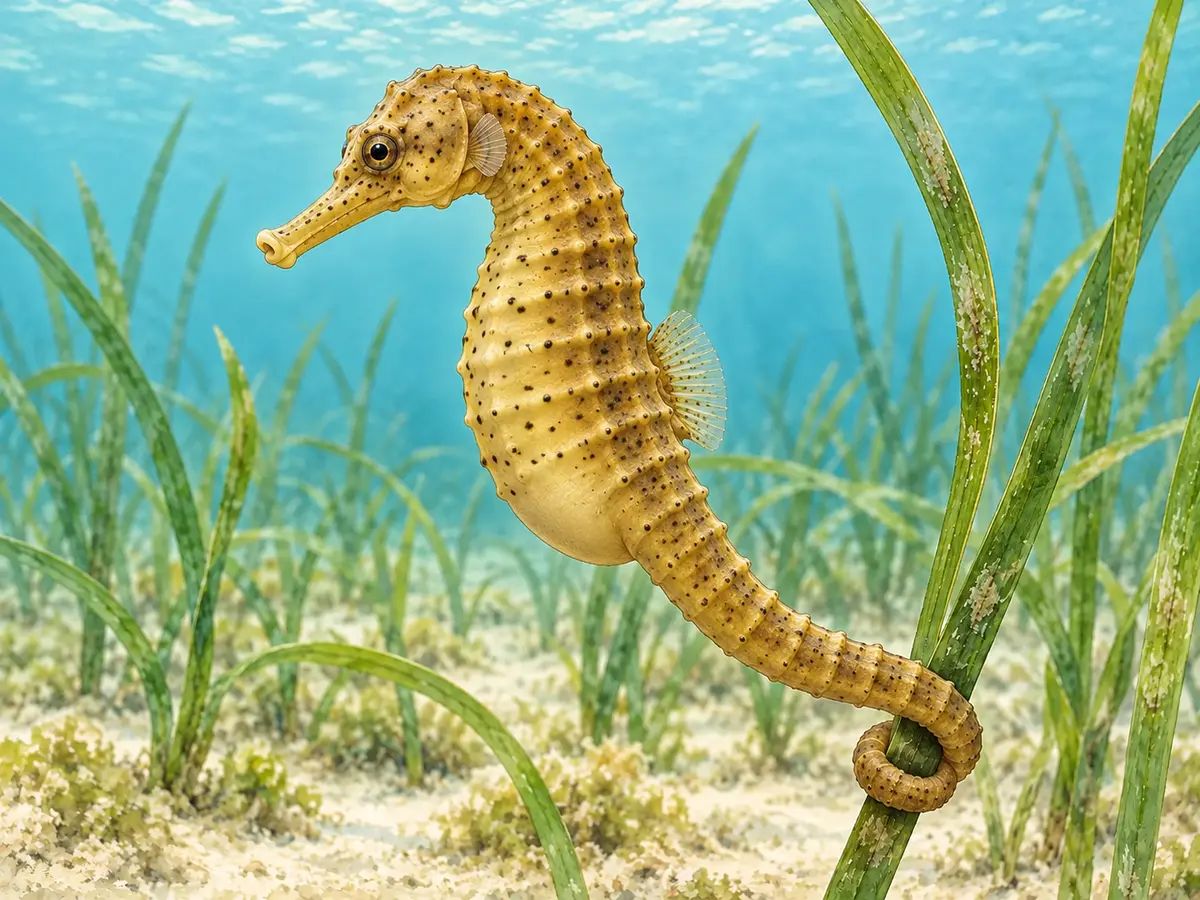
Recorded broadly from the Indian Ocean through Southeast Asia to the western Pacific, in shallow coasts, estuaries, lagoons, mangroves, seagrass, harbours and sandy or rocky bottoms; ADW reports it commonly at 0–8 m but down to about 55 m. [1–3]
ADW reports adults commonly around 7–17 cm, while FishBase contains a larger maximum record. Seahorse measurements vary with method and specimen condition, so this profile uses the common range rather than presenting a maximum as typical. [2,3]
The body is encased in bony rings beneath the skin, with no pelvic or caudal fin; the tail is prehensile, the snout thick, the head deep and the coronet low and rounded. Colour may be yellow, brown or black with dark spots or rings, so colour alone cannot confirm this difficult seahorse identification. [2,3]
The prehensile tail anchors the fish in moving water; the eyes scan semi-independently and the tubular snout produces rapid suction. The male pouch regulates the embryo environment, while bony rings protect the body at the cost of flexibility. [2]
Behaviour and ecology
It swims upright using a rapidly beating dorsal fin and steers with pectoral fins, but is a weak long-distance swimmer. Individuals anchor to seagrass, soft coral or other holdfasts, and pairs may greet and synchronise movements before mating. [2]
Diet
Spotted seahorses ambush small crustaceans and plankton near holdfasts, sucking prey through the tubular snout. Lacking teeth and a true stomach, they process small prey rapidly and need repeated suitable feeding opportunities through the day. [2]
Reproduction and life cycle
The female transfers eggs into the male's brood pouch, where fertilisation and embryo development occur. ADW reports pregnancy commonly around 20–28 days; brood size varies greatly with individual and conditions, so no single fixed number represents the species. [2]
Ecosystem role
Spotted seahorses consume small crustaceans and are prey for larger fishes, linking energy through seagrass, mangrove and estuarine food webs. Dependence on holdfasts also reflects microhabitat structure, although the species is not an absolute water-quality indicator. [1,2]
Threats & conservation
Loss of seagrass and mangroves, pollution, bycatch and collection for traditional medicine, curios or aquaria are major pressures. DinoJura must require traceable captive origin, CITES permits and health and water records, never relying on an undocumented 'captive-bred' label. [1,4,5]
IUCN lists Hippocampus kuda as Vulnerable (VU) in a 2014 record based on a 2012 assessment; that age is stated rather than replaced by a guessed update. The entire genus Hippocampus is in CITES Appendix II, so international trade requires suitable origin evidence and permits. [1,4,5]5 sourced facts
Species in five facts
The male carries embryos in a brood pouch. [2]
A prehensile tail replaces a caudal fin. [2]
The species has no teeth and no true stomach. [2]
Body colour varies greatly and cannot by itself confirm the species. [2,3]
The entire genus Hippocampus is included in CITES Appendix II. [4,5]
Sources
[1] IUCN Red List 2014 — Hippocampus kuda[2] Animal Diversity Web — Hippocampus kuda[3] FishBase — Hippocampus kuda[4] CITES Appendices effective 5 March 2026[5] Australian Government — CITES seahorse non-detriment finding