
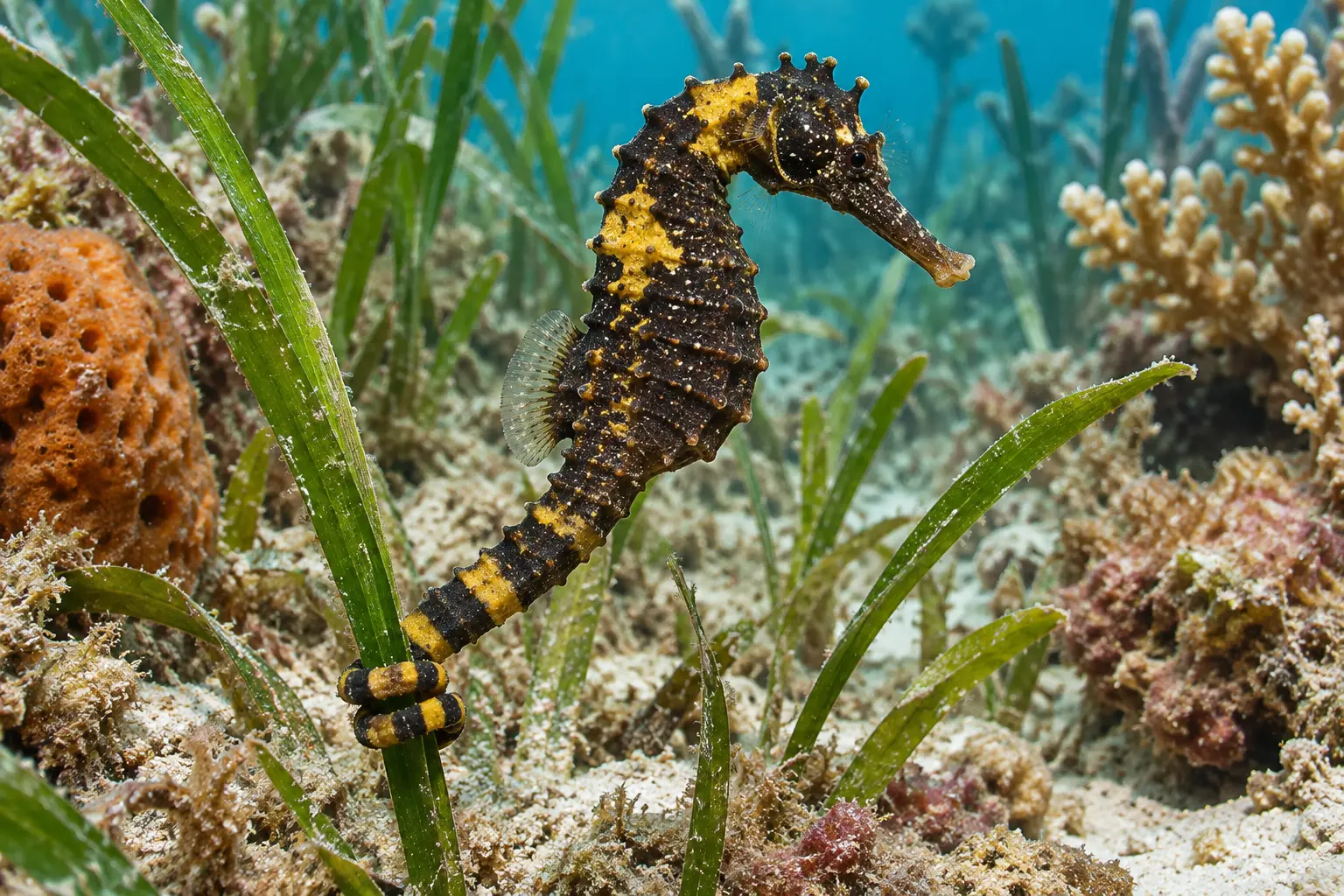
Ranges from the central-southern Philippines west through Viet Nam, Singapore, Malaysia and northern Indonesia to the Andaman Islands; newer records show habitat knowledge remains incomplete. It occurs on coral reefs, sponge gardens, seagrass, macroalgae and drifting Sargassum. [1–3,6]
FishBase reports a maximum height of 18.7 cm, measured from the coronet to the straightened tail tip; many individuals are smaller. Seahorse records must state ‘height’ versus ‘length’ because measurement method changes the value. [2]
Usually dark brown or black with yellow saddle-shaped dorsal patches and a strongly yellow-black banded tail; the coronet is low with five knobs, the snout long and body plates ringed. Colour varies, so professional identification also uses ring and fin-ray counts. [1–3]
A prehensile tail resists drift; independently moving eyes locate prey, the tubular snout creates suction and bony plates replace flexible fish scales. Upright posture and mottled pattern disrupt the outline among seagrass, sponges and coral. [1–3]
Behaviour and ecology
More active at night, it anchors with a prehensile tail and shows fidelity to small areas; pairs may be observed. Rapid oscillation of the dorsal fin produces relatively slow swimming, creating dependence on holdfast structure and moderate flow. [2,3]
Diet
Sucks zooplankton and small crustaceans through the tubular snout with a rapid mouth expansion. It lacks teeth and a typical stomach, requiring repeated small prey captures. Managed diets must match mouth size and live/frozen prey quality. [2,3]
Reproduction and life cycle
The female transfers eggs into the male brood pouch; the male fertilises them, regulates the embryonic environment and later contracts to release young. Male pregnancy does not remove female investment: large eggs and synchronised courtship are central to the cycle. [3,4]
Ecosystem role
Predation on tiny planktonic crustaceans, while being prey for larger fish, links benthic microhabitats with reef-seagrass food webs. Density and condition also reflect holdfast quality, but are not a sole indicator of reef health. [2,3]
Threats & conservation
Targeted fishing, dried-product and aquarium trade, bycatch and reef-seagrass degradation are key pressures. Appendix II requires documentation and sustainability findings for international trade; captive origin cannot be assumed merely because an animal is held in a facility. [1,4,5]
Reviewed 2 October 2026: IUCN lists the species as Vulnerable (VU), assessed in 2015; all Hippocampus spp. are in CITES Appendix II. The assessment is more than a decade old and recent citizen records expand habitat knowledge, so range and trend should not be treated as fixed. [1,4–6]5 sourced facts
Species in five facts
Yellow-black tail bands give the species its ‘tiger-tail’ name. [1–3]
Male seahorses carry embryos in a brood pouch. [3,4]
FishBase records a maximum height of 18.7 cm. [2]
The species is more active at night and often shows small-area fidelity. [2,3]
All species in the genus Hippocampus are included in CITES Appendix II. [4,5]
Sources
[1] IUCN Red List 2015 assessment — Hippocampus comes[2] FishBase — Hippocampus comes[3] FAO Cultured Aquatic Species — Tiger-tail seahorse[4] CITES — Seahorses (Hippocampus spp.)[5] CITES Appendices effective 5 March 2026[6] Project Seahorse — Citizen science expands seahorse habitat records