
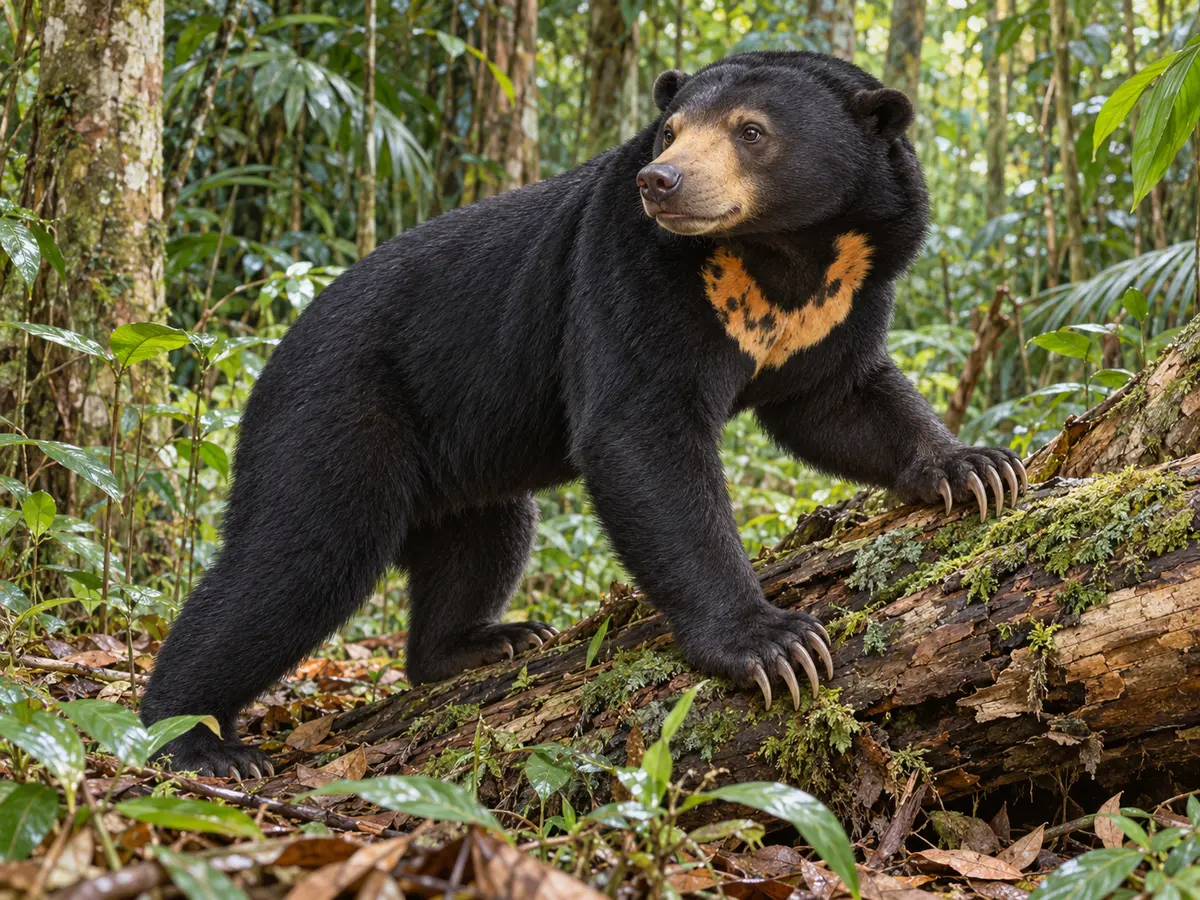
Occurs from north-eastern India and Bangladesh through mainland South-East Asia to Malaysia, Sumatra and Borneo, with a contracted and fragmented range. It uses lowland evergreen, lower montane, swamp and some structurally complex secondary forests. [1,2]
Body length is about 100–150 cm and mass roughly 30–90 kg; males average larger than females. The compact build, slightly bowed forelimbs and large paws suit climbing; size varies with sex, age and population. [1,2]
Short black to black-brown fur contrasts with a grey-yellow muzzle and small rounded ears; the chest bears a yellow-to-orange U or crescent. This patch varies individually and should not alone establish subspecies or provenance. [1–3]
Long curved claws, broad bare soles and flexible joints grip tree trunks, while the exceptionally long tongue reaches deep cavities. Short fur suits humid heat and a strong sense of smell locates ripe fruit, insects and carrion. [1–3]
Behaviour and ecology
Mostly solitary outside breeding, climbing to forage, rest and make branch platforms. Often diurnal or crepuscular where disturbance is low but may shift nocturnal near people; it does not hibernate in its tropical environment. [1–3]
Diet
Omnivorous, taking figs and other fruit, termites, ants, beetles and larvae, honey and small animals. Claws open rotten wood or insect nests, while a tongue reported to reach about 46 cm extracts honey and insects from cavities. [1–3]
Reproduction and life cycle
Breeding may occur year-round in the tropics. Gestation is reported at about 96–110 days; one cub is typical and two uncommon, born in a cavity or sheltered den. Cubs depend on the mother while learning to climb, forage and recognise danger. [1,2]
Ecosystem role
Disperses seeds in faeces, opens decaying wood to insects and creates cavities that other species may use. Honey and larval foraging modifies tree microstructure, a role tied to forests retaining large trees and dead wood. [1,2]
Threats & conservation
Deforestation, roads, hunting for bile, cubs or body parts, pet keeping and crop conflict are major pressures. DinoJura excludes wild commercial sourcing; any rescue or transfer must proceed through authorities with CITES and veterinary records and a specialist bear facility. [1,2,4]
IUCN lists the sun bear as Vulnerable (VU); the IBA specialist account reports a global decline exceeding 30% over 30 years. Appendix I since 1979 generally prohibits international commercial trade in wild specimens; exceptions and conservation transfers require authority confirmation. [1,2,4]5 sourced facts
Species in five facts
It is the smallest living bear species. [1,2]
The tongue may reach about 46 cm. [1]
The chest patch varies among individuals. [1]
The species does not hibernate in its tropical range. [1,2]
The sun bear has been in CITES Appendix I since 1979. [1,4]
Sources
[1] International Association for Bear Research — Sun bear[2] IUCN Red List search — Helarctos malayanus[3] Smithsonian's National Zoo — Sun bear[4] CITES Appendices effective 5 March 2026