
Occurs in East Africa from Somalia through Kenya to Tanzania, including Zanzibar and Tumbatu. It inhabits open forest, woodland, dense thickets and forest–savanna mosaics, often foraging over leaf litter. [1,3]
Roughly 45–56 cm long, with a rounded body, small head and short tail. Measurements across sources may still reflect the older taxonomic concept, so a range is reported rather than a single absolute value. [2,3]
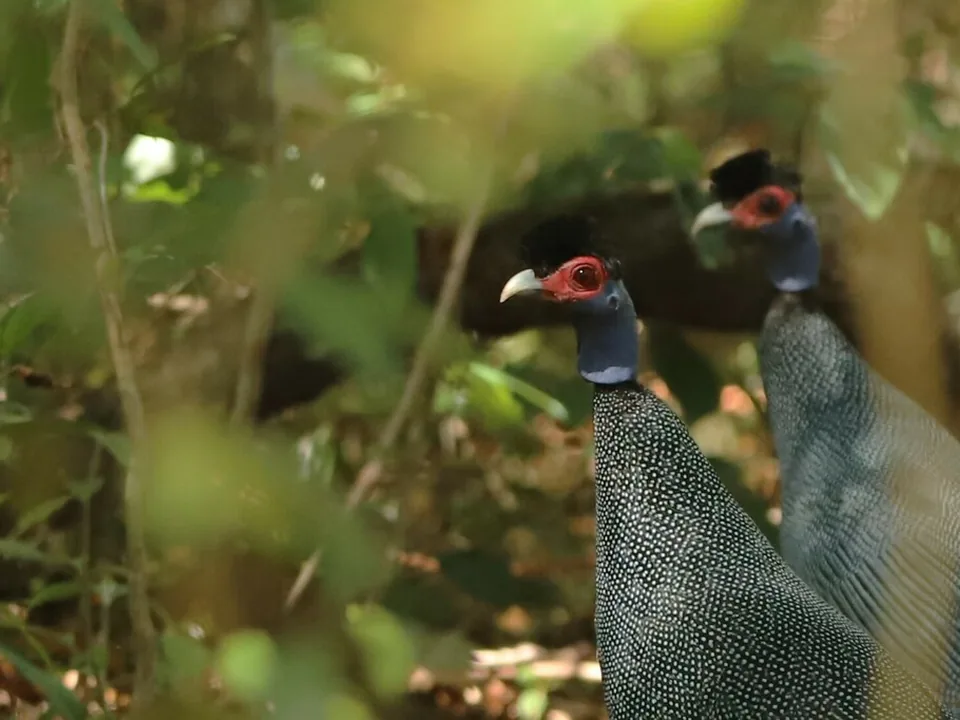
Dense dark grey-black plumage is white-spotted; the head and upper neck are largely bare with bluish-grey skin and a short curly black crest. Guttera species should not be identified from the word “crested” alone; geography and head–neck details matter. [2,3]
Strong legs and toes suit scratching on the forest floor; white spotting disrupts the outline among leaf litter and sun flecks. The crest is not disposable decoration but an identification and communication feature. [2,3]
Behaviour and ecology
Mostly walks in pairs or small flocks, scratching leaf litter for food and running rapidly when disturbed. Although strongly terrestrial, it can fly short distances and roost in trees, so “ground-dwelling” does not mean no need for vertical space. [2]
Diet
Takes seeds, fruit, shoots, small underground plant parts and many invertebrates including insects. The balance varies seasonally; managed diets need a balanced galliform base and opportunities to scratch and forage, not scattered grain alone. [2]
Reproduction and life cycle
The nest is a concealed shallow ground scrape. Species husbandry material reports commonly 4–5 eggs and sometimes up to 7; precocial chicks leave the nest and follow their parents. Clutch data should not be generalised to every crested guineafowl. [2]
Ecosystem role
As a terrestrial omnivore it consumes insects, disturbs leaf litter and may move seeds. Eggs, chicks and adults also feed snakes, mammalian carnivores and raptors. [1,2]
Threats & conservation
Forest and thicket loss, hunting and habitat degradation can cause local declines despite the LC category. For managed birds, DinoJura must verify the post-split taxon, legal origin, health status and poultry-disease risks. [1,3,4]
BirdLife/IUCN lists Guttera pucherani as Least Concern (LC) with a decreasing trend. The name was not located in the CITES Appendices effective 5 March 2026; this is not permission to capture or trade and does not replace wildlife, veterinary or quarantine law. Modern taxonomy splits the former broad crested-guineafowl complex into eastern, western and southern species. [1,3,4]5 sourced facts
Species in five facts
G. pucherani is now the eastern species, not the name for the whole crested-guineafowl complex. [1,3]
The crest consists of short curled black feathers. [2]
BirdLife treats the species as non-migratory. [1]
The bird forages by scratching through leaf litter. [2]
The nest is on the ground and the chicks are precocial. [2]
Sources
[1] BirdLife DataZone — Eastern Crested Guineafowl[2] Cleveland Metroparks — Eastern Crested Guineafowl[3] Avibase — Guttera pucherani[4] CITES Appendices effective 5 March 2026Photo record — Adrien Jailloux, iNaturalist 259802833, CC BY