
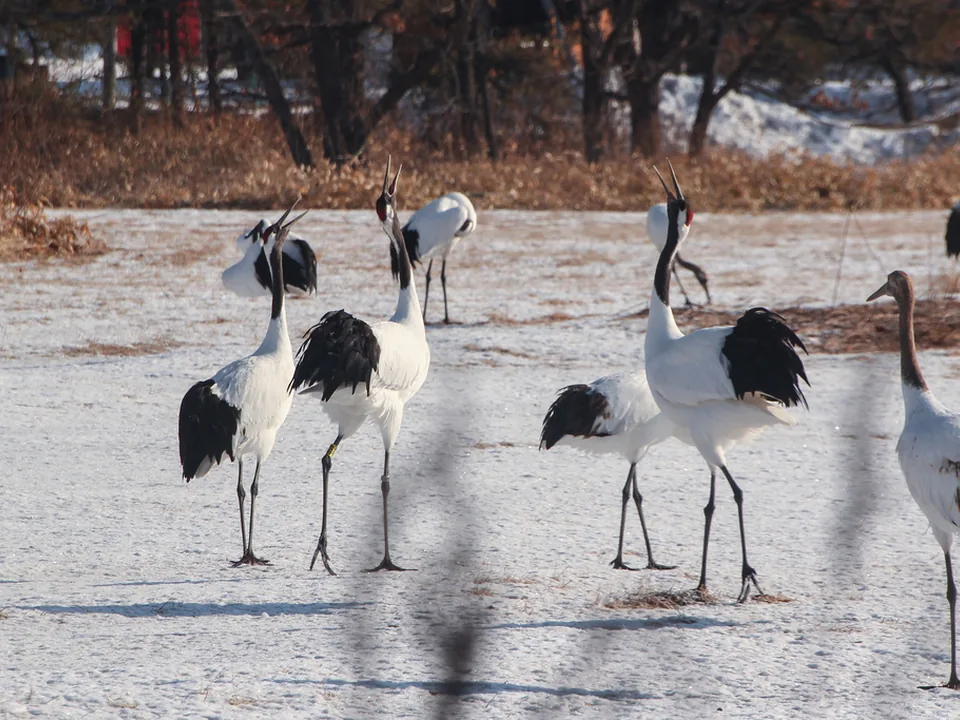
The continental population breeds in the Russian Far East and north-eastern China and winters in China and the Korean Peninsula; Hokkaido's Japanese population is largely resident. Reed marshes, floodplains and nearby farmland form core habitat. [1–3]
Roughly 150–158 cm tall, commonly 7–10 kg, with a wingspan approaching 2.4 m. The sexes look alike in plumage, although males average larger. [1,2]
White body, black neck and underwing, long dark legs, a pointed bill and bare red crown skin. When the wings are folded, drooping black secondaries can appear like a black tail. [1,2]
Long legs wade, the pointed bill probes and seizes prey, and an elongated trachea produces resonant calls. The red crown can expand, strengthening visual signals. [1,2]
Behaviour and ecology
Territorial pairs breed separately and gather in flocks outside the breeding season. Displays combine bows, leaps and tossed material, while pairs perform far-carrying unison calls. [1,2]
Diet
Omnivorous, taking insects, worms and aquatic invertebrates, fish, amphibians, small rodents, grain, shoots and marsh plants. A long bill and walk-and-peck technique support foraging in relatively deep water. [1]
Reproduction and life cycle
Builds a large nest in marsh vegetation and usually lays two eggs. Both parents incubate and defend; eggs hatch after about a month, and chicks can fly at around 70 days but remain with the parents. [1]
Ecosystem role
It acts across both plant and animal food chains in marshes and serves as a flagship and indicator species, mobilising protection for wetlands shared with many other organisms. [2; conservation interpretation]
Threats & conservation
Wetland conversion, fragmentation and pollution, power-line collision, disturbance, dependence on winter feeding sites and disease create population-specific risks. CITES Appendix I imposes strict international controls. [2–4]
Reviewed 20 September 2026: BirdLife/IUCN currently records VU; the International Crane Foundation likewise records VU and CITES Appendix I. Some older sources still display EN, so this profile uses the current category and states the review date.5 sourced facts
Species in five facts
The red crown is bare skin, not red feathers. [1]
Hokkaido holds a resident population while continental birds migrate long distances. [1–3]
Pairs perform coordinated unison calls with characteristic postures. [1]
A clutch usually has two eggs, though both chicks do not always survive to fledging. [1]
The species can stand more than 1.5 metres tall. [2]
Sources
[1] Animal Diversity Web — Grus japonensis[2] International Crane Foundation — Red-crowned Crane[3] BirdLife DataZone — Grus japonensis[4] CITES Appendices effective 5 March 2026[Ảnh] iNaturalist observation 9600943 — Austin 0201, CC BY