
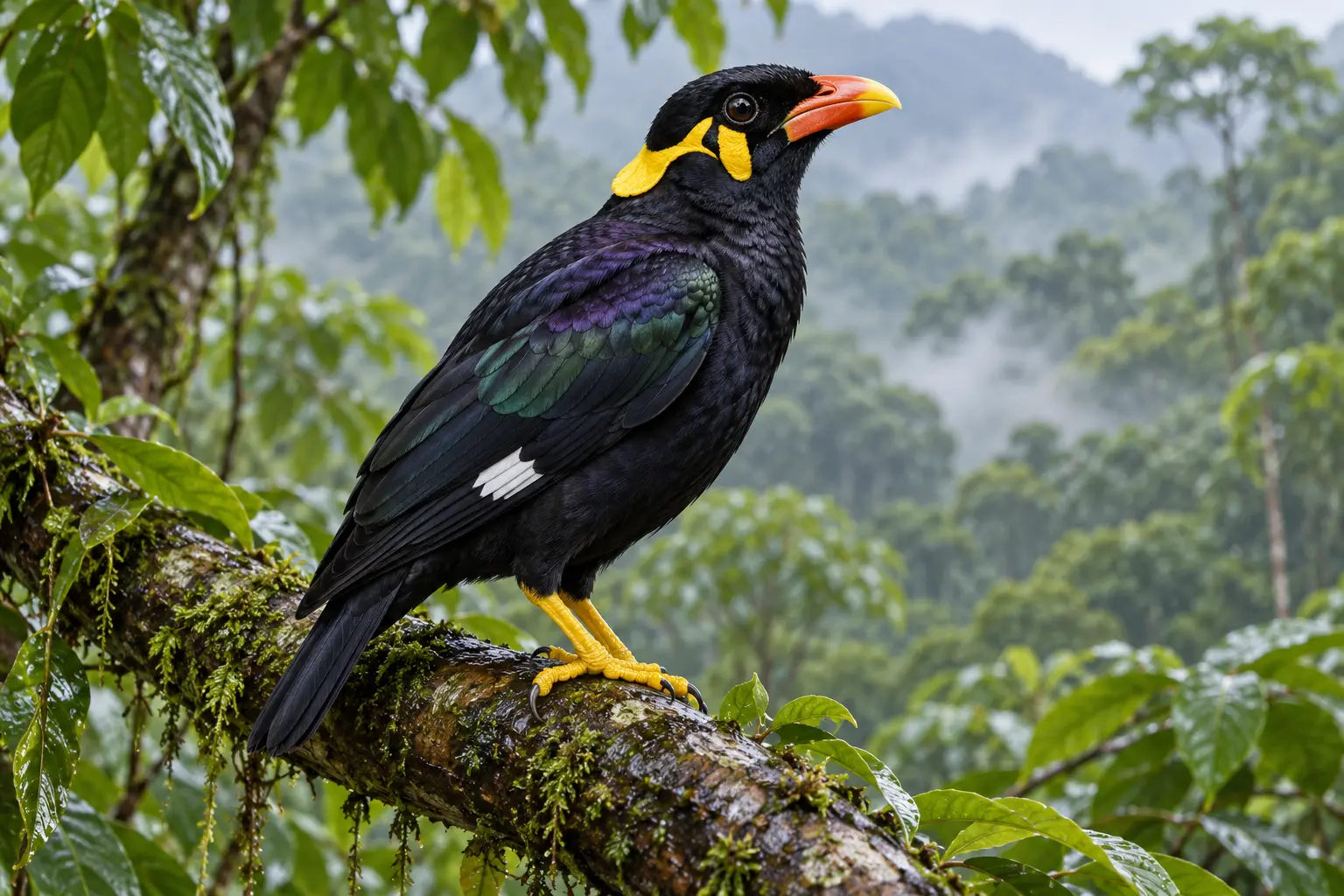
Ranges from India and southern China through mainland Southeast Asia to the Malay Peninsula and regional islands. It inhabits humid forest, edges and fruiting-tree areas from lowlands to roughly 2,000 m depending on locality. [1,2,4]
About 27–31 cm long, with a robust body, moderately large head, short tail and rounded wings. Size alone should not separate subspecies or closely related Gracula species. [1,2,4]
Glossy black plumage shines green-purple, a large white primary patch flashes in flight, and an orange bill with yellow tip accompanies yellow post-ocular wattles. Wattle form varies among populations, so captive hill mynas should not automatically be assigned to one subspecies. [1,2,4]
Strong feet grip branches, the bill handles fruit and small prey, and vocal plus auditory learning supports a rich sound repertoire. White wing patches may assist recognition as birds move through dense canopy. [1,2]
Behaviour and ecology
Diurnal and arboreal, usually moving in pairs or small groups. Its natural repertoire is diverse; individuals learn environmental sounds and may imitate people, but repetition does not prove comprehension of every sound. [1,2]
Diet
Primarily frugivorous, especially taking berries and figs, while also consuming nectar, seeds, insects and occasional small animals. Managed diets require veterinary control of excess iron because hill mynas are susceptible to iron-storage disease. [1,2]
Reproduction and life cycle
A cavity nester. Compiled accounts commonly report two blue spotted eggs, fledging after about a month and more than one brood in a season; values vary by population and conditions. [1]
Ecosystem role
By swallowing fruit and depositing seeds elsewhere it can disperse forest plants, while also taking insects. Dispersal effectiveness depends on seed size, gut passage and perch location; not every seed survives. [1,2]
Threats & conservation
Forest loss and trapping for the cage-bird trade create strong local pressure despite the global LC category. Provenance, subspecies, rings or identifiers and CITES permits require cross-checking; vague captive-bred claims must not legitimise birds of unknown origin. [3–5]
Reviewed 3 October 2026: IUCN currently lists the species as Least Concern (LC), while the current CITES Appendices place Gracula religiosa in Appendix II. Some older references still say Appendix III; this profile follows the CITES text effective 5 March 2026. [1,3–5]5 sourced facts
Species in five facts
The white wing patch is most obvious when the bird opens its wings or flies. [1,2]
Yellow wattles sit behind and below the eyes, with shape varying among populations. [1,4]
The species can learn and imitate many complex sounds. [1,2]
Natural nests are usually placed in tree cavities. [1]
CITES currently lists Gracula religiosa in Appendix II. [5]
Sources
[1] Animal Diversity Web — Gracula religiosa[2] Bird Society of Singapore — Common Hill Myna[3] IUCN Red List search — Gracula religiosa[4] eBird — Common Hill Myna[5] CITES Appendices effective 5 March 2026