
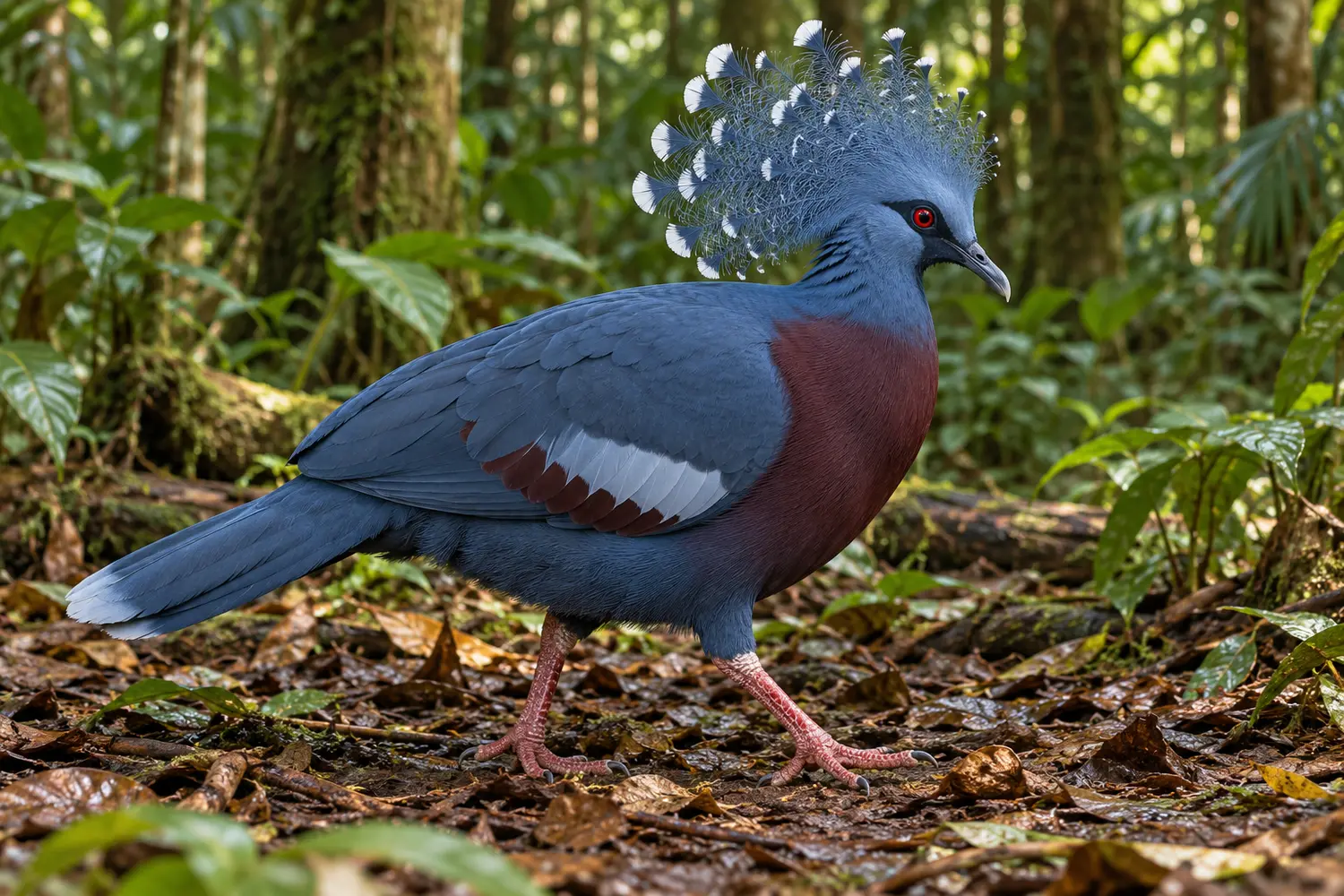
Occurs in northern New Guinea and the islands of Biak, Supiori and Yapen, using lowland rainforest, swamp forest and secondary forest with a relatively open floor. Island and mainland subspecies should not have their provenance conflated. [1,2]
About 66–75 cm long and commonly 2–3.5 kg; despite its large body it can fly short distances to roost. Size varies with subspecies, sex and individual. [2,3]
A blue-grey body, maroon breast, red iris, dark facial mask and fan-like lace crest with conspicuous white tips are distinctive. A pale blue-maroon wing bar helps separate it from other Goura, but confirmation should use the complete morphology and provenance. [2,3]
Strong legs and a large body suit terrestrial foraging, while crest display, posture and calls form a visual-acoustic signalling system. Nutrient-rich crop milk supports the chick without immediate dependence on external solid food. [2,3]
Behaviour and ecology
Forages on foot in pairs or small groups, flying to branches when disturbed or to roost. Deep resonant calls and loud wingbeats support communication in dense forest. [2,3]
Diet
Feeds on fallen fruit, seeds and small invertebrates such as snails or insects. Ground foraging processes fruit and seed material and may move seeds within the forest. [2,3]
Reproduction and life cycle
Usually lays one white egg in a stick nest above ground; both parents incubate for about a month and feed crop milk. A single chick per attempt makes recovery slow when adults are hunted. [2,3]
Ecosystem role
As a large ground consumer of fruit and seeds, it contributes to processing and moving plant material. Protecting the bird also maintains functions of New Guinea swamp and lowland forests. [1,2]
Threats & conservation
Hunting for meat, feathers or live birds and lowland forest loss are principal pressures. Management requires pedigree records, avoidance of interspecific or subspecific mixing and CITES permit confirmation before any international transfer. [1,4]
Reviewed 29 September 2026: BirdLife/IUCN lists the species as Near Threatened (NT), and CITES includes it in Appendix II. Captive-bred status does not automatically prove lawful origin or authorise trade.5 sourced facts
Species in five facts
White tips on the lace crest are a key field mark. [2,3]
The species commonly lays only one egg per clutch. [2,3]
Both parents produce crop milk for the chick. [2]
Although primarily terrestrial, it flies to branches to roost. [3]
CITES regulates the species under Appendix II. [4]
Sources
[1] BirdLife DataZone — Goura victoria[2] Cincinnati Zoo — Victoria crowned pigeon[3] San Diego Zoo Wildlife Alliance — Crowned pigeons[4] CITES Appendices effective 5 March 2026