
Recorded from Myanmar, Thailand, Laos, Cambodia, Vietnam and the Malay Peninsula to Singapore, the Philippines and several Indonesian islands. Habitats include lowland rainforest, riverine forest, bamboo, swamp and mangrove; fine-scale range should be checked against local records. [1,4]
Zoo Olomouc reports a maximum length of about 230 cm and mass up to 1.6 kg. The form is very long but slender; maximum values do not represent every individual, population or managed setting. [2]
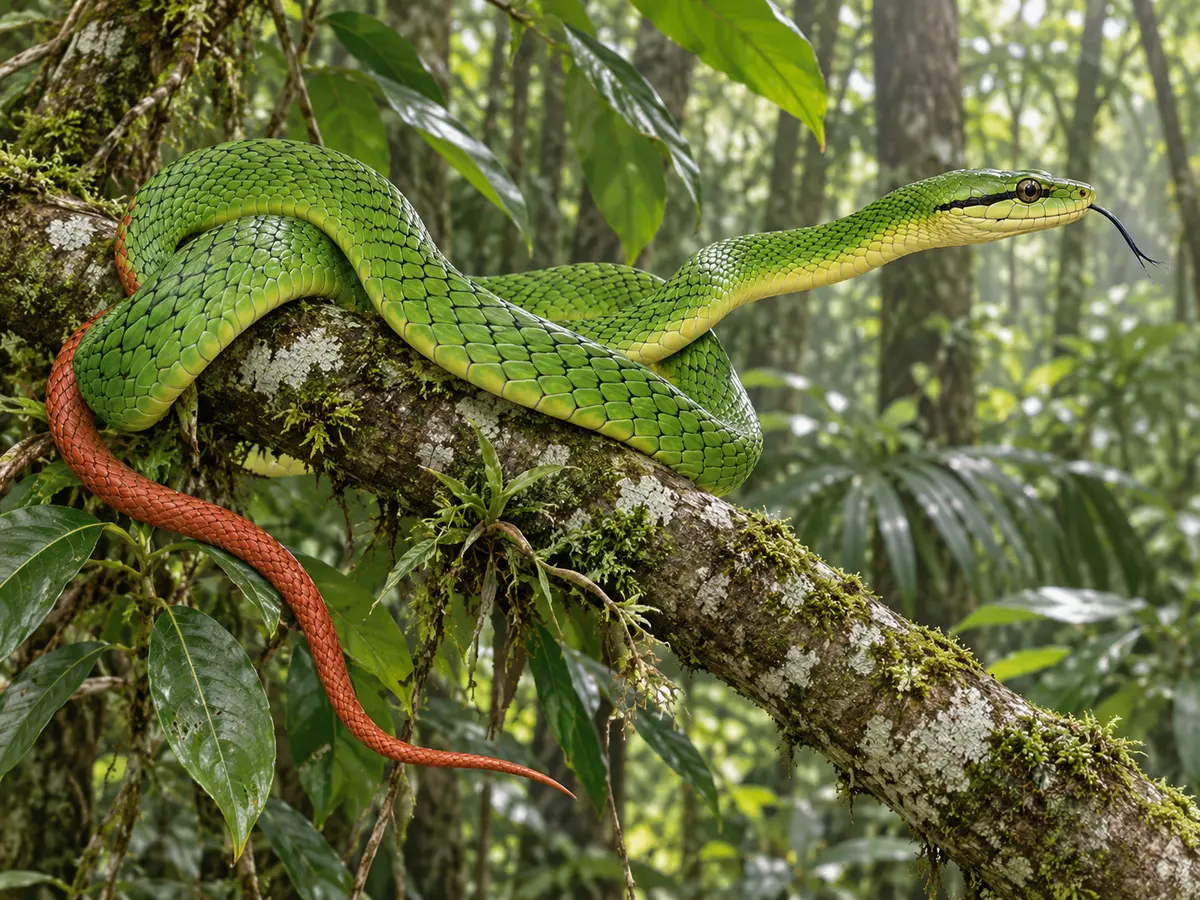
Bright green above with a yellow-green belly, pointed head, fine dark eye stripe and orange-red to reddish-brown tail; scales may be dark-edged and the tongue blue-black. Brown colour variants are recorded, so absence of typical green alone should not exclude the species. [1,4]
Green colour blends with foliage, the slender body reaches fine branches, and ventral scales plus tail improve grip. A pointed head and lateral eyes scan the canopy, while constriction replaces a venom-delivery system. [1,3]
Behaviour and ecology
Diurnal and strongly arboreal. The body is somewhat triangular in section, notched ventral scales aid grip and the tail anchors the snake on branches; when threatened it may inflate the neck, gape and strike. [1,3]
Diet
Takes birds, eggs and nestlings, small mammals, lizards, frogs and other suitably sized vertebrates. It is a non-venomous constrictor; managed prey should match body size, weight should be monitored and live feeding should not be the default. [1–3]
Reproduction and life cycle
Oviparous; Toronto Zoo reports clutches of 5–12 eggs and hatchlings around 45 cm long. Incubation differs among sources and conditions—65–70 days in one zoo account but over three months in another—so temperature, humidity and method should be recorded rather than imposing one fixed figure. [1,2]
Ecosystem role
A mid-level canopy predator influencing small-mammal, bird, reptile and amphibian populations, while also serving as prey for raptors and larger carnivores. Nest predation is a natural component of the food web. [1–3]
Threats & conservation
Loss of lowland forest and mangrove, fear-driven killing, roads and undocumented collection can create local pressure. Before any sourcing, DinoJura should verify captive origin, identity, health history, quarantine and law in both exporting and importing countries. [1–5]
Reviewed 7 October 2026: zoo sources describe the species as common or not threatened, but DinoJura could not independently verify a current IUCN assessment page and therefore assigns no category. Gonyosoma oxycephalum was not located in the CITES Appendices of 5 March 2026; national law, provenance, veterinary, quarantine and dangerous/alien-animal rules still require checking. [1–5]5 sourced facts
Species in five facts
Reported maximum length is about 230 cm. [2]
It is non-venomous and subdues prey by constriction. [1,3]
A recorded clutch contains five to twelve eggs. [1]
Hatchlings are about 45 cm long. [1,2]
The tail helps anchor the body while moving on branches. [1]
Sources
[1] Toronto Zoo — Red-tailed green ratsnake[2] Zoo Olomouc — Gonyosoma oxycephalum[3] Schönbrunn Zoo — Red-tailed green ratsnake[4] The Reptile Database — Gonyosoma oxycephalum[5] CITES Appendices effective 5 March 2026