
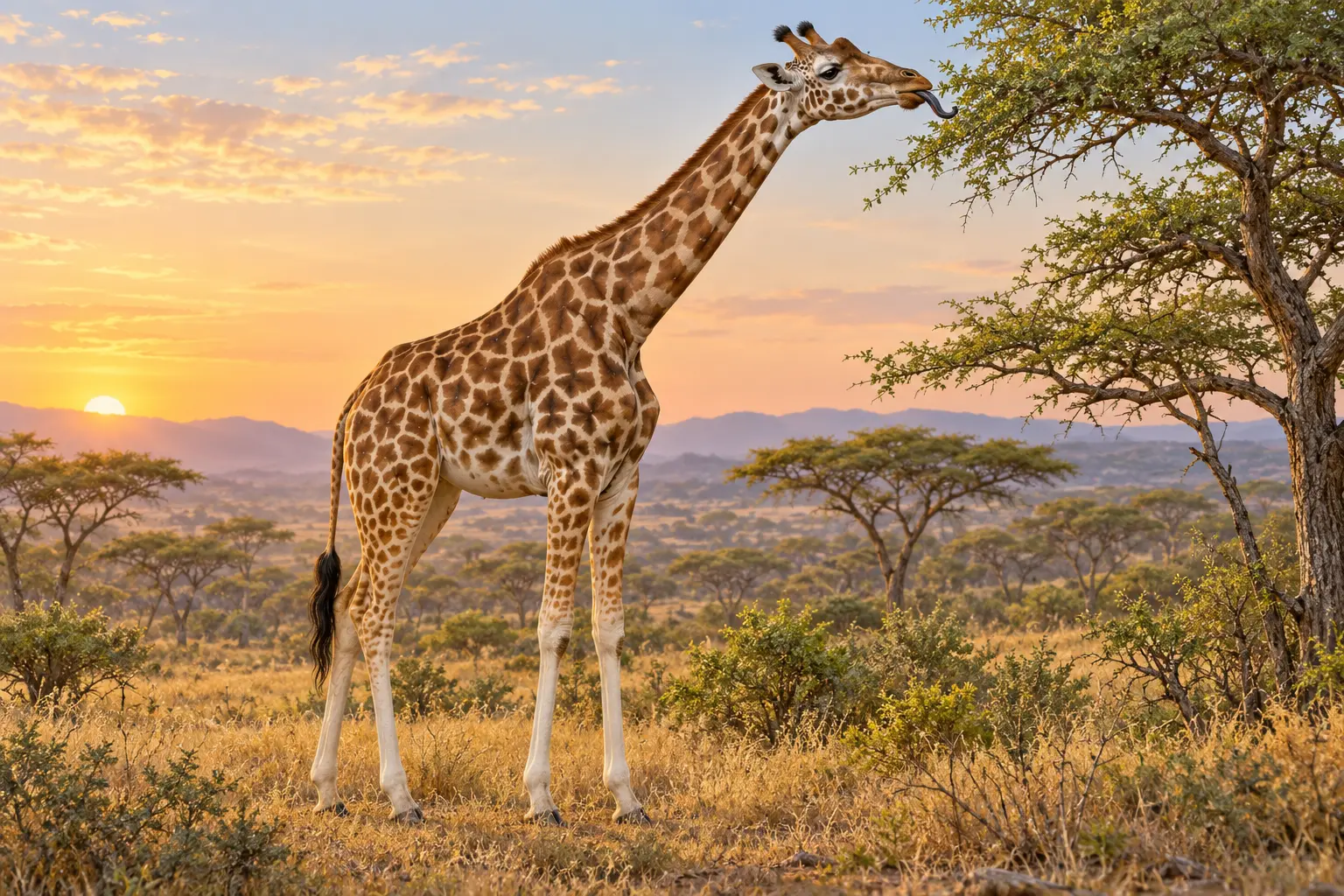
Fragmented populations persist from Niger, Chad, Cameroon, the Central African Republic and DR Congo to South Sudan, Ethiopia, Uganda and Kenya. Habitats include wooded savanna, open woodland, shrub grassland and riverine areas; each subspecies has a distinct range and records should not be generalised across Africa. [1]
Giraffes are the tallest land animals: males may reach about 5.5 m and 1,360 kg, females about 4.3 m and 680 kg in San Diego Zoo's synthesis. Values vary by age, sex and population and do not diagnose subspecies. [3]
Northern giraffes usually carry large, near-rectangular chestnut patches separated by broad cream lines, with pale, weakly marked lower legs that resemble 'white socks'. Both sexes have skin-covered ossicones; pattern alone cannot confirm subspecies or provenance. [1,3]
Long neck and legs open a feeding layer unavailable to many herbivores. A large heart, specialised vessels and pressure controls deliver blood to the brain while limiting swings during drinking; coat pattern aids camouflage, thermoregulation and individual recognition. [3,4]
Behaviour and ecology
Lives in fluid social networks whose membership changes with forage, reproduction and risk. Adult males may neck-fight; individuals scan from exceptional height and can reach about 56 km/h briefly. Foraging occupies much of the day. [3,4]
Diet
A browser of trees and shrubs rather than primarily a grazer. A roughly 45–50 cm tongue and mobile lips pull foliage around thorns, while ruminant digestion processes fibrous plant material. Selection changes with season and range. [3,4]
Reproduction and life cycle
Gestation lasts about 14 months and usually produces one calf. A newborn is nearly 1.8 m tall, may stand within an hour and later joins calf nurseries watched by a female; it samples leaves early but nurses for months. [3]
Ecosystem role
By pruning canopies, breaking branches and moving seeds, giraffes shape savanna structure and make fallen foliage available to shorter animals. Herd movements may alert other species to predators, while protecting their corridors maintains broad landscape connectivity. [2,4]
Threats & conservation
Habitat loss and fragmentation, hunting, conflict, political instability and isolated small populations are key pressures; giraffes have lost nearly 90% of their historical range over three centuries. Any managed transfer requires species-subspecies, genetic and health confirmation plus CITES and national approvals before movement. [1,2,5]
Reviewed 26 September 2026: IUCN still displays VU under the 2016 single-species assessment. IUCN now recognises the four-species approach and reassessment is underway; GCF expects northern giraffe to qualify as EN, but that is not yet a completed Red List outcome. CITES lists Giraffa camelopardalis in Appendix II.5 sourced facts
Species in five facts
GCF estimates 7,037 northern giraffes remain in the wild. [1]
The species comprises Kordofan, Nubian and West African subspecies. [1]
The tongue is about 45–50 cm long and can grasp foliage. [4]
A calf commonly stands and walks within about an hour of birth. [3]
Both sexes have ossicones—skin-covered bone structures rather than hollow horns. [3,4]
Sources
[1] Giraffe Conservation Foundation — Northern giraffe[2] Giraffe Conservation Foundation — Conservation status[3] San Diego Zoo Wildlife Alliance — Giraffe[4] Giraffe Conservation Foundation — Facts about giraffe[5] CITES Appendices effective 5 March 2026