
The native range extends from northeastern India, Bangladesh and southern China through Southeast Asia to parts of Indonesia and the Philippines; some populations elsewhere are introduced. It uses forest, cliffs, tree cavities and built environments where shelter and prey are available. [1–3]
Smithsonian reports adult males commonly around 35–40 cm and females around 20–30 cm total length. Size varies with sex, population and measurement method; a regenerated tail usually does not retain the original proportions or pattern. [1]
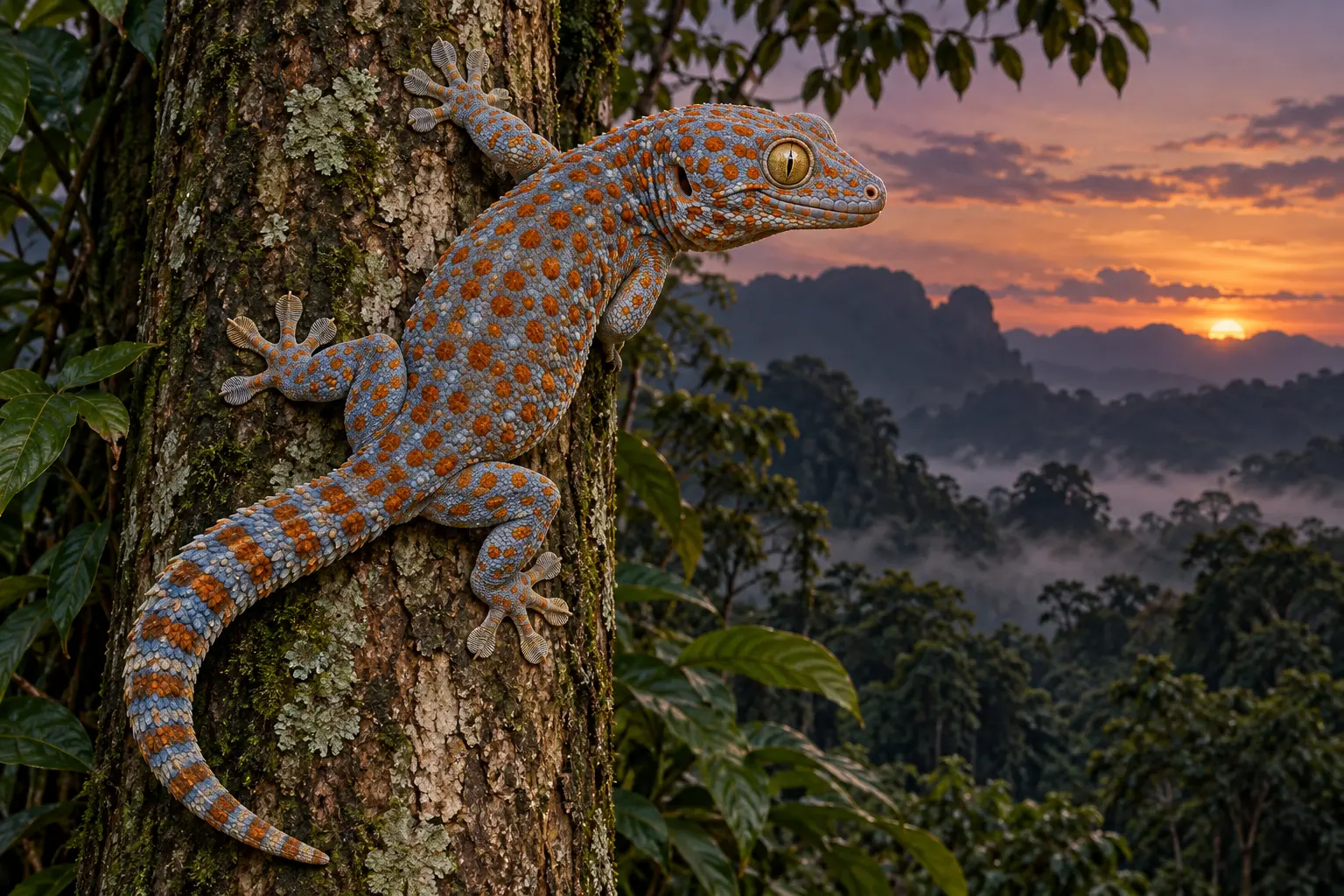
A broad head, vertical pupils, blue-grey body with numerous orange or red spots, broad adhesive toe pads and a banded tail are characteristic. Colour alone is insufficient because tone varies with light, state and population; scalation and provenance should also be checked. [1,2]
Millions of microscopic hair-like structures on the toe pads generate molecular adhesion on many dry surfaces; they are not suction cups. Lateral skin folds and tail autotomy aid escape, but losing a tail remains an energetically costly injury. [1,2]
Behaviour and ecology
Mostly nocturnal, sheltering by day in crevices or cavities and defending sites with calls, posture and biting. Males produce the conspicuous namesake call; remaining still for long periods does not mean an animal is tame or welcomes handling. [1,2]
Diet
Feeds mainly on insects, spiders and other invertebrates; large individuals may take lizards, frogs or other small vertebrates. Managed diets require varied, size-appropriate prey and controlled mineral-vitamin provision rather than reliance on one feeder insect. [1,2]
Reproduction and life cycle
Females commonly cement two hard-shelled eggs to a sheltered surface; once fixed, eggs should not be peeled away. Several females may use a communal laying site, and hatchlings are independent after emergence. [1,2]
Ecosystem role
As both an invertebrate predator and prey for snakes, birds and small mammals, the Tokay gecko occupies two sides of the food web. Where introduced, impacts on native species require separate assessment; native-range conservation value does not justify release. [1–3]
Threats & conservation
Large-scale collection for trade, medicine and pets contributed to the species' Appendix II listing, with habitat loss and local persecution adding pressure. Sourcing must distinguish wild from captive-bred animals, retain parental records and verify permits before transport. [3–5]
Reviewed 30 September 2026: IUCN lists the species as Least Concern (LC) in its 2019 assessment; CITES includes Gekko gecko in Appendix II. LC does not mean unrestricted collection or trade: origin, permits, quarantine and national law still require transaction-level verification. [3–5]5 sourced facts
Species in five facts
The male's ‘to-kay’ call gives the species its common name. [1]
Its toe pads adhere through microscopic hairs, not suction. [1,2]
A typical clutch contains two eggs cemented to a surface. [1,2]
The tail can detach and regrow, but the replacement usually differs from the original. [1]
International trade is regulated under CITES Appendix II. [5]
Sources
[1] Smithsonian's National Zoo — Tokay gecko[2] Animal Diversity Web — Gekko gecko[3] The Reptile Database — Gekko gecko[4] IUCN Red List species search[5] CITES Appendices effective 5 March 2026