
Ranges from the Himalayan foothills through north-eastern India, Bangladesh, Bhutan, Myanmar and southern China to Thailand, Laos, Cambodia and Vietnam. It uses broadleaf evergreen and mixed deciduous forest, bamboo, scrub, secondary growth and gardens near forest. [1–3]
Total length is about 26–31 cm. This is an identification range, not a substitute for checking crest, mask, wing colour and range because subspecies vary in appearance. [2,3]
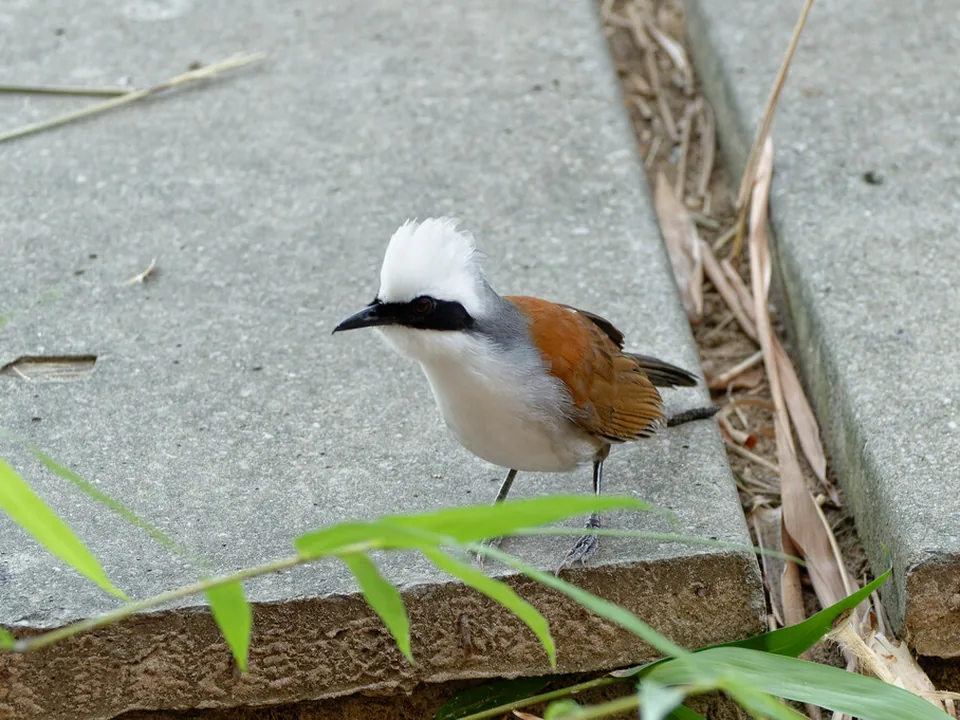
A raised white crest joins white cheeks, throat and breast; a black eye-mask contrasts with the rufous-brown back and wings and long tail. Head shape changes when the crest is flattened, so a single-angle photograph is insufficient for confirmation. [2,3]
Strong legs and a pointed bill support leaf-litter foraging; the crest, mask and loud calls form effective visual-acoustic signals in dense forest. Cooperative care distributes work within family groups. [2]
Behaviour and ecology
Often forages in groups of 6–20 or more, moving low through cover and turning leaf litter. Flocks can launch rapid laughing choruses and stop almost together, helping maintain social contact and vigilance. [2]
Diet
Takes insects and other leaf-litter invertebrates, sometimes small vertebrates, as well as berries, seeds and nectar. Managed diets should reflect omnivory and foraging needs rather than relying on sugary soft food. [2]
Reproduction and life cycle
A large shallow cup of coarse grass, bamboo or dead leaves is placed in a shrub or low tree; National Aviary reports 2–6 eggs, about 14 days of incubation and fledging around 10–12 days. Related group members may help feed nestlings and attend fledglings. [2]
Ecosystem role
As a low-level insect predator and fruit eater, the species participates in both invertebrate control and movement of plant material or seeds. Its scratching also creates small-scale disturbance in leaf litter. [2]
Threats & conservation
Global LC status does not exclude local declines from forest loss, trapping or the cage-bird trade. DinoJura must verify taxon or subspecies, lawful captive origin, ring and transfer records, and avian-disease screening; a single white-crested image cannot establish provenance. [1,4]
IUCN/BirdLife lists Garrulax leucolophus as Least Concern (LC) in the 2016 assessment. The name was not located in the CITES Appendices effective 5 March 2026; this does not waive Vietnamese wildlife, quarantine, origin or transport rules. [1,4]5 sourced facts
Species in five facts
Foraging groups often contain 6–20 birds or more. [2]
Coordinated calls can begin and end very abruptly. [2]
The species shows cooperative care within family groups. [2]
Young may leave the nest after only about 10–12 days. [2]
The latest IUCN assessment retrieved for this profile dates to 2016. [1]
Sources
[1] IUCN Red List 2016 — Garrulax leucolophus[2] National Aviary — White-crested Laughingthrush[3] Vietnam Wildlife — Khướu đầu trắng[4] CITES Appendices effective 5 March 2026Photo record — Donald Davesne, iNaturalist 142739462, CC BY