
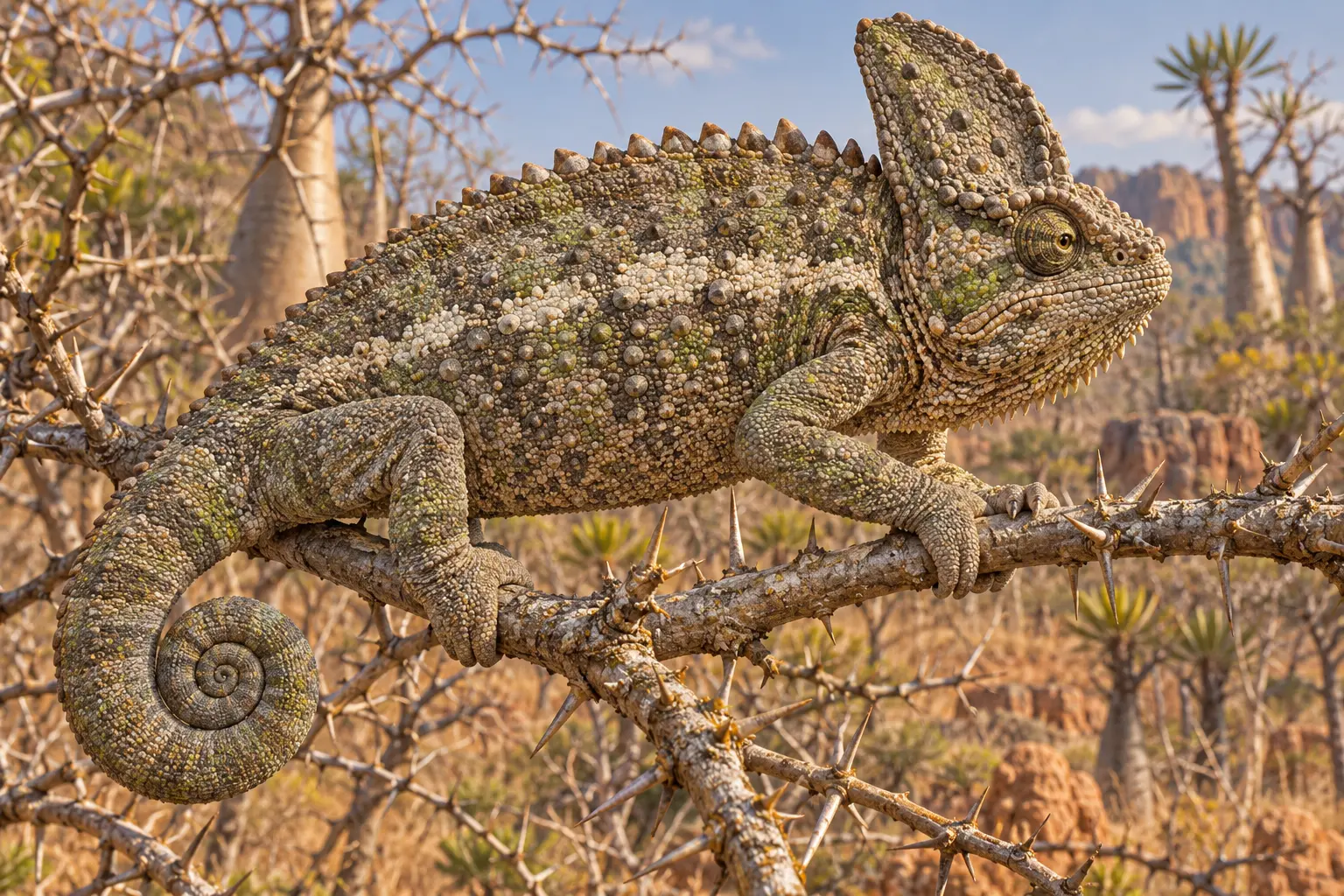
Endemic to Madagascar, chiefly in the dry south and west. It favours spiny forest but also occurs in secondary scrub, dune vegetation and modified landscapes where suitable branches and microclimates remain. [1–3]
The specialist source Madcham reports males reaching about 57 cm total length while females remain around 21 cm at most. These are reported maxima, not default sizes for every population; sex and provenance should accompany measurements. [2]
A robust body, high casque, turreted eyes, pincer-like feet, prehensile tail and enlarged wart-like scales are characteristic. Males are often grey-brown but may turn green or turquoise with a pale lateral stripe; females are much smaller and have only an anterior dorsal crest. It is readily confused with F. oustaleti, so size or colour alone is insufficient. [1–3]
Opposed toe bundles and a prehensile tail provide three-point branch support; independently moving eyes widen surveillance, and the projectile tongue captures prey without a full-body lunge. Rough texture and earth tones disrupt the outline in spiny forest, while colour change signals physiological and social state. [1,2]
Behaviour and ecology
Diurnal, arboreal and largely solitary. The eyes scan semi-independently before converging on prey; colour, lateral flattening, gaping and rocking movements communicate or warn. Long periods of stillness serve prey detection and crypsis, not a preference for handling. [1,2]
Diet
It primarily captures insects and other invertebrates with a projectile tongue; very large individuals may take small vertebrates. Managed care requires varied, size-appropriate prey, controlled mineral-vitamin provision and body-condition monitoring rather than unlimited feeding. [1,2]
Reproduction and life cycle
Oviparous, depositing eggs in soil. Females need deep, well-drained substrate with thermal and moisture choice; egg retention caused by an unsuitable laying site is a serious welfare risk. Clutch and incubation vary, so values from other Furcifer species must not be substituted. [1,2]
Ecosystem role
As a large insect predator and prey for birds, snakes and small mammals, it links several levels of Madagascar's dry-forest food web. Its occurrence in secondary vegetation does not mean intact spiny forest is fully replaceable. [2,3]
Threats & conservation
Spiny-forest conversion, habitat degradation and collection can create local pressure; confusion with F. oustaleti also weakens data. Appendix II requires valid documentation for international trade; a historical quota is not a current permit and must be checked by year, country, source and purpose. [3–5]
Reviewed 1 October 2026: the 2011 IUCN assessment lists the species as Least Concern (LC); CITES regulates Furcifer spp. under Appendix II. The assessment is old and the giant Malagasy chameleon complex remains genetically and taxonomically complicated, so geographic provenance, captive-bred status and permits require individual verification. [1,3–5]5 sourced facts
Species in five facts
The name verrucosus derives from Latin for ‘wart’, referring to the enlarged body scales. [1,2]
Reported maximum male length can exceed twice that of females. [2]
Spiny-forest habitat shifts dramatically from green to grey-dry between wet and dry seasons. [2]
F. verrucosus and F. oustaleti are sister species frequently confused in the field. [3]
International trade is controlled under CITES Appendix II. [5]
Sources
[1] The Reptile Database — Furcifer verrucosus[2] Madcham — Furcifer verrucosus: distribution, morphology and habitat[3] PLOS ONE — Phylogeography of Malagasy giant chameleons[4] IUCN Red List 2011 assessment — Furcifer verrucosus[5] CITES Appendices effective 5 March 2026