
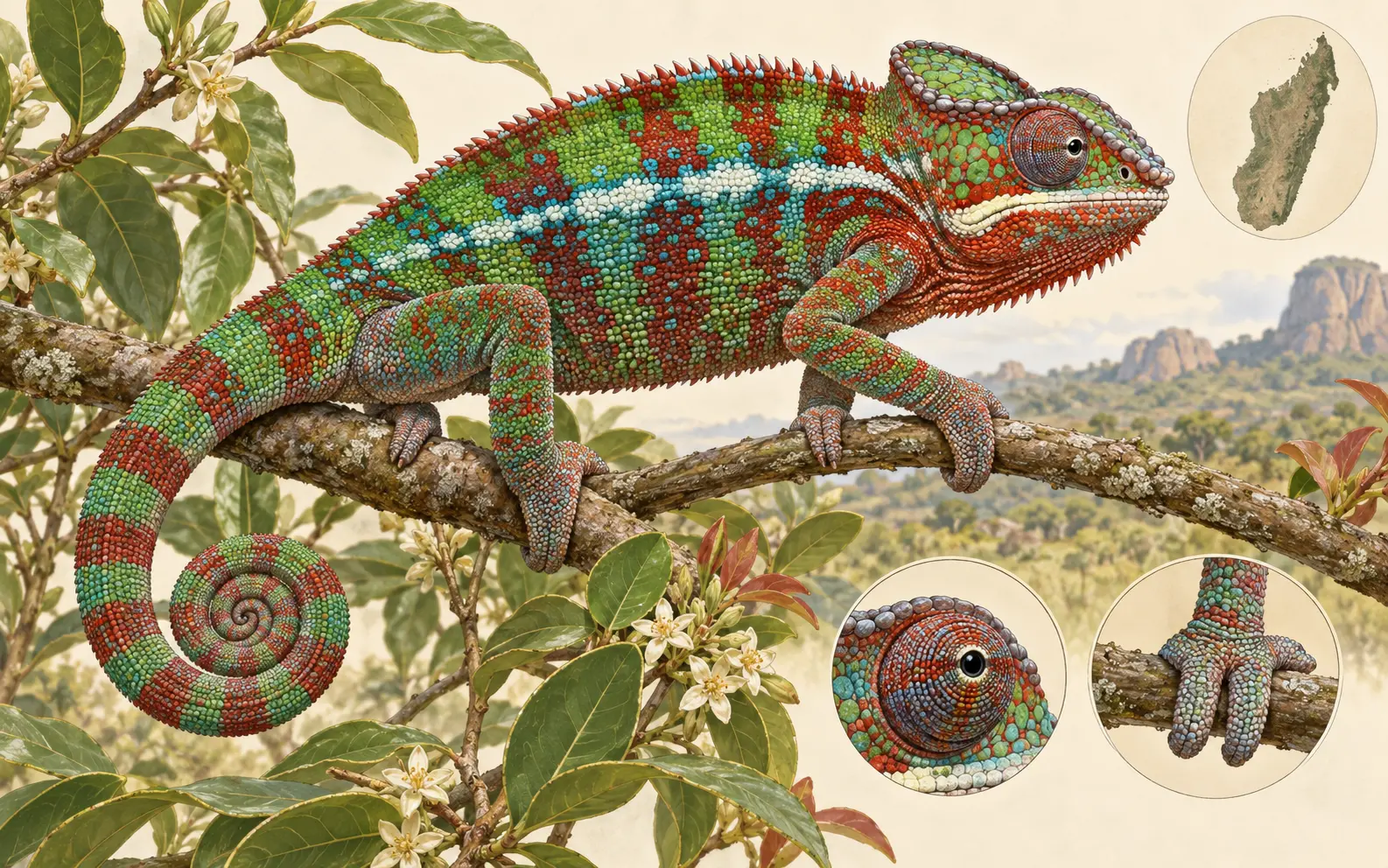
Northern and eastern Madagascar, with introduced populations on nearby islands; commonly associated with scrub, forest edges and human-modified habitats.
Males are generally larger than females; large males may approach roughly 40–50 cm total length, with the tail accounting for a substantial share.
Turreted eyes move semi-independently; split toe bundles grip branches; the prehensile tail coils; and a projectile tongue captures prey. Male colour varies strongly by locality and state.
Grasping feet, a prehensile tail and projectile tongue form an integrated branch-hunting system. Reflective skin cells with nanostructures contribute to colour change in Panther chameleons.
Behaviour and ecology
Arboreal, diurnal and largely solitary, communicating mainly through posture and colour. The eyes converge on prey to support distance judgement.
Diet
Primarily an invertebrate predator; large individuals may occasionally take small vertebrates. Captive diets require variety and controlled mineral–vitamin provision, without generalising across all chameleons.
Reproduction and life cycle
Oviparous, depositing eggs in soil. Clutch size and incubation vary; compiled records report about 10–46 eggs per clutch and embryonic development lasting many months.
Ecosystem role
An insect predator and prey for birds, snakes and other predators, it contributes to Madagascar's local food webs.
Threats & conservation
IUCN currently lists the species as LC, while international trade remains regulated under CITES Appendix II. Collection, export, import and breeding require appropriate origin evidence and permits; LC does not mean unrestricted trade.
IUCN/CITES status was checked on the profile date; re-verify before any legal or transaction decision.5 sourced facts
Species in five facts
Male colour can suggest geographic origin but should not alone establish provenance.
The eyes can scan semi-independently and then converge on prey.
Females change colour signals and behaviour when unreceptive or gravid.
Hatchlings are independent; there is no post-oviposition parental care.
The species is diurnal and hunts primarily by sight.
Sources
IUCN Red List searchCITES Species+ / ChecklistAnimal Diversity Web — Furcifer pardalisNature Communications — photonic crystals and colour change