
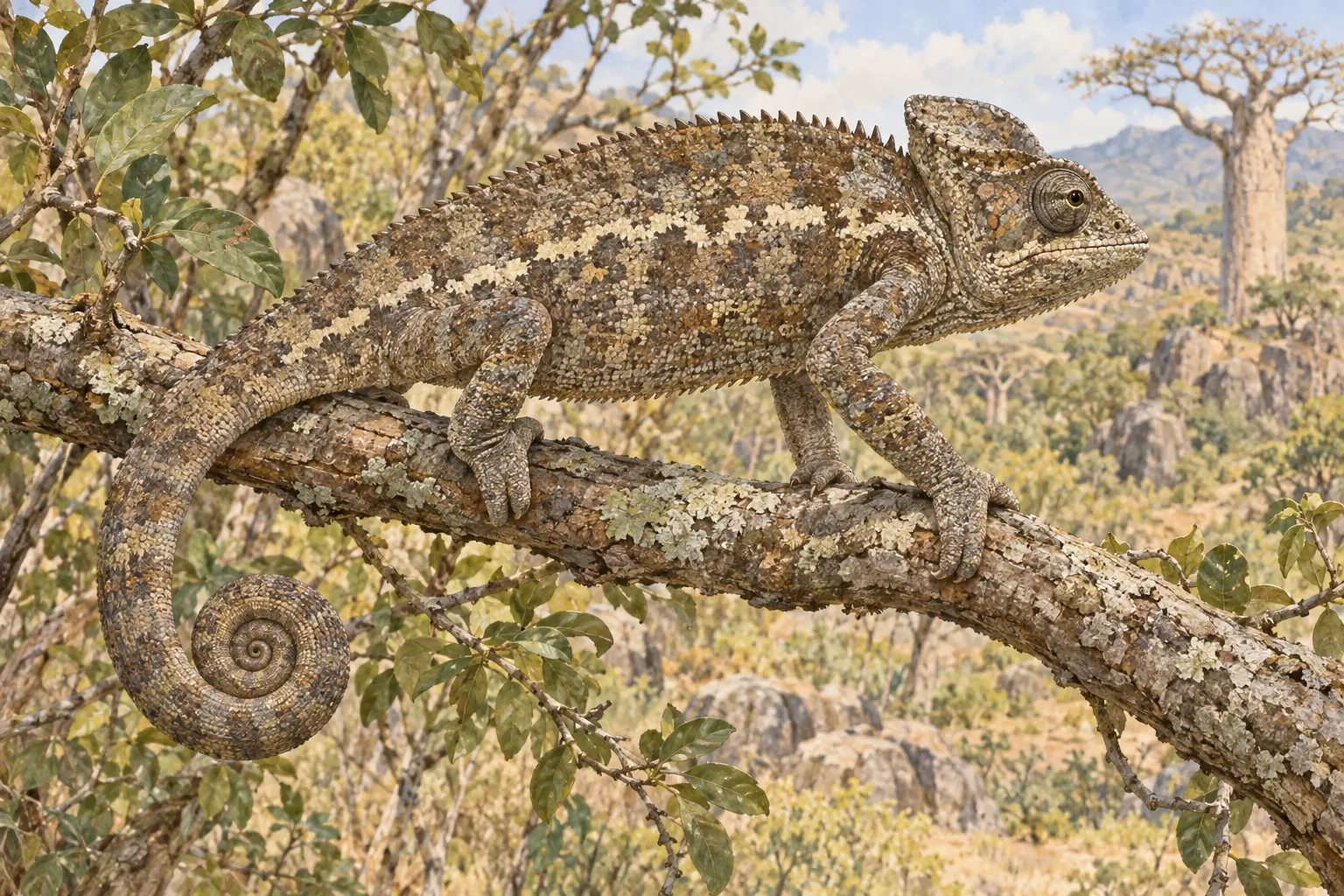
Madagascar: dry and humid habitats across elevations. Florida populations are introduced, not native. [1,2]
Large animals reach about 68 cm including the tail, not body length alone. [1]
Often brown-grey, with a casque and dorsal crest; coloration varies. [1]
Mobile eyes, projectile tongue, gripping feet and tail support arboreal hunting. [1]
Behaviour and ecology
Diurnal and mainly solitary; posture and colour convey signals. [1]
Diet
Eats insects; small vertebrates and fruit are also recorded. [1]
Reproduction and life cycle
Lays eggs in soil. An introduced Florida population averaged 42.3 eggs per clutch; this is not a universal locality value. [3]
Ecosystem role
Consumes small animals; its ecological effects in Florida remain incompletely understood. [1]
Threats & conservation
The indexed IUCN result shows LC. Never release captive animals; LC does not imply unrestricted trade. [1,4]
Reviewed 16 September 2026: direct CITES sources were inaccessible; no Appendix or trade entitlement is inferred. IUCN labels identify indexed or secondary sources; the full current assessment was not confirmed. Recheck before legal decisions.5 sourced facts
Species in five facts
Native to Madagascar. [2]
Named after Émile Oustalet. [2]
Described in 1894. [2]
The largest clutch in the Florida study contained 72 eggs. [3]
Reproductive measurements refer to the studied population. [3]
Sources
[1] UF/IFAS — introduced chameleons[2] Reptile Database[3] Smith et al. 2016 — nesting study[4] IUCN — indexed taxon search