
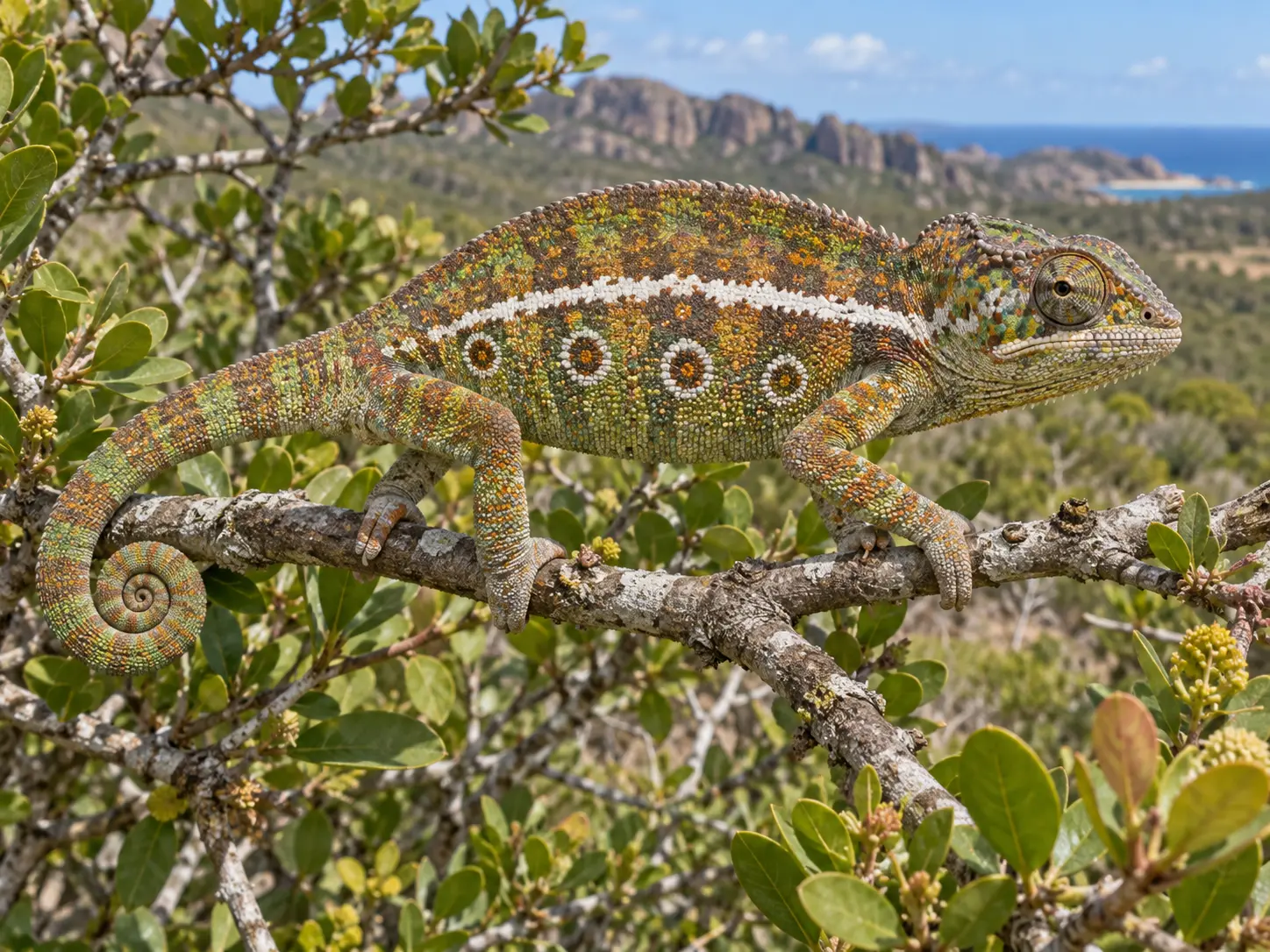
Widely distributed across central, eastern and southern Madagascar from lowlands to uplands, using scrub, wooded grassland, forest edges, gardens and modified habitats.
Total length is commonly about 17–25 cm; males are generally slimmer, while females become more robust, especially when gravid.
A pale lateral stripe, contrasting rings or spots and barred lips are typical. Females may combine green, yellow, red, blue and black; males are often more subdued green and white.
Colour change supports signalling, thermoregulation and background matching; opposed toes grip branches, the prehensile tail stabilises movement and turret eyes provide a wide visual field.
Behaviour and ecology
Diurnal and shrub-dwelling, using independently moving eyes, a projectile tongue and prehensile tail. Adults are generally intolerant of close contact.
Diet
Feeds on insects and other small invertebrates, with prey choice varying by body size and season.
Reproduction and life cycle
Oviparous and relatively fast-maturing. Females dig soil nests and typically lay multiple eggs per clutch; repeated clutches impose high mineral and energy demands.
Ecosystem role
A predator of insects in low vegetation and prey for birds, snakes and small mammalian predators.
Threats & conservation
IUCN lists it as LC because of its broad range and tolerance of modified habitat, though collection and habitat change require monitoring. CITES Appendix II regulates international trade.
IUCN/CITES status was checked on the profile date; re-verify before any legal or transaction decision.5 sourced facts
Species in five facts
Its intricate pattern gives rise to the name carpet chameleon.
Females are often more colourful than males.
Gravid colours can signal rejection of mating.
The species can use gardens as well as forest edges.
Some populations formerly grouped under this name are now recognised as other species.
Sources
U.S. Fish & Wildlife ServiceAnimal Diversity WebIUCN Red List searchCITES Checklist