
Breeds on coasts and offshore islands from southern California through Alaska and the Aleutians to Japan and northeastern Asia. Outside the breeding season it lives mainly over open North Pacific waters and the continental shelf. [1,2]
About 38 cm tall in the NPS account; Alaska SeaLife Center gives an average wingspan near 76 cm and mass of 600–800 g. It is the largest living puffin species, although measurements vary by sex, season and population. [1,2]
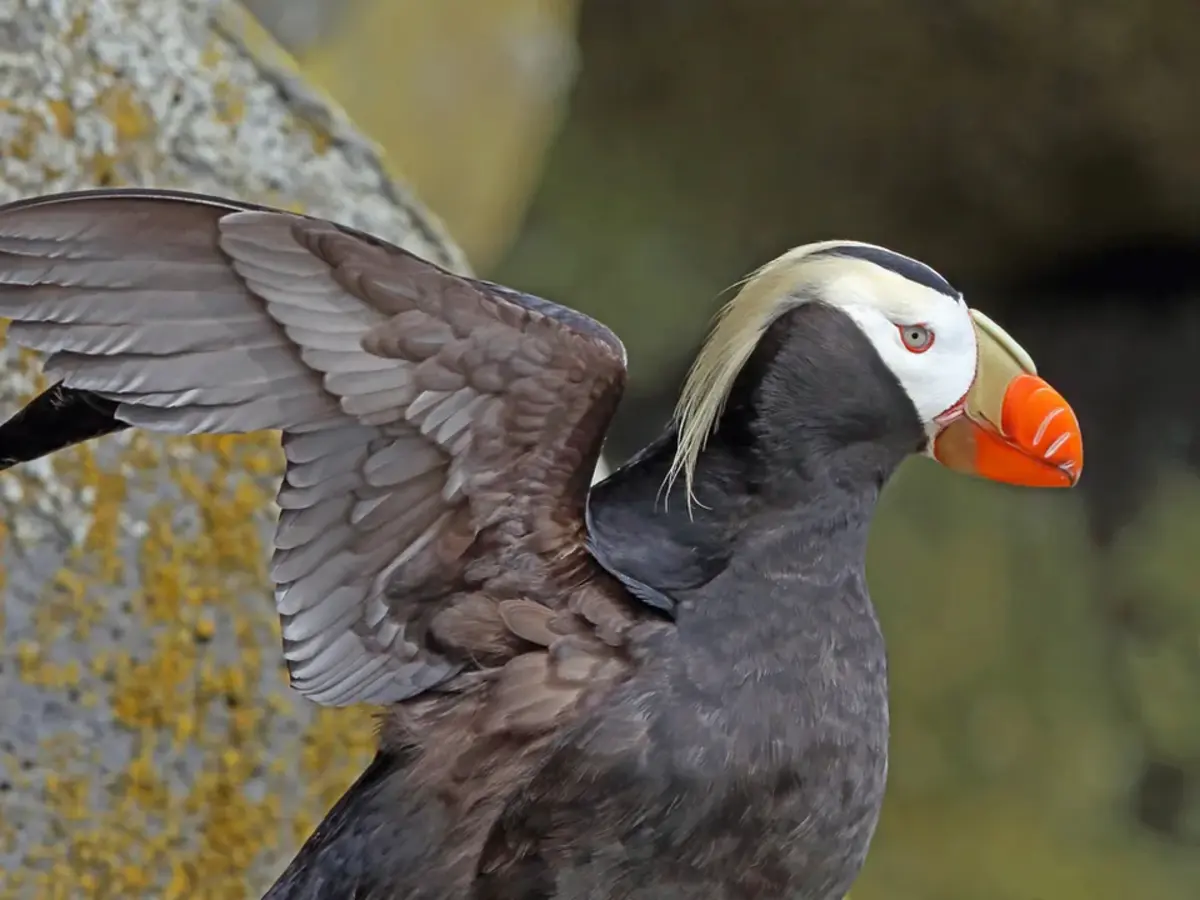
The basic plumage is dark; breeding birds develop a white face, bright red-orange bill plates and two golden plumes sweeping backwards. After breeding they shed the plumes and outer bill sheath, with a darker face and duller bill that look markedly different from summer images. [1]
Short powerful wings generate underwater thrust but demand rapid beats in flight. The deep bill can hold several small fish, while waterproof plumage and fat conserve heat in cold water. Seasonal loss of ornamental feathers and bill sheath reduces display structures outside breeding. [1,2]
Behaviour and ecology
Swims underwater with its wings and steers with its feet; in air it beats the wings rapidly, with NPS reporting up to about 400 beats per minute. It is marine outside breeding and often commutes in groups between colonies and feeding areas. [2]
Diet
Consumes small fish, cephalopods, crustaceans, zooplankton and jellyfish. At Kenai Fjords, white capelin dominated the reported diet sample; actual composition varies with place, season and marine prey availability. [1,2]
Reproduction and life cycle
A pair invests in one egg, with both adults incubating for about 42 days and provisioning the chick with fish. It digs burrows in sloping soil, often about 0.6–1.8 m long; fledglings leave at night and head to sea, avoiding many terrestrial predators. [1,2]
Ecosystem role
Predates small pelagic fish and is prey for eagles, falcons, sea lions and killer whales. Breeding success and diet track nearshore prey variation, so populations are monitored as indicators of marine ecosystem change. [2,3]
Threats & conservation
Fishing nets, oil spills, introduced predators at colonies and climate-driven prey shifts are major pressures. DinoJura should treat this as a highly specialised seabird, not a routine display species; origin, welfare, seawater systems, nutrition and quarantine require specialist and authority confirmation. [1–4]
BirdLife lists the species as Least Concern (LC), although some regional populations are declining; global status does not replace local assessment. Fratercula cirrhata was not located in the CITES Appendices of 5 March 2026; this does not waive migratory-bird, veterinary, quarantine or national rules. [1–4]5 sourced facts
Species in five facts
Reported average mass is about 600–800 g. [1]
Each clutch contains a single egg. [1,2]
Incubation is reported at about 42 days. [1]
Nesting burrows are commonly about 0.6–1.8 m long. [1,2]
The bird may beat its wings about 400 times per minute in flight. [2]
Sources
[1] Alaska SeaLife Center — Tufted Puffin[2] U.S. National Park Service — Tufted and Horned Puffins[3] BirdLife DataZone — Fratercula cirrhata[4] CITES Appendices effective 5 March 2026Photo record — Nigel Voaden / iNaturalist