
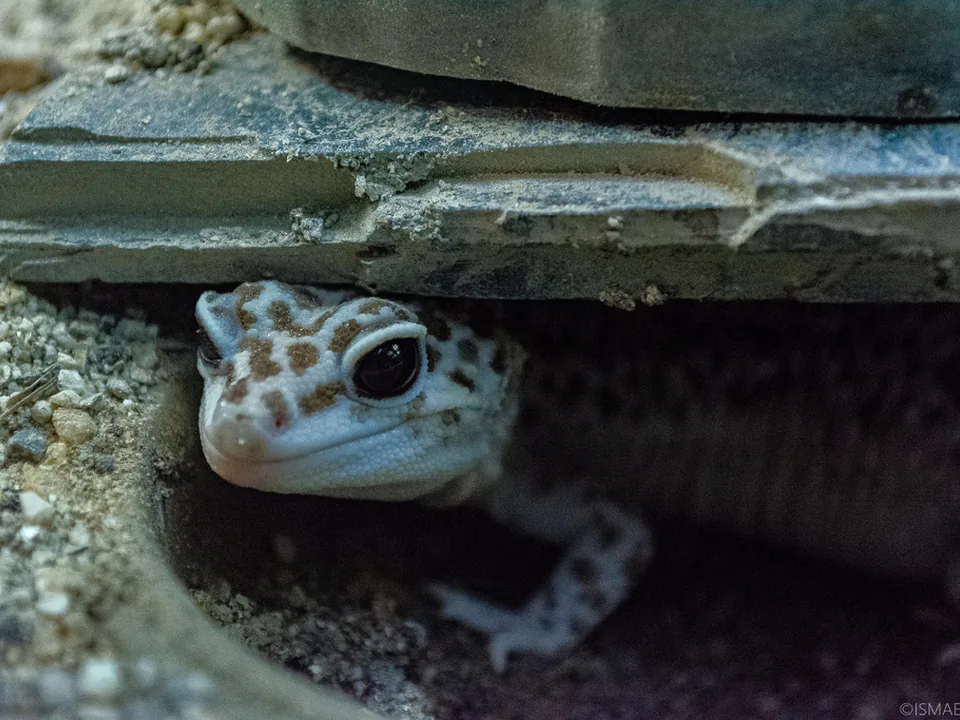
Recorded from Afghanistan, Iran, Iraq, Pakistan and north-western India; it uses semi-arid desert, dry grassland and shelters beneath rocks or in burrows. [1]
Adults are commonly about 22 cm in total length; some individuals may approach 25 cm. [1]
Adults are cream-yellow with dark spots; they have vertical pupils, movable eyelids and clawed toes without the adhesive lamellae of many climbing geckos. [1]
Eyelids protect the eyes in dusty terrain; the segmented tail stores energy and can function as an escape mechanism during predation attempts. [1]
Behaviour and ecology
Mainly nocturnal, sheltering beneath rocks or in burrows by day. The tail can autotomise under threat and regrow, although the replacement differs from the original. [1]
Diet
Feeds on invertebrates including beetles, spiders, centipedes and scorpions; diet varies with prey availability. [1]
Reproduction and life cycle
Oviparous, commonly laying two eggs. ADW reports 45–53 days of incubation near 28°C under the cited conditions; this is not a universal husbandry parameter. [1]
Ecosystem role
As a small predator it participates in dryland food webs by consuming several arthropod groups while also serving as prey for larger animals. [1; ecological interpretation]
Threats & conservation
The reviewed source displays no completed IUCN assessment. Collection, transport and keeping still require lawful origin, welfare and jurisdiction-specific compliance; NE does not mean risk-free. [1]
Reviewed 17 September 2026: Animal Diversity Web displays IUCN ‘Not Evaluated’. A direct CITES species record was not retrievable in this review, so no Appendix or trade entitlement is inferred. Recheck with the relevant management authority before legal decisions.5 sourced facts
Species in five facts
It has movable eyelids—a feature reflected in Eublepharis, roughly meaning ‘true eyelid’. [1,2]
It lacks the adhesive toe pads used by many climbing geckos. [1]
The tail can detach as an escape response. [1]
A clutch commonly contains two eggs. [1]
It is primarily nocturnal. [1]
Sources
[1] Animal Diversity Web — Eublepharis macularius[2] Reptile Database — Eublepharis macularius[Ảnh] iNaturalist observation 49241895 — Ismael EPM, CC BY-SA