
Widespread but thinly distributed across Africa south of the Sahara, using rivers, lakes, marshes, floodplains, shallow wetlands and sometimes reservoirs. It requires shallow feeding areas connected to quiet large trees for nesting. [1,2]
About 140–150 cm tall, with a 240–270 cm wingspan and a mass around 5–7.3 kg; males are generally larger. Despite its height, the avian skeleton is light, so visual height is a poor estimator of body mass. [1]
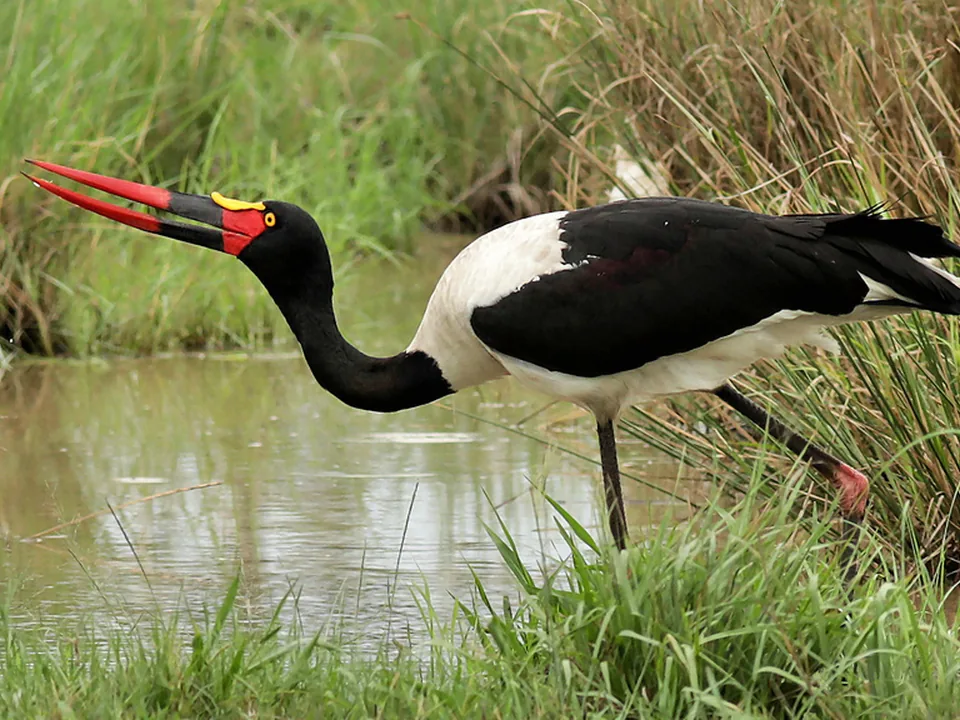
A white body contrasts with an iridescent black head, neck, back and wings; the huge red bill carries a black band and yellow saddle. Males have dark brown irises, females yellow irises, and juveniles are greyer-brown. [1]
Long legs extend the feeding zone, long toes spread weight over mud, and the massive bill handles slippery, powerful prey. Sex-specific iris colour is unusual and permits sexing without capture. [1]
Behaviour and ecology
Usually solitary or paired, walking slowly through water and visually locating prey before seizing or stabbing with the bill. Breeding pairs hold large territories, and birds use thermals to soar between wetlands. [1,2]
Diet
Fish are important prey, supplemented by frogs, crabs, molluscs, aquatic insects, snakes, lizards and occasionally small birds or mammals. Composition shifts with hydrology, prey size and locality. [1]
Reproduction and life cycle
A pair builds a large stick nest high in a tree and usually lays 2–3 eggs. Both parents incubate and provision the young for months; territorial solitary nesting contrasts with densely colonial storks. [1]
Ecosystem role
As a large shallow-water predator, it links fish, amphibian, crustacean and reptile communities. A breeding pair often indicates a landscape retaining both feeding wetlands and mature nest trees. [1,2]
Threats & conservation
Although globally LC, wetland drainage, pollution, altered flows, loss of nest trees and disturbance can reduce local populations. Facility planning requires shallow-water area, foot-safe substrates, flight space and secluded nesting opportunities. [1,2]
Reviewed 23 September 2026: BirdLife/IUCN records LC. Ephippiorhynchus senegalensis was not found in the CITES Appendices effective 5 March 2026; absence from the Appendices is not a trade permit, and national law still applies.5 sourced facts
Species in five facts
The yellow bill shield resembles a saddle and gives the bird its name. [1]
Males have dark brown eyes while females have yellow eyes. [1]
The wingspan can reach roughly 2.7 m. [1]
Pairs usually nest solitarily rather than in dense colonies. [1]
Both parents share incubation and chick rearing. [1]
Sources
[1] BirdLife DataZone — Saddle-billed Stork[2] IUCN Red List species search[3] CITES Appendices effective 5 March 2026[Ảnh] iNaturalist observation 10002585 — Wynand Uys, CC BY