
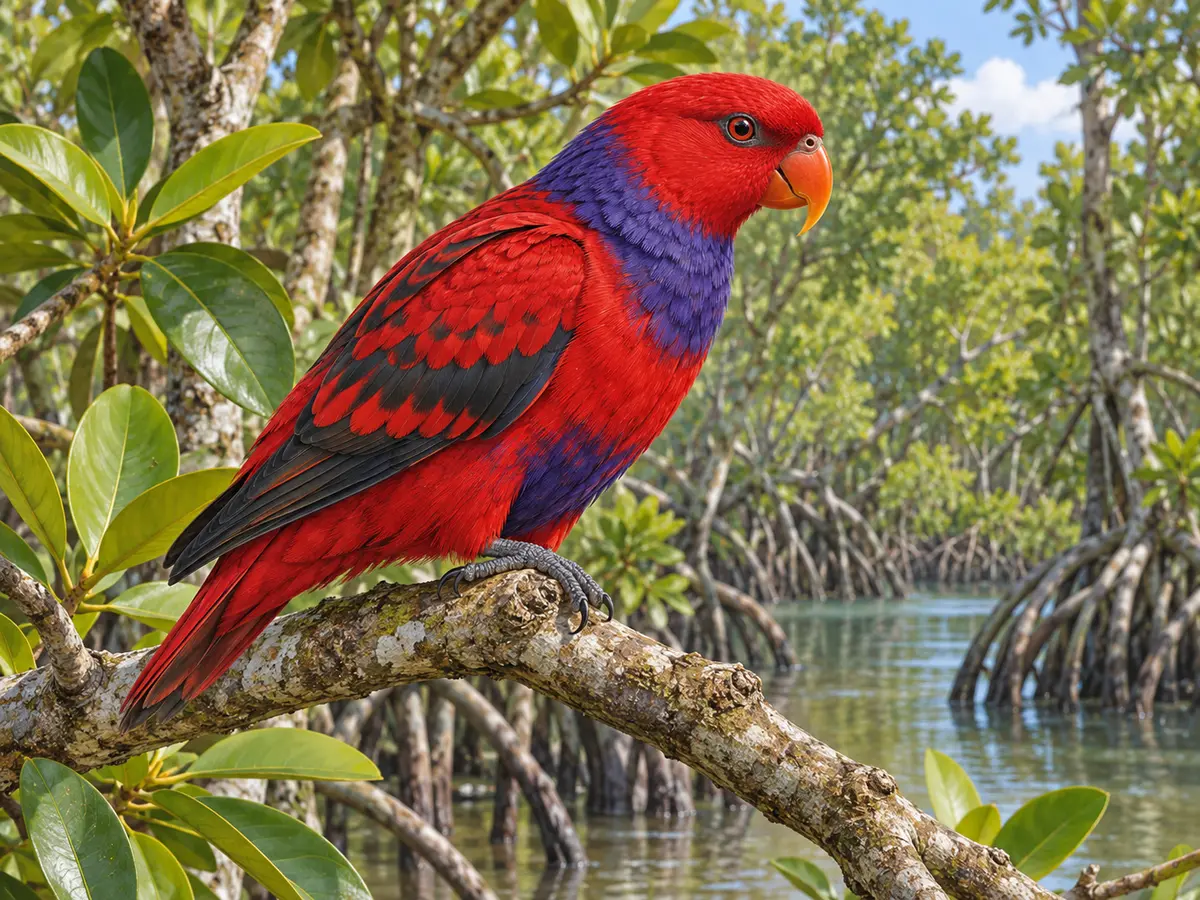
Native to islands of North Maluku and western New Guinea, including Biak and neighbouring islands depending on subspecies treatment. It uses lowland moist forest, edges, secondary growth and mangroves; island-level provenance should be retained in records. [1,2]
About 26–27 cm long; World Parrot Trust reports roughly 180–220 g. These are species-level ranges, not condition targets for every individual or all lories. [2]
Adults are mainly red with a violet-blue collar and belly, red-black wings, an orange bill and a short tail. Violet extent and wing pattern vary among subspecies; a photograph or colour alone cannot establish island provenance. [2,3]
Brush-like papillae at the tongue tip retain nectar and pollen, while the curved bill manipulates flowers and fruit. Two-forward, two-back toes provide a strong grip as the bird leans to forage in the canopy. [2]
Behaviour and ecology
Usually encountered in pairs or small flocks, flying rapidly among flowering and fruiting trees and sometimes gathering in larger feeding groups. Calls maintain canopy contact; managed grouping requires compatibility assessment rather than assuming every bird tolerates a large flock. [1,2]
Diet
In the wild it takes nectar, pollen, flowers, soft fruit and possibly small insects. A brush-tipped tongue does not justify a sugar-water-only diet; managed food must be balanced, frequently renewed and hygienically controlled. [1,2]
Reproduction and life cycle
It nests in tree cavities. World Parrot Trust reports a two-egg clutch and about 25 days of incubation from managed-care records; wild data remain limited, so these values should not become fixed rules for every population. [2]
Ecosystem role
Moving among flowers and fruit, lories may carry pollen and disperse some seeds while acting as canopy consumers. The species' quantitative contribution has not been established for every island. [1,2]
Threats & conservation
Forest-cover decline and capture for the cage-bird trade are cited risks despite the current LC category. DinoJura should consider only lawful, traceable captive origin with Appendix-II records, quarantine and facility or parent-generation evidence; LC is not a trade permit. [1,2,4]
BirdLife/IUCN lists the species as Least Concern (LC), with a suspected decline. BirdLife and World Parrot Trust use Eos squamata, while newer systems may use Trichoglossus squamatus; transaction records must therefore reconcile synonyms. The species is covered by the Psittaciformes Appendix-II listing. [1–4]5 sourced facts
Species in five facts
Both Eos squamata and Trichoglossus squamatus occur in current sources. [1–3]
Its brush-tipped tongue is specialised for nectar and pollen. [2]
It uses both mangroves and lowland moist forest. [1,2]
Managed-care sources report a typical two-egg clutch. [2]
CITES Appendix II applies through the Psittaciformes listing. [4]
Sources
[1] BirdLife DataZone — Violet-necked Lory[2] World Parrot Trust — Violet-necked Lory[3] AviList — global avian checklist[4] CITES Appendices effective 5 March 2026