
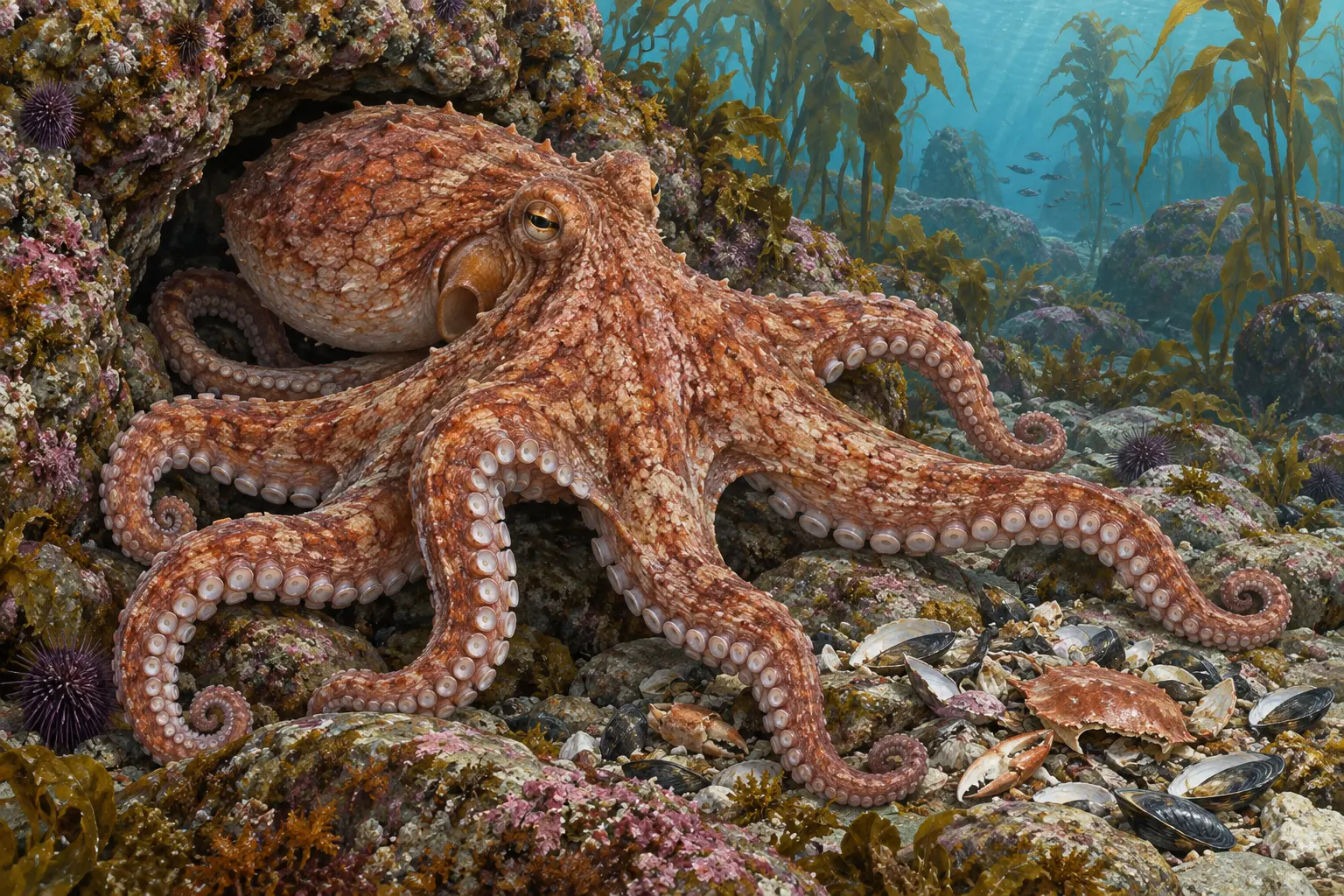
Ranges around the North Pacific from Japan and the Korean Peninsula through Alaska and down western North America to Baja California. It uses rocky reefs, dens, kelp forests, sand-mud bottoms and depths exceeding 1,500 m. [1–3]
Monterey Bay Aquarium reports a body around 60 cm and an arm span commonly 2–4 m or more; large animals often exceed 23 kg, but records are not typical size. Mass varies strongly with age, sex and reproductive condition. [1]
A large reddish-brown mantle-head, eight long arms with two sucker rows, high-set eyes and no squid-like lateral fins. Colour and skin texture change rapidly, so red colour alone is not diagnostic; structure, sucker rows, range and taxonomy are required. [1–3]
Chromatophores and reflective structures control colour, muscular papillae alter skin texture, and a skeleton-free body enters narrow gaps. Suckers both grip and chemosense; three hearts and haemocyanin support circulation in cold water. [1–3]
Behaviour and ecology
Mostly solitary and uses rocky dens; discarded prey shells form characteristic middens outside. It explores with arms and suckers, learns from experience, solves problems and can use jet propulsion when rapid movement is needed. [1–3]
Diet
Takes crabs, shrimp, bivalves, snails, fish and many other benthic animals. A hard beak bites prey, the radula processes tissue and salivary compounds aid subdual; prey choice varies with size and habitat. [1–3]
Reproduction and life cycle
Females attach tens of thousands of eggs in den strings, cleaning and ventilating them for months while scarcely feeding, and die after hatching. Monterey Bay Aquarium reports about 18,000–74,000 eggs, occasionally up to 100,000. [1,2]
Ecosystem role
An important benthic predator and prey for sea otters, large fish, sharks and marine mammals. Shell middens concentrate calcium-rich material and small shelters for other organisms, connecting several levels of the seafloor food web. [1–3]
Threats & conservation
Fishing, bycatch, warming and acidification may have regional effects despite the current global LC assessment. Facilities must address cold-water quality, cognitive enrichment, escape prevention, lawful origin and cephalopod welfare before acquisition. [1–4]
Reviewed 4 October 2026: the WoRMS taxonomic record links the current IUCN assessment as Least Concern (LC). The name was not found in the CITES Appendices effective 5 March 2026; absence from CITES is not permission to collect, transport or display the animal, and local fisheries and welfare rules still apply. [1–4]5 sourced facts
Species in five facts
The species has eight arms with two rows of suckers on each. [1–3]
It can occur from intertidal waters to depths beyond 1,500 m. [1,2]
Lifespan is usually only about 3–5 years despite its great size. [1,2]
Females brood eggs for months and die after they hatch. [1,2]
The species name is absent from the CITES Appendices of 5 March 2026. [4]
Sources
[1] Monterey Bay Aquarium — Giant Pacific octopus[2] Animal Diversity Web — Enteroctopus dofleini[3] WoRMS — Enteroctopus dofleini[4] CITES Appendices effective 5 March 2026