
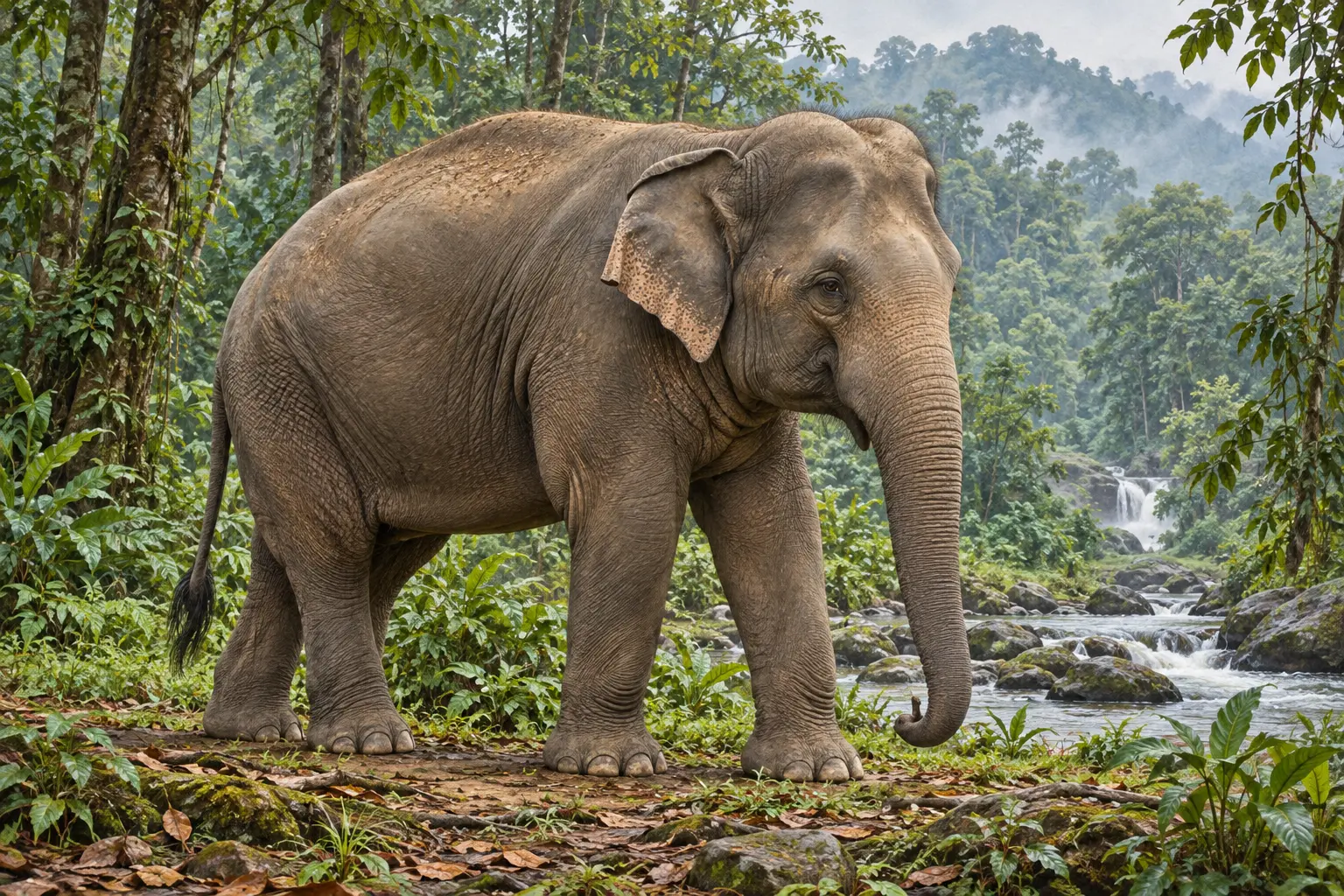
Remaining populations are fragmented from India and Sri Lanka through Nepal, Bhutan, Bangladesh and Southeast Asia to Borneo. Elephants use evergreen and dry forest, grassland and mosaics, but require broad connected ranges and regular access to water. [1,2]
Large males may stand roughly 2.75–3 m at the shoulder and weigh around 4–5 tonnes; females are generally substantially smaller. Maximum values do not represent an average animal and vary among populations. [1]
Key features are a twin-domed head, relatively small ears, an arched back and one grasping projection at the trunk tip. Only some males have large tusks; many males and most females lack prominent tusks, so tusks alone do not determine sex. [1]
The trunk combines nose and upper lip for smelling, breathing, drinking, calling and precise manipulation. Elastic foot cushions distribute weight, ears aid heat exchange, and molars replace sequentially to process abrasive vegetation. [1]
Behaviour and ecology
Females and calves form fluid matriarchal groups led by experienced females, while mature males are often solitary or loosely associated. Elephants communicate through audible calls, infrasonic sound, ground vibration, scent and touch. [1]
Diet
Feeds on grasses, leaves, twigs, bark, roots and fruit, spending much of the day acquiring a very large volume of vegetation. Managed diets and feeding points should be dispersed to promote movement, reduce competition and prevent obesity. [1]
Reproduction and life cycle
Gestation lasts roughly 18–22 months, the longest among terrestrial mammals, and usually produces one calf. Young nurse and remain dependent for years, receiving care from the mother and other females, so birth intervals are long. [1]
Ecosystem role
Elephants open trails and gaps, break vegetation, dig for water and disperse large seeds over long distances. They are therefore ecosystem engineers; their loss can alter vegetation structure and landscape connectivity. [2]
Threats & conservation
Habitat loss and fragmentation, human–elephant conflict, poaching and captive-welfare failures are major pressures. Projects should prioritise corridors, community-based conflict prevention, protected-contact management and lifelong individual records rather than treating elephants as display assets. [2–4]
Reviewed 24 September 2026: IUCN records EN; Elephas maximus is in CITES Appendix I. Appendix I strictly limits international trade; any transaction, transfer or movement still requires authority confirmation for the specific origin and purpose.5 sourced facts
Species in five facts
The Asian elephant's trunk tip has one finger-like projection. [1]
Gestation can last close to 22 months. [1]
Not every male has large tusks, and females usually lack prominent tusks. [1]
Elephants can receive infrasonic signals that travel farther than higher calls. [1]
Large seeds can be carried through the digestive tract far from parent trees. [2]
Sources
[1] Smithsonian's National Zoo — Asian Elephant[2] Smithsonian Conservation Biology Institute — Saving Asian Elephants[3] IUCN Red List species search[4] CITES Appendices effective 5 March 2026