
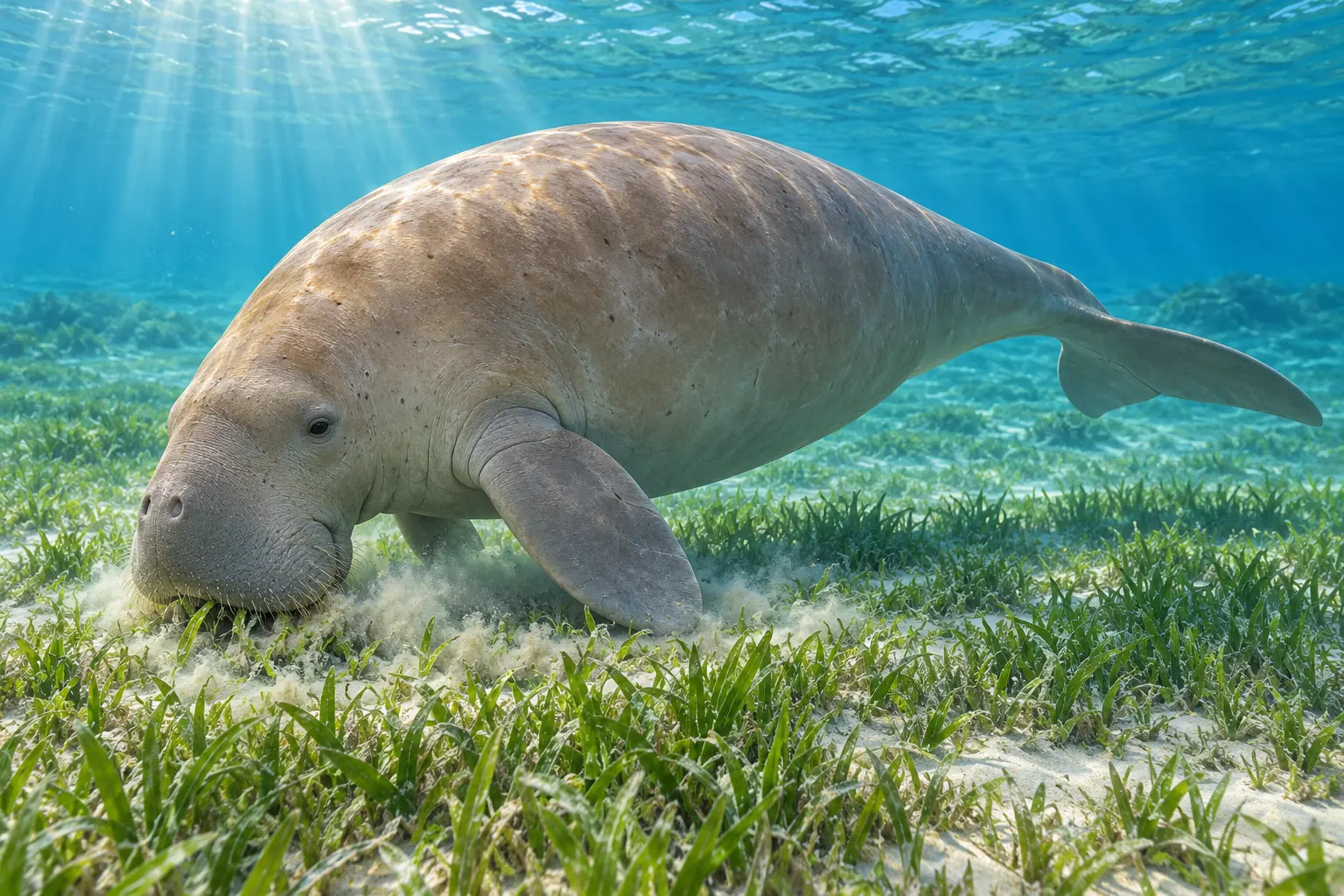
Widely but discontinuously distributed from eastern Africa, the Red Sea and Indian Ocean through Southeast Asia to northern Australia and western Pacific islands. It favours sheltered shallow bays, channels and island coasts with seagrass; use shifts with season, storms and food quality. [1,2]
The Australian Museum records dugongs to about 3 m long; mass is commonly several hundred kilograms and varies with age, sex and region. Large size should not be used to estimate viewing distance by eye underwater, where perspective is deceptive. [1]
A grey-brown fusiform body without a dorsal fin, rounded paddle forelimbs, broad downturned bristled muzzle and whale-like fluked tail identify the species. Unlike manatees, the dugong's tail divides into two clear flukes rather than one rounded paddle. [1,2]
Dense bones assist buoyancy control near the seabed, while the downturned muzzle and sensory bristles locate seagrass in turbid water. Horizontal flukes provide propulsion and elongated lungs support buoyancy and air breathing. [1,2]
Behaviour and ecology
Usually seen alone, in mother-calf pairs or small groups, though larger feeding aggregations can form. Dugongs surface to breathe, move among meadows and may leave feeding trails; slow travel does not reduce vessel-strike risk. [1,2]
Diet
Feeds mainly on seagrass, using a muscular muzzle and lips to crop leaves and uproot softer species, stirring sediment while foraging. It is a specialised herbivore, so seagrass loss cannot simply be offset with substitute food. [1,2]
Reproduction and life cycle
Females normally produce one calf after a gestation of about 13–14 months; the calf nurses and accompanies its mother for well over a year, and births are separated by several years. Slow reproduction makes adult deaths from fishing gear or hunting difficult to replace. [2]
Ecosystem role
Cropping and uprooting create new habitat patches, cycle nutrients and shape seagrass structure. Protecting dugongs also protects blue carbon, shorelines, juvenile fish and many organisms that use seagrass meadows. [1,2]
Threats & conservation
Entanglement, vessel strike, hunting and seagrass loss from coastal development, dredging, pollution and storms are major threats, with pressure differing among populations. Slow-speed zones, safer gear, seagrass protection and Appendix I enforcement are required; approaching, chasing or feeding is inappropriate. [2–5]
Reviewed 30 September 2026: the 2015 global IUCN assessment lists Dugong dugon as Vulnerable (VU), while some populations have separate, higher-risk assessments; CITES lists the species in Appendix I. A population category must not be assigned to the entire species, or vice versa. [2–5]5 sourced facts
Species in five facts
The dugong is the only living species in Dugongidae. [2]
It is a marine herbivore dependent mainly on seagrass. [1,2]
Horizontal flukes distinguish dugongs from round-tailed manatees. [1]
A calf commonly follows and nurses from its mother for more than a year. [2]
CITES lists the species in Appendix I. [5]
Sources
[1] Australian Museum — Dugong[2] CMS Dugong MOU — Dugong facts[3] IUCN Red List species search[4] IUCN — Regional dugong assessments, December 2022[5] CITES Appendices effective 5 March 2026