
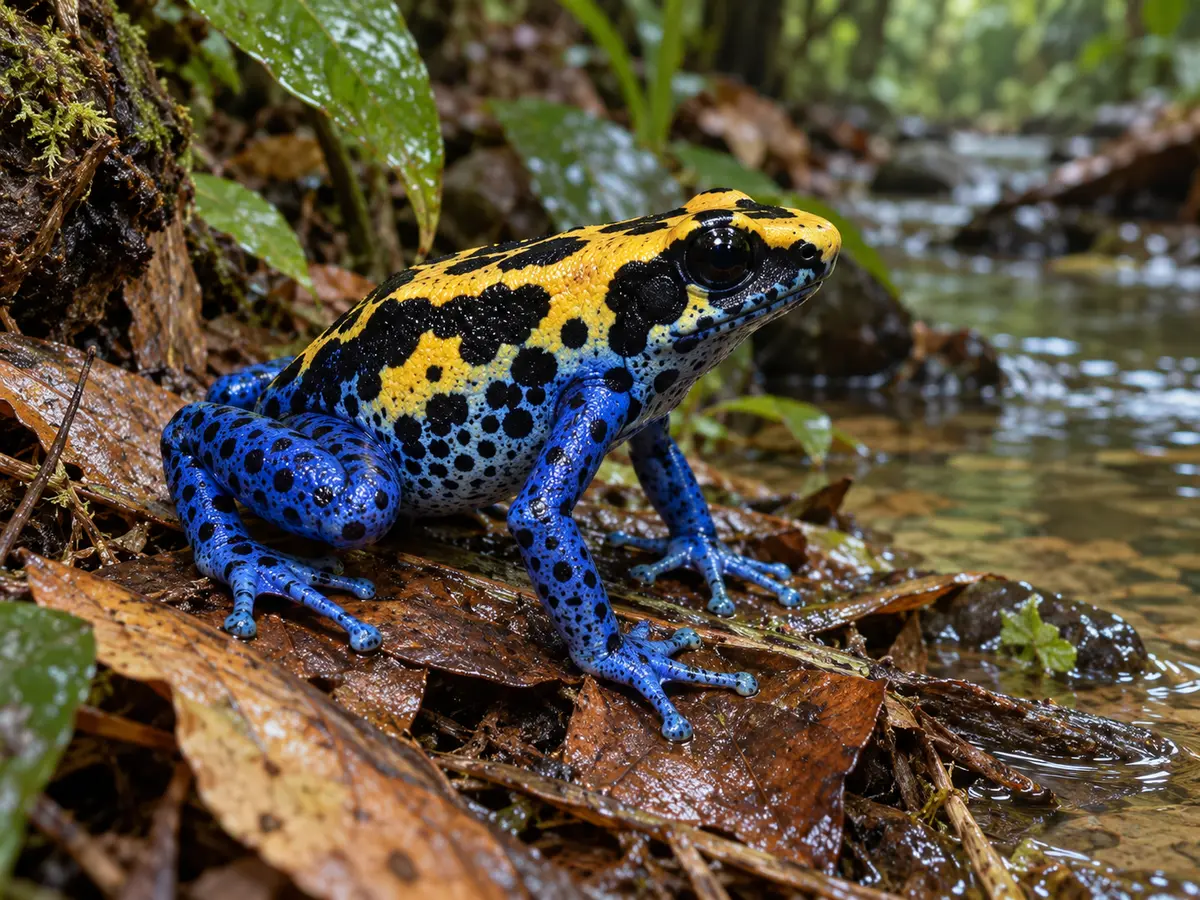
Occurs in Guyana, Suriname, French Guiana and adjacent Brazil, in primary rainforest from lowlands to about 600 m. It often uses leaf litter and treefall gaps, but can climb to tree holes, palm bracts and small water bodies used by tadpoles. [1,3]
A French Guiana field study records snout–vent length of 37–53 mm; MNHN summarises 4–5 cm and 3–5 g. Size varies with population and sex, with females generally larger at the study site. [1,2]
A black ground colour carries yellow, white or blue patches and bands, often with blue spotted limbs; no single pattern represents the species. Males at the study population had relatively wider front toe discs, but sexing should combine several traits and mature observations. [1]
Contrasting colour warns of chemical defence and varies enough for patterns to identify individuals within a population. Toe discs aid grip, while tadpole transport lets offspring use tiny fish-free water bodies. [1]
Behaviour and ecology
Diurnal and mostly terrestrial; males defend areas and both sexes may engage in conflict. Unlike many frogs, males lack a loud advertisement call, using very soft calls during courtship or aggression together with visual and tactile signals. [1]
Diet
Hunts small invertebrates including ants, mites and other insects. Defensive alkaloids in wild frogs are linked to prey; captive frogs fed insects lacking those alkaloid sources usually lose toxicity, but hygiene and careful handling remain essential. [2,4]
Reproduction and life cycle
Eggs are laid on sheltered damp substrate; MNHN reports 3–10 eggs per clutch. After roughly two weeks, males transport tadpoles to water-filled tree holes or palm bracts; field observations place metamorphosis about two months later. [1,2]
Ecosystem role
It is a leaf-litter invertebrate predator and chemically defended prey; tadpoles consume detritus, insect larvae and sometimes other tadpoles in small pools. This life cycle connects forest litter with arboreal micro-waters. [1,3]
Threats & conservation
Deforestation, illegal collection and chytrid fungus Bd are recorded risks; an old LC assessment does not exclude local decline. DinoJura should accept only captive-bred animals with lineage, chain of custody, valid CITES records and strict amphibian quarantine for Bd and ranavirus. [1,3,5]
The scientific source cross-checks an IUCN Least Concern (LC) assessment from 2010, whose age should be noted; Dendrobates spp. are in CITES Appendix II. Colour varies strongly within and among populations, so a trade colour name does not prove locality or provenance. Reviewed 6 October 2026. [1–5]5 sourced facts
Species in five facts
Snout–vent length at one study site was 37–53 mm. [1]
The species lacks the loud advertisement call typical of many frogs. [1]
Patterns can identify individuals in the studied population. [1]
Males carry tadpoles to small water-filled cavities. [1]
Dendrobates spp. are listed in CITES Appendix II. [5]
Sources
[1] PeerJ / PMC — Natural history of Dendrobates tinctorius[2] Muséum national d'Histoire naturelle — Dendrobates tinctorius[3] AmphibiaWeb — Dendrobates tinctorius[4] Smithsonian's National Zoo — Poison frogs[5] CITES Appendices effective 5 March 2026