
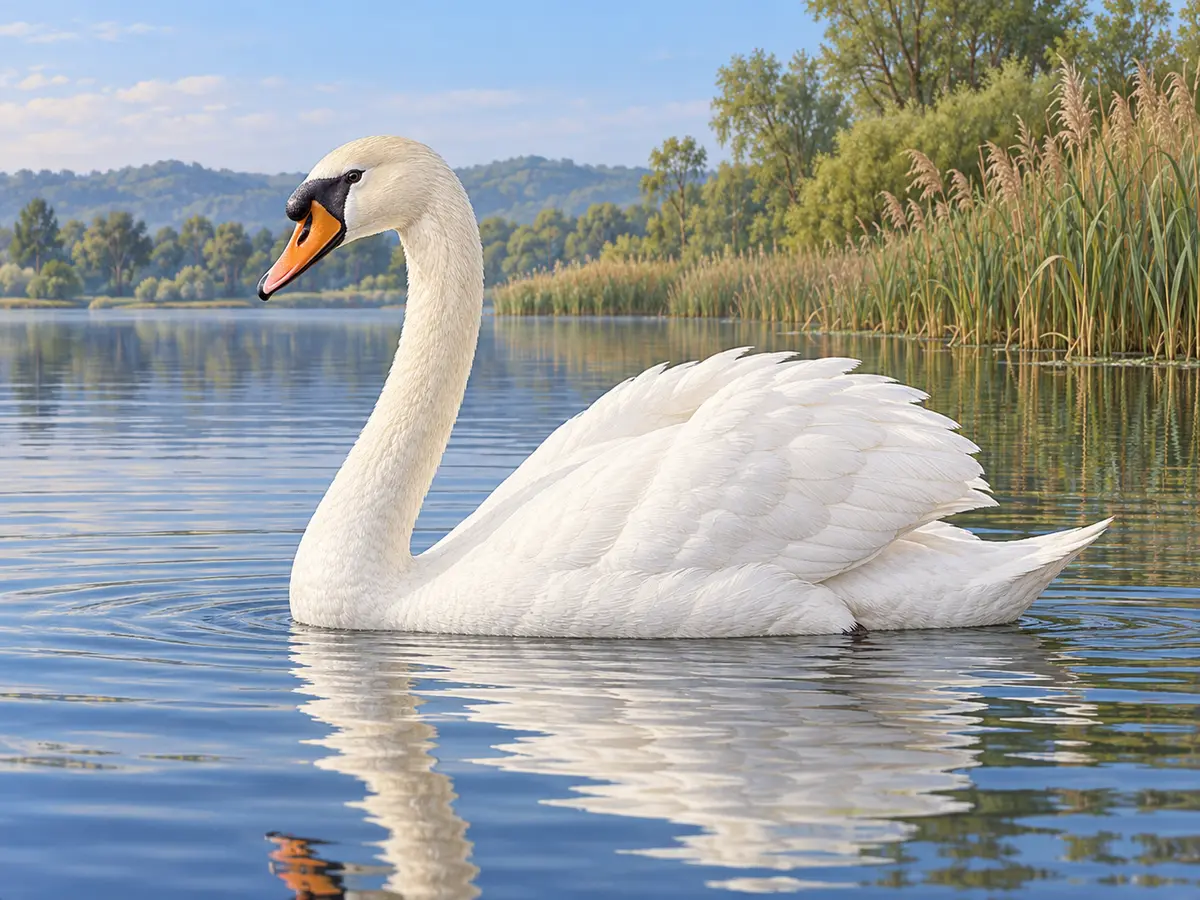
Native across much of Europe and temperate Asia, using lakes, ponds, slow rivers, marshes, estuaries and sheltered bays; in winter it may move onto brackish or coastal waters. Introduced populations occur beyond the native range, notably in North America, so native-versus-alien status must be checked locally. [1–3]
Animal Diversity Web reports a length of 144–158 cm, a 2–2.5 m wingspan and a mass of 7.6–14.3 kg. Males are generally larger, but sex should not be assigned from size or bill-knob size alone. [2]
Adults have white plumage, an orange bill with black tip and base, a black knob and a characteristically curved neck. Juveniles are grey-brown before whitening; plumage colour alone can therefore confuse young birds with other swans. [2,3]
A long neck reaches submerged plants, webbed feet provide propulsion and waterproof plumage retains heat. Large body size and raised-wing postures create strong visual signals during territorial defence. [2,3]
Behaviour and ecology
Pairs occupy and defend breeding territories, communicating through neck and wing postures, hisses and movement. Outside breeding, birds may gather in large flocks; “mute” does not mean an absence of sound or warning behaviour. [2]
Diet
The diet is dominated by aquatic vegetation gathered by upending the head and neck rather than diving; small amounts of aquatic insects, molluscs and other animals may be taken. Bread is not a balanced substitute and can intensify crowding and pollution at feeding sites. [2,3]
Reproduction and life cycle
A large plant nest is built near water. Clutches of 5–7 are common in the ADW account and incubation lasts about 36–38 days; precocial cygnets leave the nest quickly for the water but remain protected for months. [2]
Ecosystem role
Grazing and uprooting directly affect submerged vegetation, while floating plant fragments may be used by other species. Where introduced, high densities can reduce vegetation and compete with native waterfowl, so ecological effects are location-dependent. [2,5]
Threats & conservation
Collisions, fishing tackle and lead, pollution, avian influenza and conflict in introduced ranges can cause mortality or population control. DinoJura must verify origin, local legal status, veterinary testing and escape risk before any intake, with no release into open waters. [3,5]
BirdLife/IUCN lists Cygnus olor as Least Concern (LC). The name was not located in the CITES Appendices effective 5 March 2026; this is not permission to capture, transport or release the species. Wildlife, veterinary, quarantine and invasive-species rules still apply by jurisdiction. [1,4,5]5 sourced facts
Species in five facts
The orange bill and black basal knob are key adult field marks. [2]
Wingspan can reach about 2.5 m. [2]
Mute swans still hiss, snort and produce audible wing sounds in flight. [2]
Clutches of 5–7 eggs are common in the ADW account. [2]
Young birds are commonly grey-brown before becoming white. [2]
Sources
[1] BirdLife DataZone — Mute Swan[2] Animal Diversity Web — Cygnus olor[3] British Trust for Ornithology — Mute Swan[4] CITES Appendices effective 5 March 2026[5] U.S. Fish & Wildlife Service — Mute Swan ecological risk screening