
Breeds in Patagonia, Tierra del Fuego and the Falkland/Malvinas Islands; many birds move north to Paraguay and southern Brazil in winter. Habitats include inland lakes, marshes, lagoons, estuaries and shallow coasts from sea level to about 1,200 m. [1]
Body length is about 102–124 cm. The reviewed account gives males at roughly 4.5–6.7 kg and females at 3.5–4.4 kg; the sexes look similar in plumage but males are usually larger. [1]
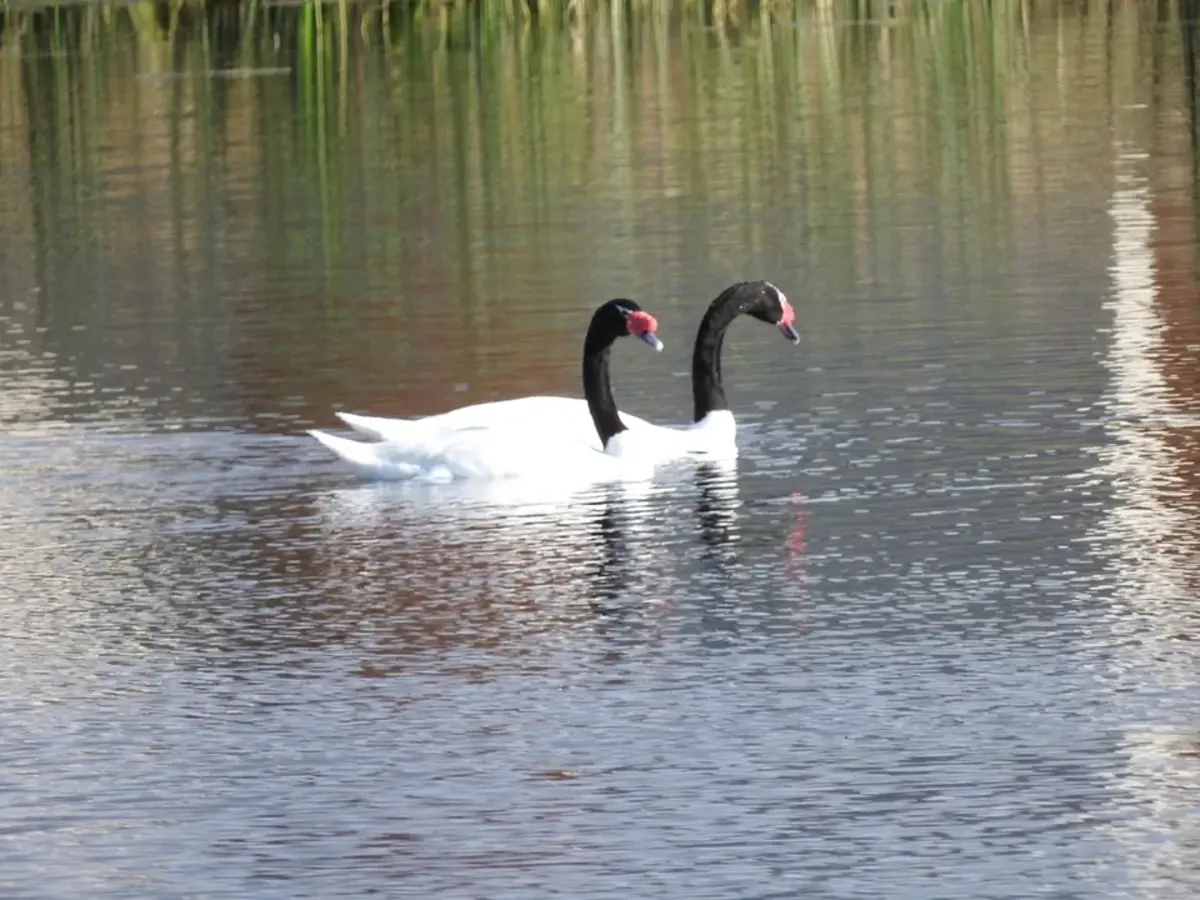
White body and wings contrast with a black head and neck; a white eye-stripe, bluish-grey bill with red base and double-lobed red caruncle are diagnostic. Cygnets are pale brown-grey with dark bill and feet and attain the typical black-and-white plumage in their second year. [1]
A long neck reaches submerged plants, webbed feet generate thrust and the bill filters food. Leg placement favours swimming over walking, a morphological trade-off that makes shallow plant-rich water more important than extensive dry ground. [1]
Behaviour and ecology
Gregarious outside breeding, but pairs defend territories around nests. Rear-set legs improve swimming but make walking awkward; birds spend much time feeding and resting on water and use soft whistles rather than the loud calls typical of many other swans. [1]
Diet
Feeds mainly on aquatic plants such as stoneworts, pondweeds, milfoil and wild celery, with some insects and other invertebrates. Serrated bill edges and a spiny tongue help grip, tear and filter submerged plant material. [1]
Reproduction and life cycle
Typically monogamous, building a large nest from reeds and aquatic vegetation. Clutches contain about three to seven eggs incubated for 34–37 days; cygnets fledge near ten weeks but may remain with their parents for 8–14 months. Both parents guard, forage with and may carry the young. [1]
Ecosystem role
Grazing and uprooting aquatic plants affect biomass, vegetation structure and nutrient cycling in wetlands. Eggs and cygnets are taken by gulls, mustelids and foxes, linking the species to both aquatic and shoreline food webs. [1]
Threats & conservation
Locally, pollution, drainage, altered hydrology, nest disturbance, lead shot and disease can cause losses despite the global LC category. DinoJura must verify Appendix-II permits, origin, veterinary status, quarantine and transport conditions before any transfer. [1–4]
The 2024 IUCN assessment lists the species as Least Concern (LC). CITES includes Cygnus melancoryphus in Appendix II; international transactions still require correct identification, lawful origin and appropriate permits, and LC does not mean unrestricted collection. [1–4]5 sourced facts
Species in five facts
Body length is about 102–124 cm. [1]
A clutch usually contains three to seven eggs. [1]
Incubation lasts about 34–37 days. [1]
Both parents may carry cygnets on their backs. [1]
The species is listed in CITES Appendix II. [3,4]
Sources
[1] Animal Diversity Web — Cygnus melancoryphus[2] IUCN Red List 2024 — Cygnus melancoryphus[3] CITES Appendices effective 5 March 2026[4] CITES species index — Cygnus melancoryphusPhoto record — iNaturalist observation 217191376