
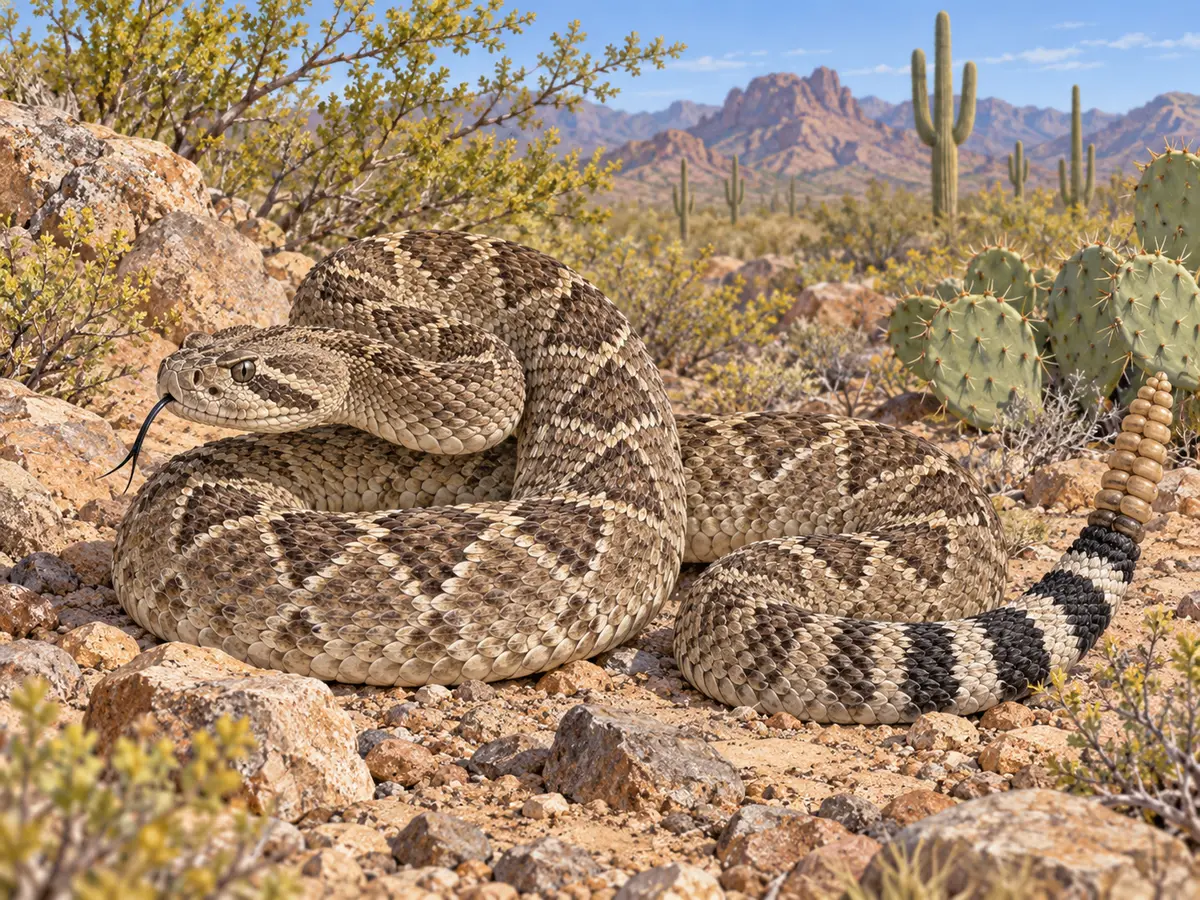
Ranges from central and western Texas through New Mexico, Arizona and southern California into Mexico. It occupies deserts, grasslands, scrub, chaparral and dry rocky ground with crevices, mammal burrows or thermally stable refuges. [1,2]
Animal Diversity Web summarises body length around 1.5 m and mass up to 6.7 kg. Size varies with sex, region and age; one measurement should not be used alone for identification or condition assessment. [1]
A heavy body and broad triangular head, with yellow-grey to pink-brown ground colour and dark pale-edged dorsal diamonds. Bold black-and-white bands precede the rattle; folding fangs and heat pits are pit-viper structures. Identification must never require close approach. [1,2]
Loreal pits detect small temperature differences and hollow fangs deliver venom deeply. The rattle consists of interlocking keratin segments, with one added after each shed, but old segments break, so segment count cannot determine age. [1]
Behaviour and ecology
Largely solitary, shifting from daytime to crepuscular or nocturnal activity with temperature. In colder areas several individuals may share winter refuges; when threatened it may coil, raise the forebody and rattle, but may also remain silent or retreat. [1]
Diet
Feeds mainly on small mammals and birds, with reptiles, amphibians and other prey taken occasionally. Heat pits help locate warm prey, venom immobilises and begins digestion, and chemical tracking leads the snake to prey that is swallowed whole. [1]
Reproduction and life cycle
Gives birth to live young after embryos develop within membranes retained by the female. The reviewed account reports maturity around three years, gestation near 167 days and litters of 10–20, while field studies show reproductive frequency and litter size vary by population and condition. [1,3]
Ecosystem role
An important mid-level predator of rodents and other small mammals, while serving as prey for eagles, roadrunners, wild turkeys and other predators. Its prey-control role does not remove venom risk but argues against indiscriminate killing. [1]
Threats & conservation
Fear-driven killing, roundups, roads, refuge loss and undocumented collection create local impacts. This is a medically significant venomous snake: only licensed facilities with escape-proof secondary containment, two-person protocols, emergency planning and appropriate medical-antivenom coordination should be considered; this profile is not a handling guide. [1,4–6]
The latest accessible IUCN assessment is from 2007 and lists the species as Least Concern (LC), so the age of the evidence is explicit. CoP20 rejected the proposal to include Crotalus and Sistrurus in Appendix II; Crotalus atrox is not listed in the CITES Appendices effective 5 March 2026. Absence from CITES does not waive dangerous-animal, veterinary, transport or national rules. [2,4–6]5 sourced facts
Species in five facts
Reference body length is about 1.5 m. [1]
The heat-sensing pit lies between eye and nostril. [1]
A new rattle segment forms after each shed, but old segments may break. [1]
The reviewed account reports litters of about 10–20 live young. [1]
The CoP20 proposal to list the genus under CITES was rejected. [6]
Sources
[1] Animal Diversity Web — Crotalus atrox[2] The Reptile Database — Crotalus atrox[3] PLOS ONE — Mating systems in Crotalus atrox[4] IUCN Red List 2007 — Crotalus atrox[5] CITES Appendices effective 5 March 2026[6] Government of Canada — CITES CoP20 species-proposal outcomes