
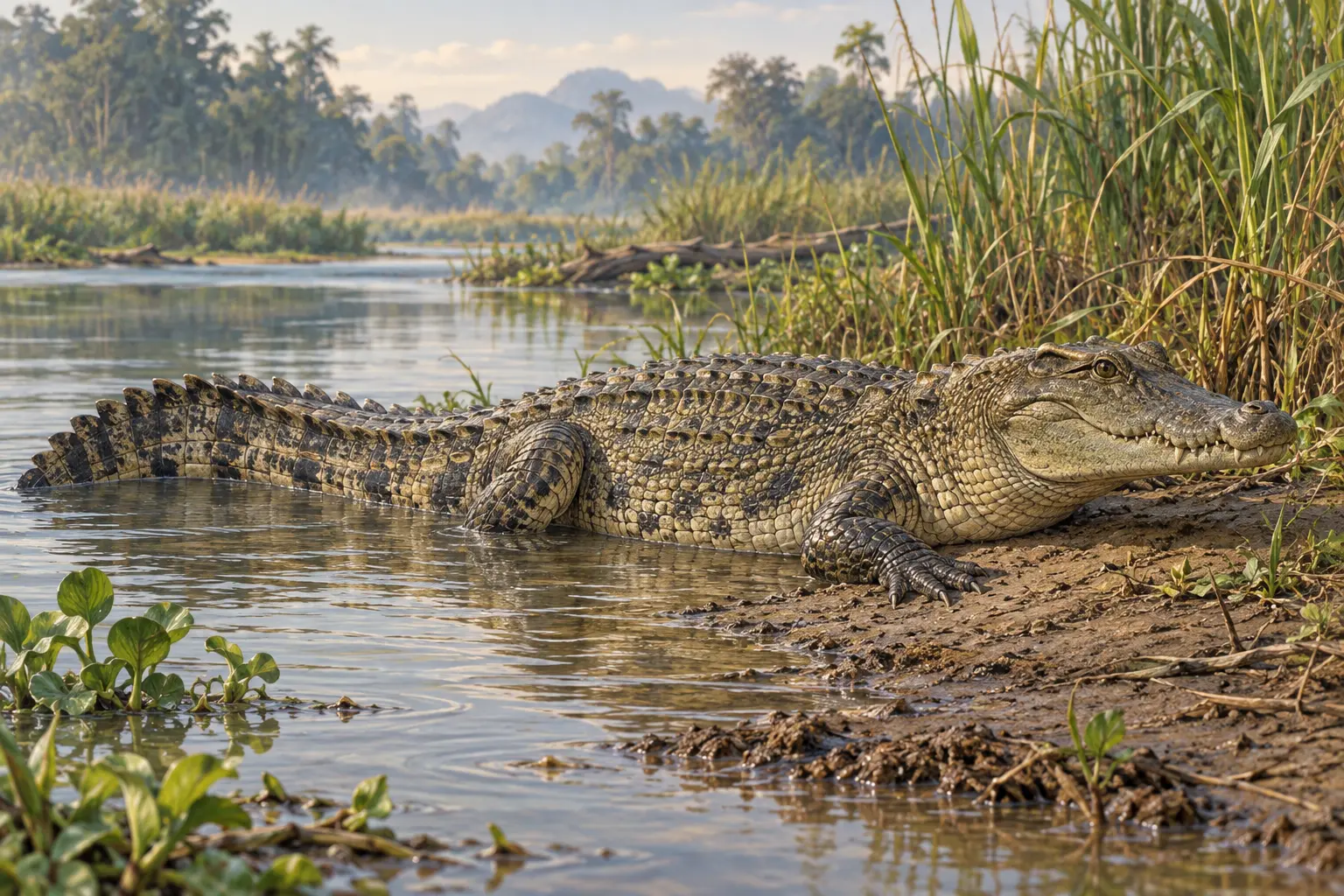
Historically ranged across Cambodia, Laos, Thailand, Viet Nam and Indonesia in slow rivers, lakes, marshes and swamp forest. Cambodia holds the principal stronghold; Viet Nam has reintroduced captive-bred animals in Cat Tien. [1]
Adults commonly measure about 1.8–2.7 m; large males may exceed this, with maximum length commonly reported near 3 m. Size cannot reliably distinguish pure animals from hybrids. [2]
The snout is relatively broad and smooth, the body olive to brown with dark juvenile bands, and a conspicuous bony crest lies behind the head. External traits overlap with hybrids and cannot establish breeding origin. [1,2]
High-set eyes and nostrils permit seeing and breathing while largely submerged; a laterally compressed tail powers swimming and a nictitating membrane protects the eye underwater. Behavioural thermoregulation combines land and water. [1,2]
Behaviour and ecology
Semi-aquatic, often sheltering in water or vegetated banks and capable of digging burrows; adult burrow use remains incompletely understood. Activity, basking and movement vary with temperature and water level. [1]
Diet
Primarily takes fish, frogs, snakes and other small animals; large individuals may take bigger prey opportunistically. Diet varies with age and habitat and should not be inferred from farm feeding. [1]
Reproduction and life cycle
Females build vegetation mound nests near water; wild nests have held 11–26 eggs. Incubation temperature affects development and sex in crocodilians; mothers guard nests and may help hatchlings reach water. [1,3]
Ecosystem role
As a large aquatic predator, the Siamese crocodile influences fish and waterside prey populations; burrows, trails and nests may create microhabitats for other species. Effects differ among wetlands. [1; ecological interpretation]
Threats & conservation
Skin hunting, egg collection, wetland loss, fishing-gear entanglement, hydropower and hybridisation in captivity all impede recovery. Conservation programmes must separate commercial production from pedigreed, genetically and legally traceable conservation stock. [1,3,4]
Reviewed 21 September 2026: IUCN and conservation programmes record CR; Crocodylus siamensis is in CITES Appendix I. Many captive stocks have hybrid ancestry, so appearance cannot replace pedigree, genetic and legal records.5 sourced facts
Species in five facts
Wild nests have been recorded with about 11–26 eggs. [1]
Much captive stock labelled “Siamese crocodile” may carry hybrid ancestry. [1]
It is primarily a freshwater species, not the saltwater crocodile. [1,2]
A captive-bred population has been reintroduced in Cat Tien National Park. [1]
A bony crest behind the head is a conspicuous identification feature. [1]
Sources
[1] Fauna & Flora — Siamese crocodile facts and conservation[2] Zoo Atlanta — Siamese crocodile species note[3] IUCN Red List species search[4] CITES Appendices effective 5 March 2026