
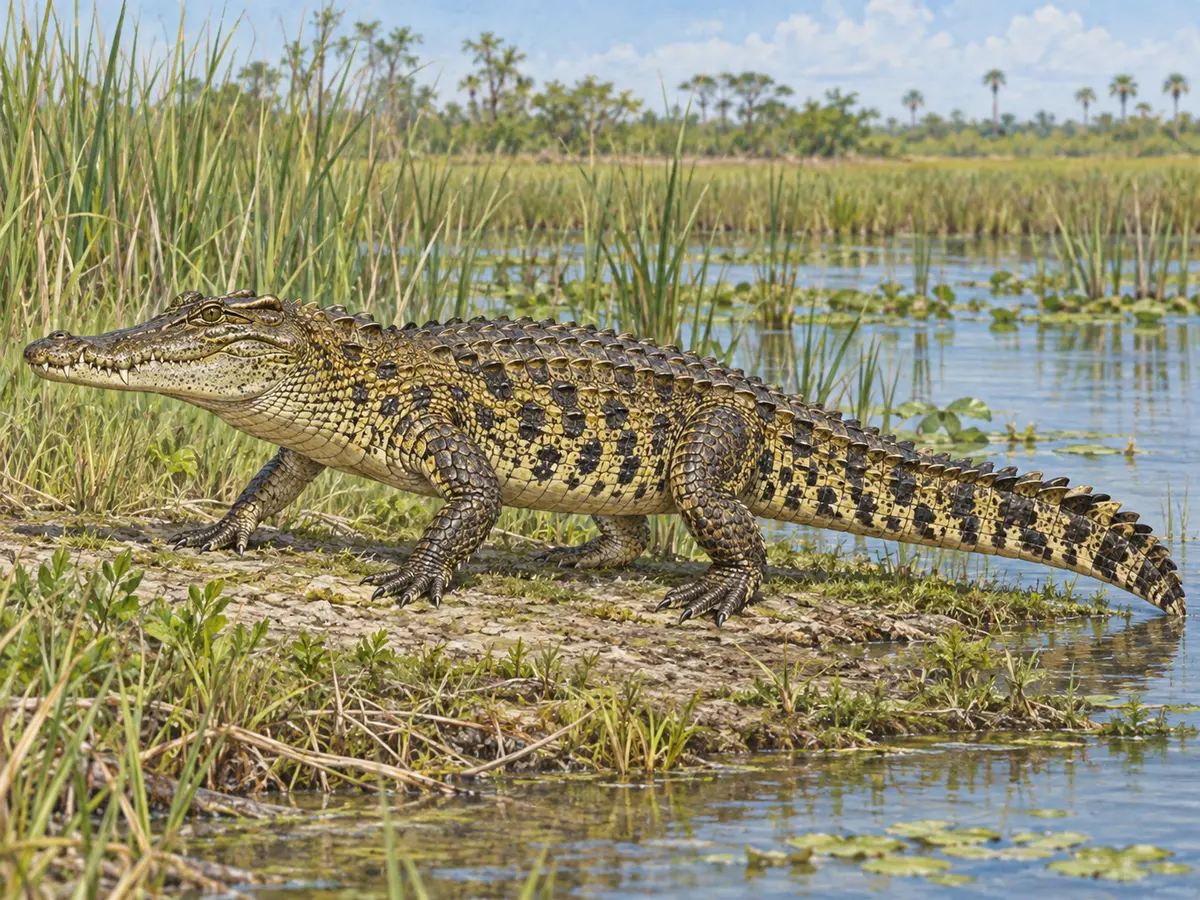
Smithsonian reports a current wild range of less than 500 km², centred on the freshwater Zapata Swamp on Cuba and Lanier Swamp on Isla de la Juventud. Such a restricted distribution means a single wetland event can affect a large share of the population. [1,2]
A 2025 Smithsonian overview gives a maximum length of about 3.2 m, with many individuals smaller. Size cannot distinguish a pure Cuban crocodile from a hybrid; conservation identification needs pedigree and genetic evidence. [2,3]
A relatively short broad snout, elevated area behind the eyes, strong limbs with large scales, yellow-olive and black mottling and diamond-like dorsal patterning are characteristic. Hybridisation with American crocodiles nevertheless makes morphology alone unreliable. [1–3]
High-set eyes, ears and nostrils allow seeing, hearing and breathing while most of the body is submerged; airway valves assist when holding prey underwater. Relatively long legs and reduced foot webbing support movement across marsh ground. [2]
Behaviour and ecology
The species is a strong swimmer, a quick walker and capable of leaping from the water for prey. Individuals thermoregulate by basking or entering water; social interactions include dominance postures, vocalisations and spatial defence. [2]
Diet
Juveniles take invertebrates and small fish, while larger animals prey on fish, turtles and small mammals. Smithsonian has observed behaviour suggestive of coordinated hunting but notes that more evidence is needed; this profile does not treat it as established for the species. [2,3]
Reproduction and life cycle
Females make mound nests and lay an average of about 30–40 eggs according to Smithsonian; hatching follows after roughly 2.5 months. Incubation temperature affects embryo sex, so conservation programmes must record nest data and manage incubation rather than simply maximise hatch numbers. [2]
Ecosystem role
As a large wetland predator, the Cuban crocodile affects fish, turtle and small-animal populations and can create paths and small depressions through movement. The magnitude in each swamp needs quantitative study rather than inference from an 'apex' label alone. [1,2]
Threats & conservation
An extremely small range, wetland degradation, historical hunting, introduced competitors and especially hybridisation with American crocodiles threaten genetic integrity. DinoJura must not source this species commercially; any conservation animal needs pedigree, genetic testing, high-security facilities and CITES and national approvals. [1–4]
The 2022 IUCN assessment lists Crocodylus rhombifer as Critically Endangered (CR), and CITES includes the species in Appendix I. International commercial trade in wild specimens is generally prohibited, and any conservation transfer requires competent-authority confirmation. [1,4]5 sourced facts
Species in five facts
Smithsonian reports a current wild range below 500 km². [2]
The species can leap from the water to seize prey. [2]
Incubation temperature influences hatchling sex. [2]
Hybridisation with American crocodiles is a major conservation threat. [1–3]
The species is included in CITES Appendix I. [4]
Sources
[1] IUCN Red List 2022 — Crocodylus rhombifer[2] Smithsonian's National Zoo — Cuban crocodile[3] Smithsonian 2025 — eight Cuban crocodile facts[4] CITES Appendices effective 5 March 2026