
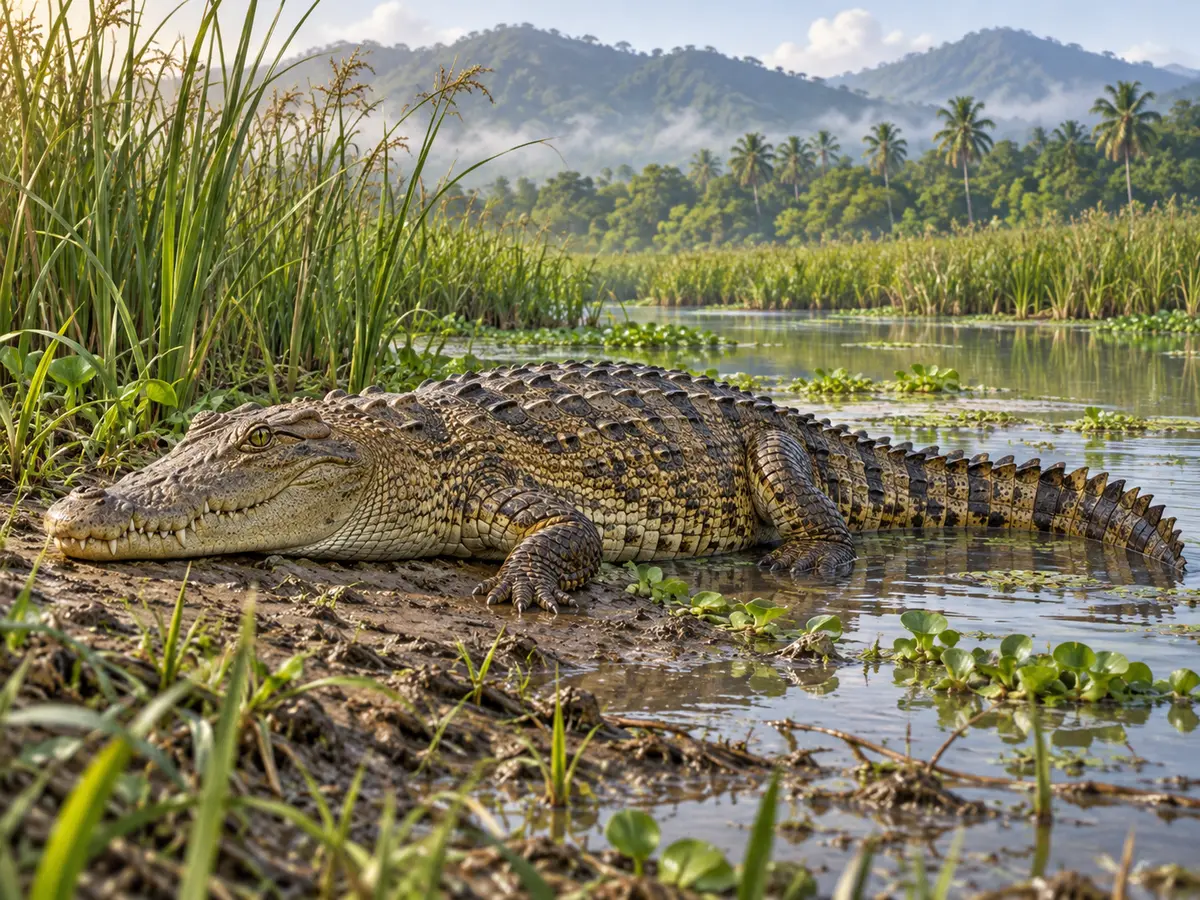
Historically recorded across many Philippine islands; surveys summarised by ADW place remaining populations mainly in northern Luzon and south-western Mindanao. It uses ponds, marshes, reservoirs, narrow creeks, rivers and sometimes brackish reaches, with records to about 850 m. [2,4]
ADW reports an average length around 2 m and a 3.02 m record, although most individuals are smaller; compiled data place maturity near 2.1 m for males and 1.3 m for females. One animal's length should not alone determine sex or age. [2]
The snout is relatively broad, adults darken to brown and the back carries heavy armour; hatchlings are golden-brown with dark cross-bands and a pale belly. Confirmation requires expert review, locality and scalation, not the general local word “buwaya.” [2,3]
Elevated eyes and nostrils permit seeing and breathing while most of the body is submerged; a muscular tail powers swimming, dorsal scutes protect the back and throat valves assist underwater prey handling. Embryonic sex is temperature-dependent as in other crocodilians. [2]
Behaviour and ecology
The crocodile thermoregulates by basking, entering water and using banks or shelters; activity changes with temperature, water level and prey. Individuals must not be treated as harmless because the species is small or rare; full crocodilian safety protocols remain necessary. [2]
Diet
Young take snails, shrimps, insect larvae and small fishes; larger animals eat fishes, snakes, waterbirds and occasional mammals. As opportunistic predators, they cannot be maintained long-term on one meat type alone. [2]
Reproduction and life cycle
Courtship is concentrated in the dry season and laying occurs roughly April–August, often peaking at the start of the rains. Recorded clutches contain 7–33 eggs; nests may be holes, mounds or combinations and are guarded by parents. ADW reports about 65–78 days of wild incubation. [2]
Ecosystem role
Where it survives, the species is a top freshwater predator linking fishes, invertebrates, reptiles, birds and small mammals in food webs. Its loss would remove a uniquely Philippine native predatory role. [2,4]
Threats & conservation
Habitat loss, accidental or retaliatory killing, historical exploitation and destructive fishing have contributed to decline. DinoJura must not commercially source wild animals; any conservation breeding requires pedigree and genetic goals, Philippine and CITES authorities, keeper safety and a lifetime facility plan. [1,4,5]
The IUCN SSC Crocodile Specialist Group records Crocodylus mindorensis as Critically Endangered (CR), assessed in 2012. It is in CITES Appendix I: international commercial trade in wild specimens is generally prohibited, and any conservation transfer requires competent authorities and complete permits. [1,4,5]5 sourced facts
Species in five facts
The species is endemic to the Philippines. [1,3]
Its snout is relatively broad for a Crocodylus species. [2]
The record length reported by ADW is 3.02 m. [2]
Recorded clutch size ranges from 7 to 33 eggs. [2]
The species is included in CITES Appendix I. [5]
Sources
[1] IUCN SSC Crocodile Specialist Group — Conservation status[2] Animal Diversity Web — Crocodylus mindorensis[3] Reptile Database — Crocodylus mindorensis[4] International Zoo Yearbook — in situ and ex situ conservation[5] CITES Appendices effective 5 March 2026