
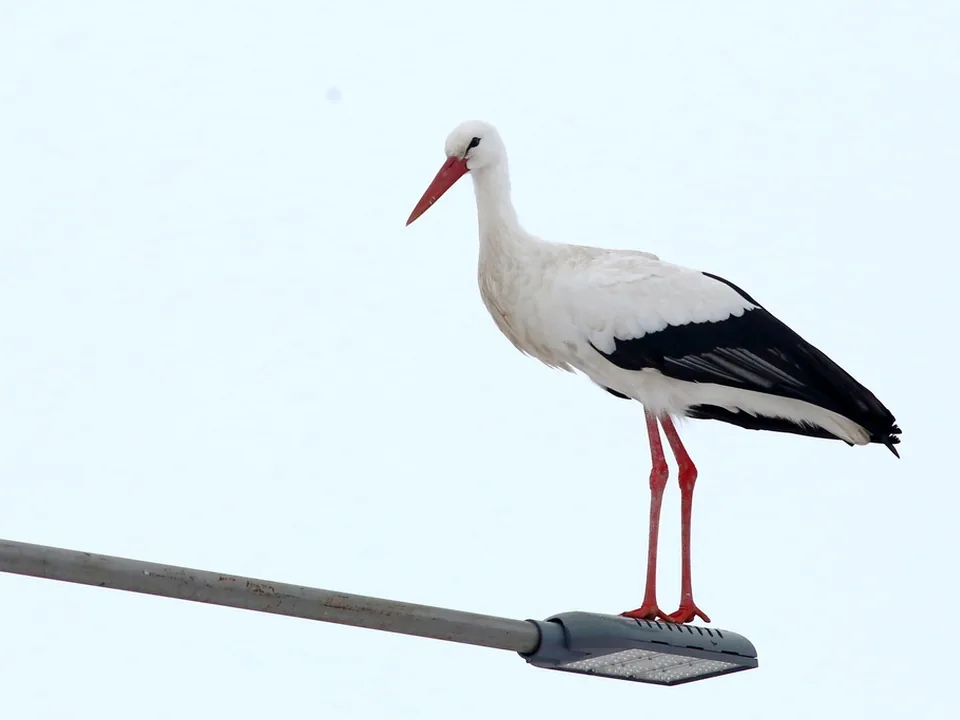
Breeds mainly in Europe, north-west Africa and west–central Asia. Many winter in sub-Saharan Africa or South Asia, while a growing share of western European birds winters in Iberia. It forages in grassland, farmland, floodplains and shallow wetlands. [1,3]
About 100–115 cm long with a wingspan around 155–215 cm. Long neck and legs contribute strongly to apparent height, so measurements should specify body length, standing height or wingspan. [2]
Adults have a white body and neck, black flight feathers, and a long straight red bill with red legs. In flight the neck is extended and legs trail beyond the tail, unlike many herons that retract the neck. Juveniles have duller bills and legs. [2,3]
Broad wings enable energy-efficient soaring, long legs permit walking through grass and shallow water, and a long bill captures varied prey. Adults communicate at the nest with head-back postures and rapid bill-clattering. [2,3]
Behaviour and ecology
Walks slowly while hunting, forms groups outside breeding and may gather in large numbers on migration. It uses rising warm air to soar, so major routes funnel through Gibraltar or the Bosporus rather than long sea crossings. [2,3]
Diet
An opportunistic predator of large insects, earthworms, amphibians, reptiles, fish, small mammals and sometimes eggs or chicks of ground-nesting birds. Diet varies strongly by place and season, so the species is not simply a “fish-eating bird”. [1,2]
Reproduction and life cycle
Pairs build and repair large stick nests on trees, roofs, chimneys or pylons, often reusing them for years. A clutch commonly contains about four eggs; both parents incubate and feed young, which hatch asynchronously and may differ in size within one nest. [2,3]
Ecosystem role
As a predator across grassland and wetland, the stork links terrestrial and aquatic food webs. Long-lived large nests can support smaller nesting birds, while landfill feeding can increase plastic ingestion and pathogen exposure. [1,2]
Threats & conservation
Electrocution and power-line collision, loss of wet foraging habitat, agricultural chemicals, hunting along flyways and waste still cause regional mortality despite an overall increase. Managed care requires flight space, foot-safe substrates, avian-influenza controls and movement records. [1,3,4]
The 2025 IUCN/BirdLife assessment lists Ciconia ciconia as Least Concern (LC), with a large and increasing global population, although regional trends differ. The name was not located in the CITES Appendices effective 5 March 2026; this does not replace bird-protection, transport, veterinary or quarantine law. [1,4]5 sourced facts
Species in five facts
It flies with the neck extended, unlike the retracted neck of many herons. [2]
The wingspan can exceed 2 m. [2]
Many nests are repaired and reused across multiple seasons. [2,3]
Thermal soaring makes land bridges important migration corridors. [3]
The 2025 IUCN/BirdLife assessment reports a large, increasing global population. [1]
Sources
[1] IUCN Red List 2025 — Ciconia ciconia[2] Animal Diversity Web — Ciconia ciconia[3] BirdLife — Migratory bird of the month: White Stork[4] CITES Appendices effective 5 March 2026Photo record — Вячеслав Юсупов, iNaturalist 331422707, CC BY