
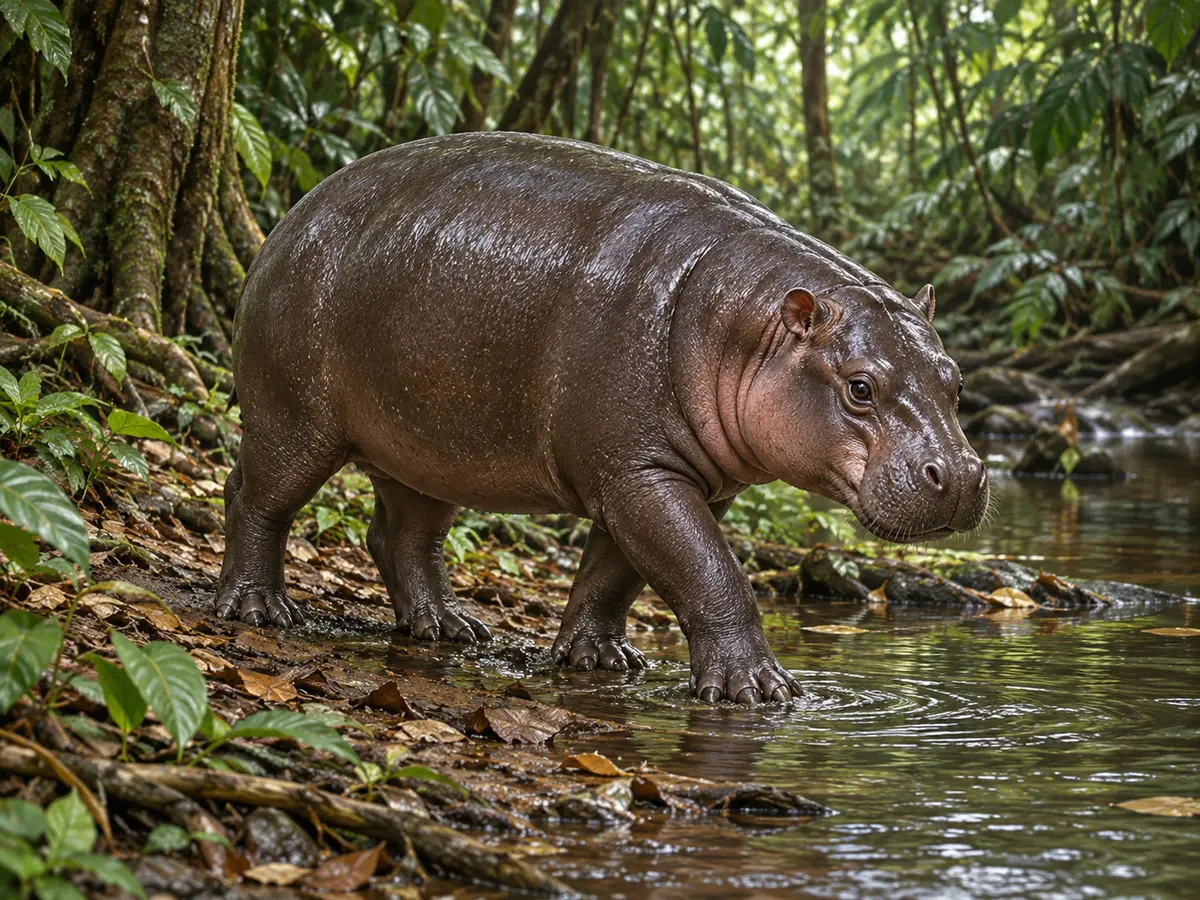
Confirmed surviving populations occur mainly in Liberia, Sierra Leone, Guinea and Côte d'Ivoire. The species is associated with lowland humid forest, swamps, streams and small rivers; home ranges depend on waterways, wet hollows, root cavities and dense ground cover rather than broad open water. [1,2,4]
EAZA and ADW report about 1.5–1.75 m head-body length, 0.7–1.0 m shoulder height and roughly 160–275 kg for managed adults. Wild body-mass data remain limited, so captive measurements should not be generalised to every wild population. [2,5]
The compact body slopes forward, with glossy dark-brown skin, a paler underside, small head and laterally placed rather than elevated eyes. Broadly spread, lightly webbed toes share weight across muddy ground. [2,3]
Muscular valves close the ears and nostrils underwater, while skin glands produce a glossy reddish-brown secretion that protects sensitive skin. Longer limbs and toe-stabilising muscles aid travel over mud and through forest. [2,3]
Behaviour and ecology
Mostly solitary except for mother-young pairs or brief breeding associations, it is most active from late afternoon through the night and uses tunnel-like forest paths. Water provides refuge and skin moisture, but substantial foraging occurs on land. [1,2]
Diet
Feeds on terrestrial and semi-aquatic plants including ferns, tender roots, grasses, shoots and leaves, fallen fruit and herbs. It is a selective browser rather than simply an underwater grazer as hippos are sometimes portrayed. [1,2]
Reproduction and life cycle
Evidence is largely from managed populations: gestation averages about 188 days and usually one 4.5–6.2 kg calf is born on land; twins are very rare. The mother leaves the calf hidden and returns to nurse, with weaning at about 6–8 months. [1,2,5]
Ecosystem role
As a rare large browser in West African forest, it creates paths, modifies low vegetation and moves nutrients between terrestrial feeding sites and streams or swamps. Its presence is an important indicator of forest-wetland continuity. [1,4]
Threats & conservation
Forest loss and fragmentation, agricultural expansion, hunting and civil instability are major pressures. For an EN, Appendix-II species with demanding facility needs, DinoJura should consider only conservation transfers with pedigree, lawful captive origin, veterinary-quarantine plans, pools, soft substrate and independently reviewed forested space. [1,4–6]
IUCN lists Choeropsis liberiensis as Endangered (EN) in a 2015 assessment whose age must be stated. CITES includes it in Appendix II under the name Hexaprotodon liberiensis. Appendix II requires legal origin, permits and an appropriate non-detriment finding; it is not evidence that an animal is available. [1,4,6]5 sourced facts
Species in five facts
The Pygmy hippo is the only living species in the genus Choeropsis. [3,4]
Its eyes sit on the sides of the head rather than high above it as in the common hippo. [2]
Calves are normally born on land, not underwater. [1]
Managed-population data give an average gestation of about 188 days. [1]
CITES still uses Hexaprotodon liberiensis for the Appendix-II entry. [6]
Sources
[1] IUCN Red List 2015 — Choeropsis liberiensis[2] Animal Diversity Web — Hexaprotodon/Choeropsis liberiensis[3] Mammalian Species — Choeropsis liberiensis[4] IUCN SSC Hippo Specialist Group — Pygmy Hippopotamus[5] EAZA Best Practice Guidelines — Pygmy hippopotamus[6] CITES Appendices effective 5 March 2026