
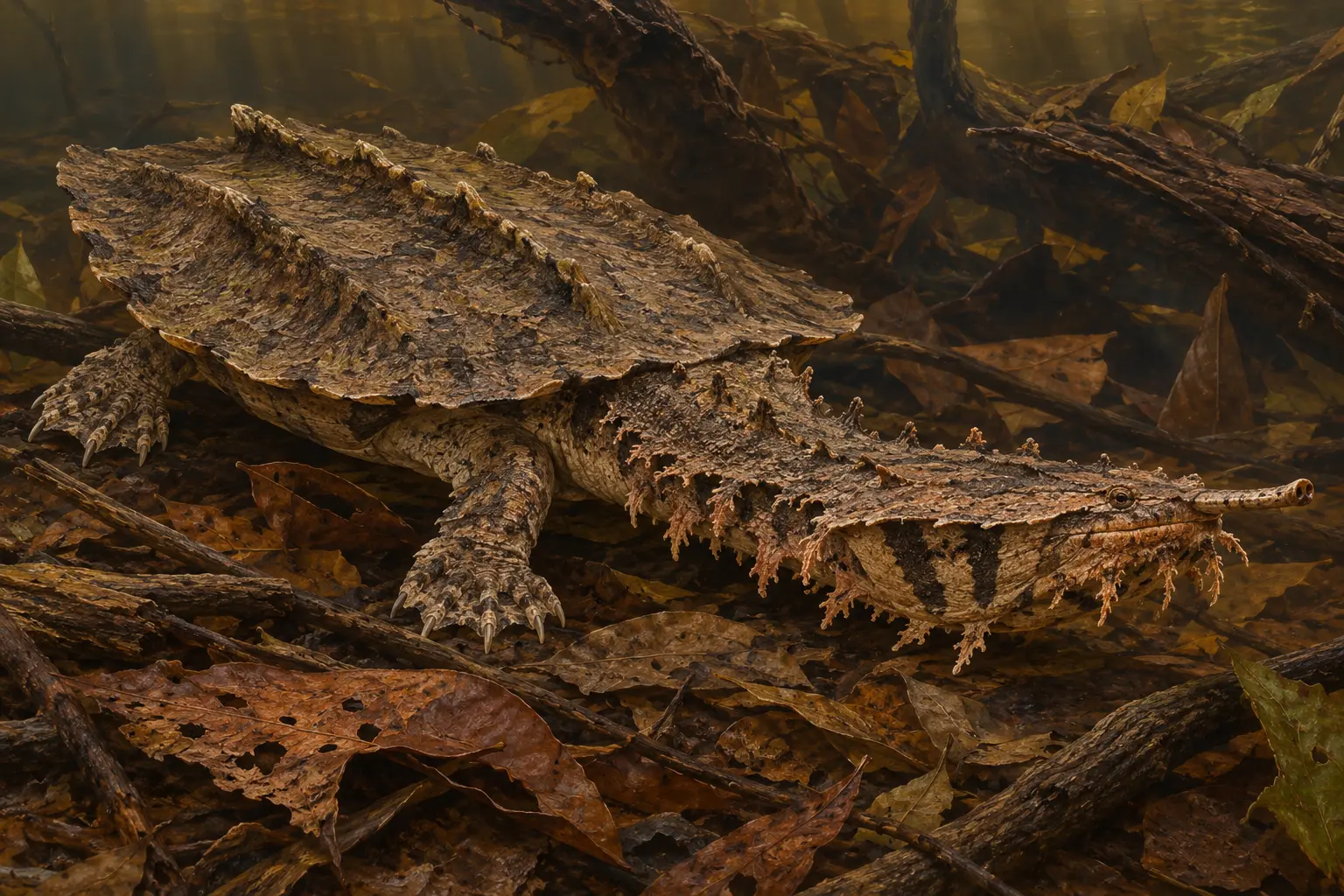
Under the 2020 revision, C. fimbriata sensu stricto is associated with the Amazon basin, while Orinoco, Río Negro and Essequibo populations were separated as C. orinocensis. It inhabits slow water, swamps, dark creeks and leaf-littered bottoms. [2,3]
Specialist sources report carapace length up to roughly 50–53 cm, with variation by sex and population. Its large size and benthic specialisation require suitable volume, depth and water quality rather than a tank chosen by one length formula. [1,3]
A broad triangular head, small eyes, tubular snout, flattened fringed neck and brown carapace with three ridges and rough scutes are characteristic. C. fimbriata and C. orinocensis should not be assigned from colour in one photograph; morphology, geographic origin and sometimes genetics are needed. [2,3]
The shell and skin fringes break up the outline like leaf litter, the tubular snout permits breathing while submerged, and the flattened head and throat form a suction chamber. These adaptations suit turbid-water ambush and do not imply poor vision or tolerance of dirty water. [1,3]
Behaviour and ecology
Rather than chasing prey, it commonly remains still among leaf litter. The snout reaches the surface like a snorkel and the long neck extends without lifting the body; the species is strongly aquatic and terrestrial handling is highly stressful. [1]
Diet
Primarily feeds on fish and small aquatic animals. Suction feeding works through rapid mouth opening and throat expansion that draws prey inward; much of the water is then expelled before swallowing. [1]
Reproduction and life cycle
Lays eggs on land. Specialist accounts describe terrestrial nesting, but clutch and incubation values vary among sources and may mix pre-2020 species concepts, so this profile does not prescribe one breeding formula. [1–3]
Ecosystem role
A benthic predator of fish and small aquatic animals, while eggs and young feed mammals, crocodilians and other predators. It links energy flow among the bottom, water column and terrestrial nesting banks. [1]
Threats & conservation
Pet trade, habitat loss and post-split misidentification create management risks. Records must capture the correct name, country and basin of origin, captive-breeding status and CITES documents; a pre-2020 IUCN category must not be used to downplay risk. [2–5]
Reviewed 4 October 2026: the 2008 IUCN/SSC account assessed a broad Chelus fimbriata concept before a 2020 study separated C. orinocensis. DinoJura therefore does not apply that historical LC category uncritically to today's Amazon species scope. Chelus spp. are in CITES Appendix II, and post-split conservation status requires reassessment. [1–5]5 sourced facts
Species in five facts
The tubular snout permits breathing while most of the body remains submerged. [1]
It captures fish by suction rather than pursuit biting. [1]
A 2020 study separated the Orinoco mata mata as C. orinocensis. [2,3]
Carapace length may reach about 53 cm. [3]
Chelus spp. are controlled under CITES Appendix II. [4,5]
Sources
[1] IUCN/SSC TFTSG — Chelus fimbriatus account (2008; pre-split)[2] Vargas-Ramírez et al. 2020 — Molecular Phylogenetics and Evolution[3] Senckenberg — Two species of bizarre matamata turtles[4] The Reptile Database — Chelus fimbriata[5] CITES Appendices effective 5 March 2026