
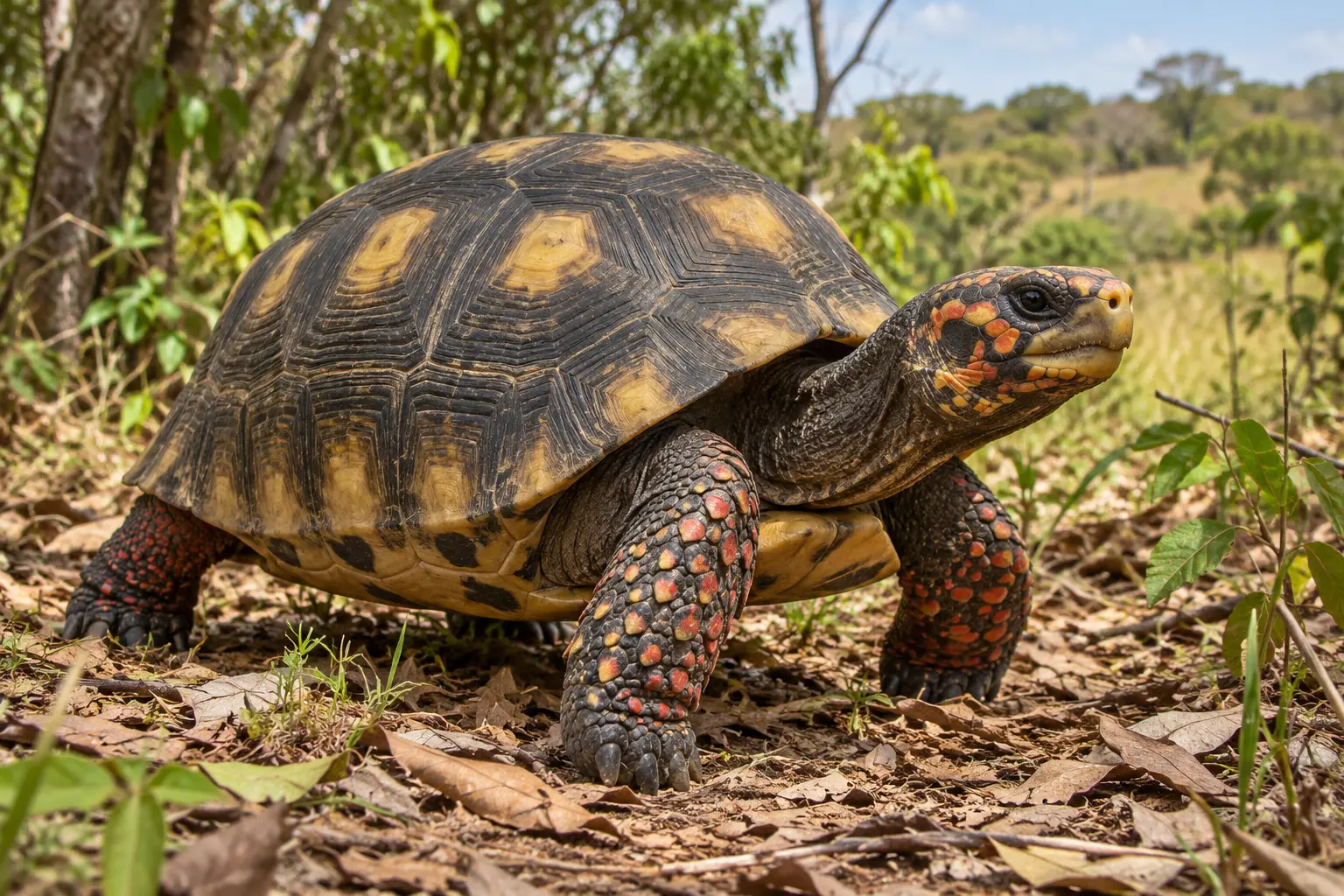
Widespread in South America from Panama to Argentina, and on Trinidad and Barbados. Habitats include wet and dry forest, savanna and grassland; a broad range does not mean every population shares one climate or extraction pressure. [1,2]
Smithsonian reports males up to about 34 cm and 9 kg, while females average around 28.5 cm. Size varies among populations and conditions; carapace length is more useful than estimating age from growth rings. [1]
An elongated domed black-brown shell has pale yellow scute centres; mostly dark skin carries red, orange or yellow scales on head and limbs. Shell bumpiness varies with age and care; do not confuse it with the differently patterned yellow-footed tortoise. [1,2]
Columnar limbs bear weight, the domed shell protects the body and a keratinous beak clips varied plants. Smell and low-level vision help locate fruit, fungi and humid refuges beneath the canopy. [1,2]
Behaviour and ecology
Walks the forest floor searching for fallen fruit, leaves and fungi, often becoming more active in warm humid conditions. Males use head movements in sex recognition and may shove, ram or overturn rivals during reproductive competition. [1]
Diet
Feeds mainly on leaves, grasses, flowers, fruit and fungi, with small amounts of invertebrate or animal matter. Managed diets require a fibre-rich plant base and controlled fruit and protein rather than unrestricted feeding. [1,2]
Reproduction and life cycle
After mating, females bury about 5–15 eggs in leaf-litter nests; Smithsonian gives a typical incubation near 150 days, though temperature and moisture cause substantial variation. There is no post-nesting parental care. [1]
Ecosystem role
Fruit consumption and seed passage can disperse some plants, while feeding on fungi and detrital material moves nutrients across the forest floor. Eggs and juveniles also provide prey for many predators. [2]
Threats & conservation
Habitat loss and fragmentation, hunting for food and collection for trade can drive local declines. Appendix II is not a sustainability certificate; taxon, captive origin, parentage, marking, chain of custody and permits require verification. [2,4]
Reviewed 5 October 2026: DinoJura could not verify a current species-wide IUCN assessment and therefore does not transfer an old category. Testudinidae spp. are in CITES Appendix II except taxa listed in Appendix I. References use Chelonoidis carbonaria, C. carbonarius and the older Geochelone carbonaria; permit names must be reconciled transaction by transaction. [1–4]5 sourced facts
Species in five facts
Males may reach about 34 cm and 9 kg. [1]
The species often lives more than 50 years. [1]
Males and females use head movements in recognition. [1]
Reported clutches contain about 5–15 eggs. [1]
Testudinidae are in CITES Appendix II except species listed in Appendix I. [4]
Sources
[1] Smithsonian's National Zoo — Red-footed tortoise[2] Animal Diversity Web — Chelonoidis carbonaria[3] ITIS — Chelonoidis carbonarius / carbonaria note[4] CITES Appendices effective 5 March 2026