
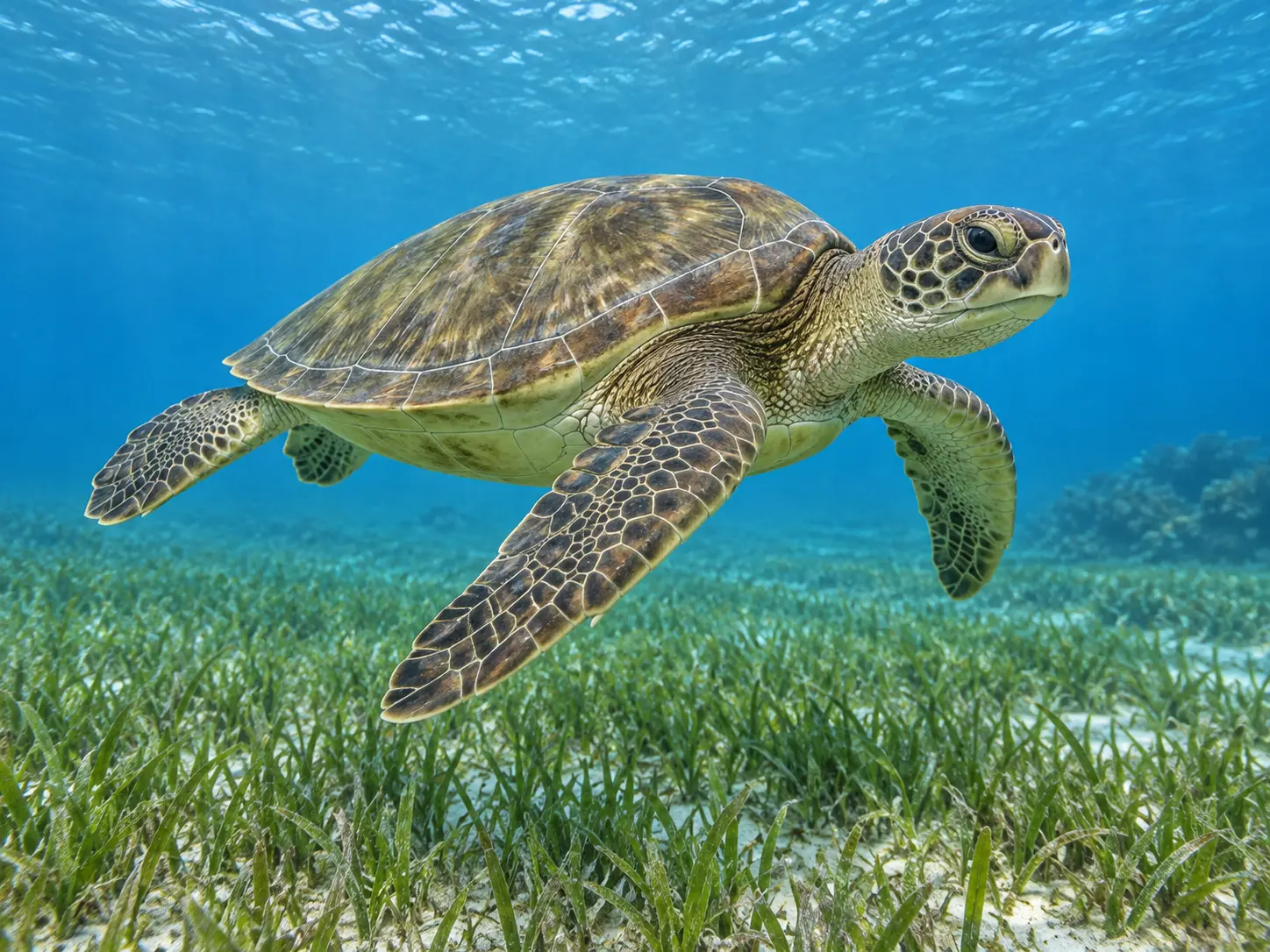
Occurs in the Atlantic, Pacific and Indian Oceans; forages in shallow bays, reefs and seagrass meadows, while adult females return to sandy beaches to nest.
Adult carapace length is commonly about 80–120 cm, with typical mass around 110–190 kg; exceptional individuals are substantially larger.
A smooth oval shell with four pairs of non-overlapping lateral scutes, small head, one pair of prefrontal scales and a serrated jaw edge for cropping vegetation.
Forelimbs form powerful flippers, salt glands remove excess salts and large lungs support diving; navigation systems enable returns to breeding regions after long migrations.
Behaviour and ecology
Migrates hundreds to thousands of kilometres between feeding and nesting areas. Juveniles are more oceanic before shifting progressively into coastal habitats.
Diet
Young turtles are more omnivorous; larger animals mainly graze seagrass and algae, although diet varies among populations and life stages.
Reproduction and life cycle
Females nest at night and lay dozens to more than one hundred eggs; incubation temperature influences hatchling sex. A female may lay several clutches in a season but does not breed every year.
Ecosystem role
Grazing maintains young, productive seagrass meadows, while nesting transports marine nutrients onto beaches through eggs and organic remains.
Threats & conservation
IUCN lists the species as EN and CITES Appendix I. Threats include bycatch, harvest of eggs and meat, nesting-beach loss, pollution, vessel strikes and climate change; any trade or keeping requires exceptionally strict legal review.
IUCN/CITES status was checked on the profile date; re-verify before any legal or transaction decision.5 sourced facts
Species in five facts
The name green turtle refers to body fat colour, not the shell.
Females tend to return to their natal region to nest.
Nest temperature helps determine sex.
Adults are among the few predominantly herbivorous sea turtles.
Seagrass meadows are both feeding grounds and ecosystems shaped by grazing.
Sources
NOAA Fisheries — Green turtleIUCN Marine Turtle Specialist GroupIUCN Red List searchCITES Checklist