
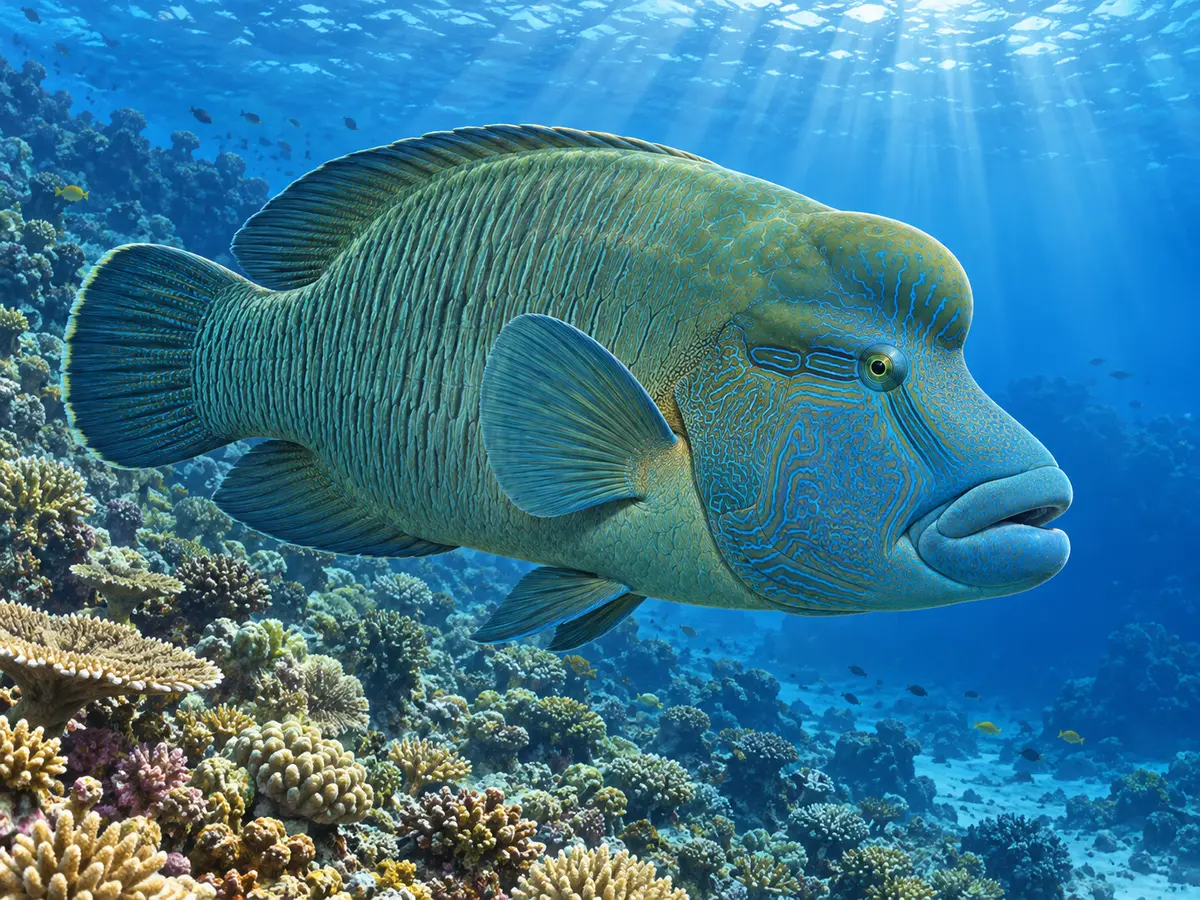
Widely distributed in the Indo-Pacific from the Red Sea and East Africa to the central Pacific. Juveniles use shallow reefs, seagrass and mangroves; large fish frequent outer reefs, slopes and caves to around 60 m. [2–4]
Published maxima reach about 2.3 m and more than 190 kg, but most individuals are far smaller. Maximum records should not be presented as typical adult size. [3,4]
A large blue-green body, thick lips, two dark lines behind the eye and maze-like head markings are characteristic; large adults develop a prominent forehead hump. Juveniles are paler and use shallow habitat, making misidentification easier. [3,4]
Powerful jaws and pharyngeal teeth crush hard prey, while thick lips and suction extract food from reef crevices. Sex change helps maintain reproductive roles socially but cannot compensate for heavy removal of large fish. [3,4]
Behaviour and ecology
Diurnal, usually solitary and often attached to a familiar reef area; at night it shelters in caves or crevices. Adults may form localised spawning aggregations, creating predictable fishing targets. [2–4]
Diet
Crushes and sucks shelled or spiny reef prey such as molluscs, crustaceans and echinoderms and also takes small fish. Crown-of-thorns starfish are recorded prey, but the species is not a movable pest-control tool. [3,4]
Reproduction and life cycle
Matures relatively late, lives beyond 30 years and is protogynous: some mature females change into males. Pair or group spawning at reef sites means removal of large fish can disrupt sex structure and reproduction. [2–4]
Ecosystem role
A large reef predator, it influences mollusc, crustacean and echinoderm populations and contributes to food-web dynamics. Large individuals also indicate structurally complex reefs with comparatively lower fishing pressure. [2–4]
Threats & conservation
The live reef food-fish trade, juvenile capture, illegal fishing and coral-reef degradation are major threats. EN status and Appendix II require DinoJura to reject shipments lacking permits, a non-detriment finding, traceability and appropriate transport-veterinary documentation. [1–4]
IUCN currently lists the species as Endangered (EN); the 2004 record is marked as needing updating, so DinoJura reports the current displayed category with a review date. Cheilinus undulatus is in CITES Appendix II, requiring permits, lawful origin and a non-detriment finding for international trade. [1–3]5 sourced facts
Species in five facts
It is the largest known wrasse. [3,4]
The forehead hump enlarges as the fish grows. [3]
Juveniles use seagrass and mangroves as nursery habitat. [2,4]
Some mature females change into males. [2–4]
International trade is regulated under CITES Appendix II. [2]
Sources
[1] IUCN Red List search — current Cheilinus undulatus record[2] CITES Appendices effective 5 March 2026[3] FishBase — Cheilinus undulatus[4] NOAA — Humphead Wrasse Status ReviewIUCN legacy assessment (2004)