
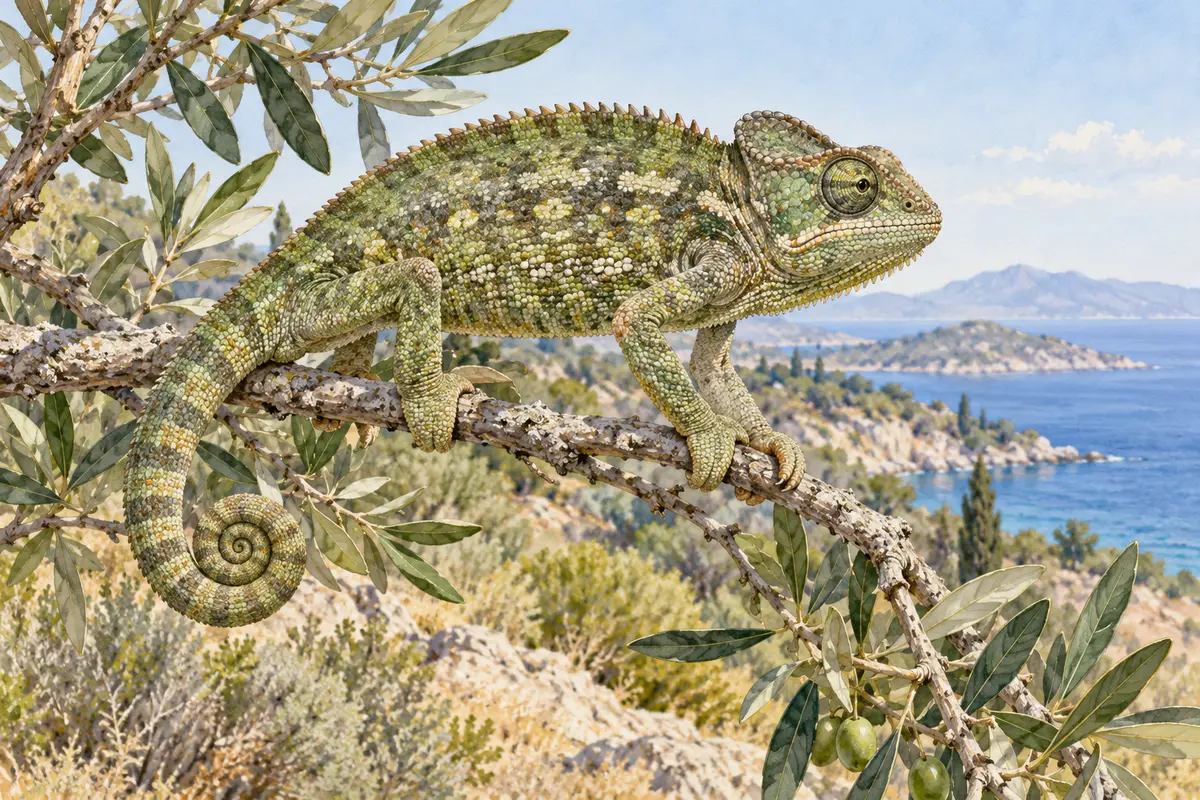
Native to coastal North Africa and the Levant into south-western Türkiye; some Iberian populations are introduced. It uses scrub, open woodland, gardens and edge habitats with suitable branching structure. [1]
ADW reports adults around 7.7–16 cm long and 17–56 g, with adult females generally heavier than males. These are reference ranges, not sole identification criteria. [1]
A rounded snout, low casque, laterally compressed body, split grasping toe bundles and coiling tail are characteristic. The eyes scan semi-independently but converge on a target. [1,3]
A projectile tongue nearly body-length, adhesive saliva, grasping feet and prehensile tail form an integrated branch-hunting system; colour change also serves communication and physiology. [1,3]
Behaviour and ecology
Diurnal, usually solitary and an arboreal sit-and-wait predator; juveniles use the ground more. Colour and posture signal territory, reproductive state and stress. [1]
Diet
The natural diet is dominated by arthropods including flies, hymenopterans, true bugs, grasshoppers and beetles, varying with season and prey availability. [1]
Reproduction and life cycle
One annual clutch, often 14–47 eggs in a soil burrow; studied populations show winter embryonic diapause and about ten months' total incubation. These figures are not a fixed husbandry calendar for every provenance. [1]
Ecosystem role
It is both an insect predator and prey for snakes, raptors, owls and small carnivores, linking it to Mediterranean scrub food webs. [1]
Threats & conservation
Habitat loss, urbanisation, roads, domestic predators and illegal collection are documented pressures. Any trade source requires provenance evidence and appropriate CITES permits. [1,2]
Reviewed 21 October 2026: LC and Appendix II were cross-checked through ADW's IUCN-linked account and the official CITES checklist. Appendix II regulates international trade; it is not unrestricted trade. [1,2]5 sourced facts
Species in five facts
The eyes can scan independently and then converge on prey. [1]
The tongue can approach body length. [1]
Females are generally larger than males. [1]
Embryos can enter winter diapause. [1]
The species is listed in CITES Appendix II. [2]
Sources
[1] University of Michigan ADW — Chamaeleo chamaeleon[2] CITES — official species checklist[3] University of Michigan ADW — Chamaeleonidae