
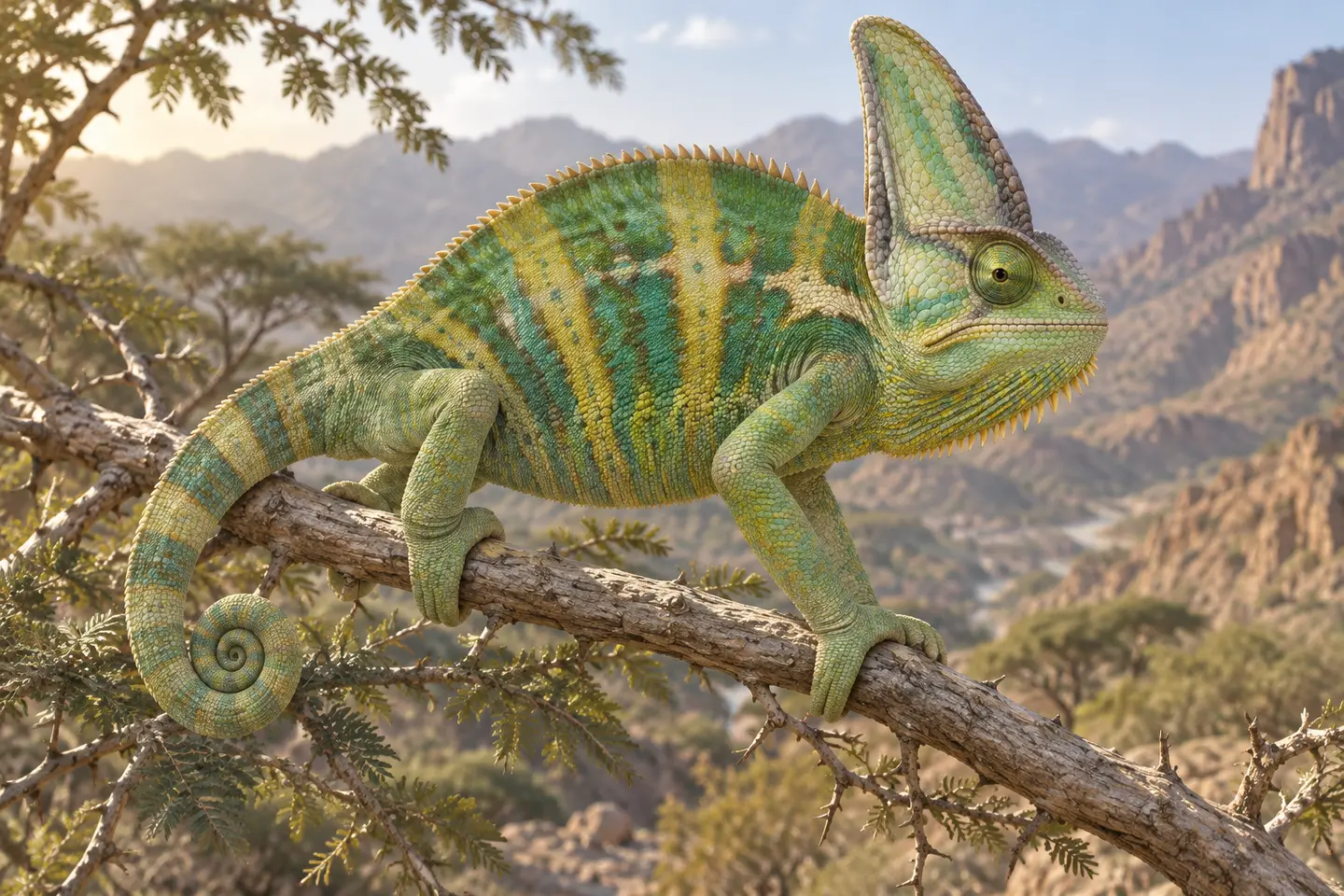
Native to uplands, vegetated wadis, scrub and cultivated landscapes in Yemen and south-western Saudi Arabia; introduced populations also occur beyond its native range. Its seasonally dry habitat is not equivalent to open desert. [1,2]
Adult males commonly reach roughly 43–60 cm total length; females are smaller, often about 25–35 cm. Much of the length is the prehensile tail. [1,2]
Males have a tall casque, hind-heel spurs and pronounced green, yellow and turquoise banding; females have a lower casque and usually quieter colour. Turreted eyes, opposed toe bundles, a prehensile tail and projectile tongue are characteristic. [1–3]
The casque, grasping feet and prehensile tail support branch life; turreted eyes widen surveillance, while a rapidly accelerating tongue captures prey beyond head length. [1–3]
Behaviour and ecology
Diurnal and largely solitary, communicating with colour, lateral body compression, rocking and posture. The eyes scan semi-independently, then converge when targeting prey. [1–3]
Diet
Primarily hunts insects and other invertebrates, while leaves or flowers are also recorded. This does not justify a monotonous captive diet or uncontrolled mineral and vitamin supplementation. [1,2]
Reproduction and life cycle
Oviparous, burying eggs in soil; females can store sperm and may also produce infertile clutches. Clutch size varies widely, often reaching dozens of eggs, while incubation lasts months and depends on temperature. [1,2]
Ecosystem role
An arboreal insect predator and prey for birds, snakes and small mammals, it participates on both sides of food webs in scrub and dry-valley habitats. [1; ecological interpretation]
Threats & conservation
IUCN lists the species as LC, but habitat change and collection can create local pressure. CITES Appendix II regulates international trade; captive-origin documentation cannot be replaced by colour or verbal claims. [3,4]
Reviewed 19 September 2026: LC was cross-checked through IUCN; Chamaeleonidae, including Chamaeleo calyptratus, is in CITES Appendix II in the Appendices effective 5 March 2026. Conservation status does not replace origin, permit and national-law checks.5 sourced facts
Species in five facts
The casque is markedly taller in adult males than in females. [1,2]
Opposed toe bundles function like a clamp around branches. [1]
Colour change supports signalling and thermoregulation, not camouflage alone. [2,3]
Females can lay infertile eggs even without mating. [2]
The English name “veiled” refers to the veil-like head casque. [1]
Sources
[1] Reptile Database — Chamaeleo calyptratus[2] Chameleon Academy — Veiled chameleon natural environment and husbandry[3] IUCN Red List species search[4] CITES Appendices effective 5 March 2026