
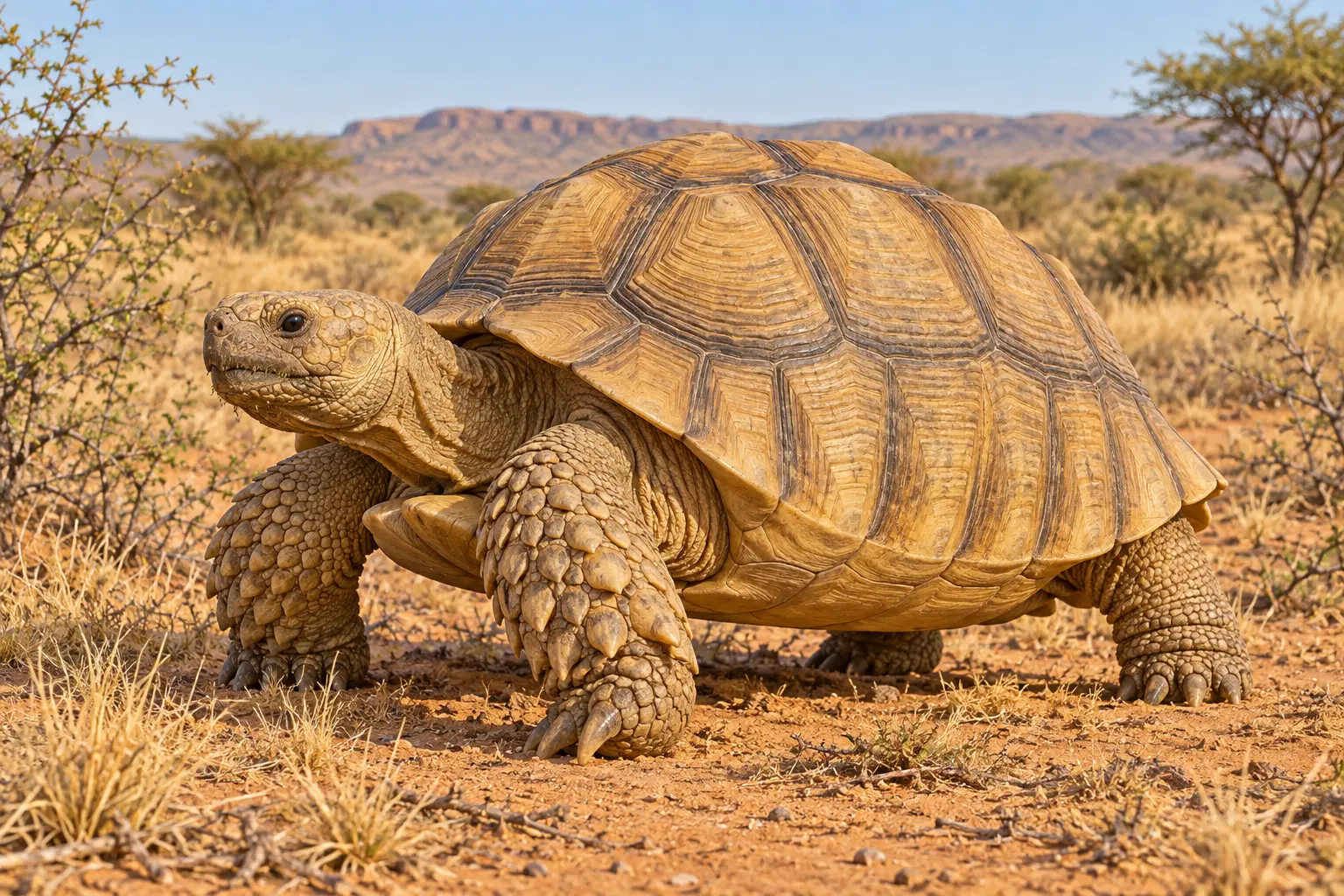
Patchily distributed from West Africa across the Sahel to Sudan, Ethiopia and Eritrea in dry savanna, semi-desert grassland, thorn scrub and desert margins. It needs diggable ground, vegetation and refuges rather than featureless open sand. [1,2]
Males may reach about 76 cm and exceed 45 kg, with exceptional males approaching 90 kg. Females are generally smaller, about 50 cm and up to 40 kg in the San Diego Zoo synthesis; these are upper values, not the size of every individual. [1]
The broad domed carapace is yellow-brown with clear furrows between scutes; the head is blunt and limbs columnar. Forelegs carry large conical scales and the rear thighs bear two or three prominent spurs. Excessive shell pyramiding commonly reflects abnormal growth, not a normal species trait. [1,2]
Deep burrows provide cooler, more stable microclimates and may shelter other wildlife. Powerful forelimbs, large claws and protective scales support digging, while sandy colour reduces contrast in dry grassland. Drought tolerance never justifies restricting water in managed care. [1]
Behaviour and ecology
Most active around dawn, dusk and the rainy season, it shelters underground during extreme heat or cold. Tortoises can excavate burrows several metres long, follow feeding routes, and males ram, bite or attempt to overturn rivals during breeding. [1]
Diet
Herbivorous, feeding mainly on grasses, weeds, flowers and occasional succulents. Managed diets require high fibre, moderate energy and adequate calcium-UVB provision; protein-rich food or accelerated growth increases skeletal and shell-deformity risk. [1]
Reproduction and life cycle
Females may excavate several trial nests before laying roughly 15–30 eggs. Eggs develop underground for about eight months; maturity is around 15 years and lifespan may reach 80–100 years, making care a multi-decade commitment. [1]
Ecosystem role
As a large herbivore it crops low vegetation, transports seeds and disturbs soil. Abandoned burrows create thermal refuges for smaller animals, so tortoise decline can remove an important microhabitat structure from the Sahel. [1]
Threats & conservation
Habitat loss and fragmentation, fire, overgrazing, collection and trade pressure wild populations. Captive individuals rapidly become very large, powerful diggers; acquisition requires legal provenance, extensive outdoor space, load-bearing barriers and a lifetime care plan. [1–4]
Reviewed 26 September 2026: IUCN records EN in the 2020 assessment; some older specialist pages still show VU from 1996. CITES regulates the species in Appendix II through the Testudinidae listing; captive breeding does not replace origin records and permits.5 sourced facts
Species in five facts
It is the largest tortoise native to mainland Africa. [1]
Burrows may reach about 3 m deep and remain markedly cooler than the surface. [1]
The name sulcata derives from Latin for the furrows on its shell. [1]
A clutch commonly contains roughly 15–30 eggs. [1]
Centrochelys sulcata is current; older sources often use Geochelone sulcata. [1,2]
Sources
[1] San Diego Zoo Wildlife Alliance — African spurred tortoise[2] The Reptile Database — Centrochelys sulcata[3] IUCN Red List species search[4] CITES Appendices effective 5 March 2026