
Recorded from the Mae Klong, Chao Phraya and Mekong basins, including river reaches in Thailand, Laos, Cambodia and Vietnam. Adults use main-channel deep pools for at least part of the year, while young occur in swamps, tributaries and seasonally flooded forest. [1]
FishBase records published maxima of 300 cm and 300 kg but explicitly states that the 300 cm length requires confirmation; modern fish encountered are usually far smaller. These are historical extremes, not expected dimensions for every individual. [1]
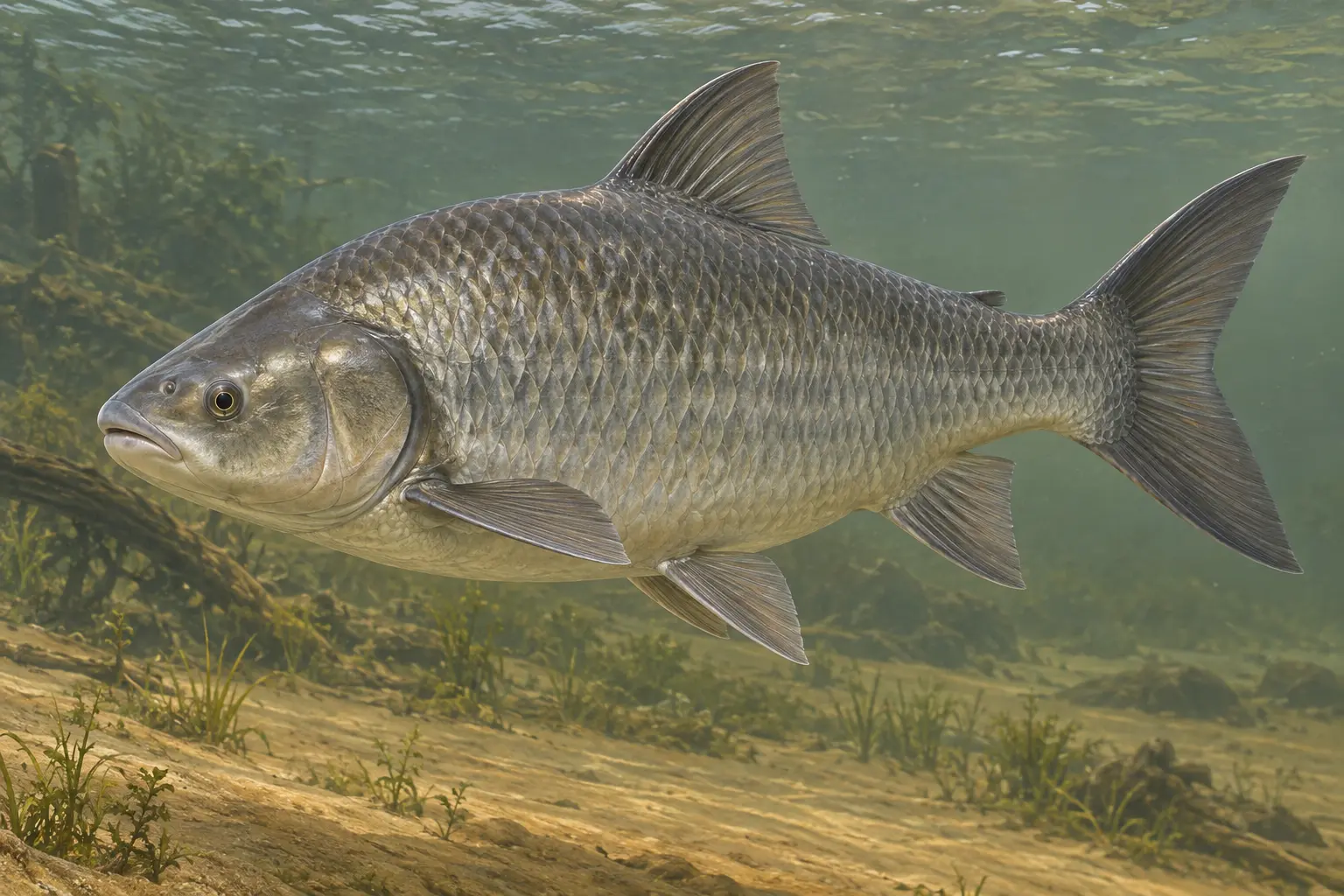
A deep robust body, very large head, large scales and silver-grey to brown-grey colour are characteristic; barbels and a hard dorsal spine are absent. Juveniles can resemble other large carps, so identification needs counts, gill-raker characters and capture locality. [1]
About 90–110 long gill rakers on the first arch help retain small food particles, fitting an algae and phytoplankton diet. Large body size stores energy for movement, while the barbel-free head and mouth differ from many bottom-feeding carps. [1]
Behaviour and ecology
A potamodromous migrant moving among main channels, deep pools, canals and floodplains with the water cycle. Young appearing in the lower Mekong around October is a seasonal observation, not a fixed breeding calendar for the entire basin. [1]
Diet
Feeds on algae, phytoplankton, fruit from inundated terrestrial plants and detritus. Both flooded-forest inputs and aquatic primary production matter, so managed diets cannot be reduced to a generic commercial carp ration. [1]
Reproduction and life cycle
Reproduction is linked to migration and flood pulses, but public data on spawning grounds, eggs and larvae remain limited. This profile does not invent fecundity or maturity values absent from FishBase; management must preserve migration routes and juvenile nursery habitat. [1]
Ecosystem role
Giant barb converts algae, phytoplankton, detritus and flooded-forest fruit into large-bodied biomass while moving nutrients between main channels and floodplains. Conservation therefore requires basin connectivity, not protection of a single deep pool. [1]
Threats & conservation
Overharvest, few fish surviving to reproductive age, habitat loss and migration barriers are prominent pressures. Dams, altered flood pulses and loss of flooded forest can simultaneously affect routes, food and nurseries; the age of the CR assessment strengthens the need for new surveys. [1,2]
Reviewed 23 September 2026: FishBase using IUCN version 2025-2 displays a CR assessment dated 5 April 2011. Catlocarpio siamensis was not found in the CITES Appendices effective 5 March 2026; absence from CITES does not replace fisheries, protected-area, import–export or quarantine law. [1–3]5 sourced facts
Species in five facts
FishBase cautions that the reported 300 cm maximum length needs confirmation. [1]
The species lacks barbels and a hard dorsal-fin spine. [1]
The first gill arch carries about 90–110 long gill rakers. [1]
It eats both algae and fruit from seasonally inundated plants. [1]
Adults and juveniles use different parts of the river system. [1]
Sources
[1] FishBase — Catlocarpio siamensis[2] IUCN Red List species search[3] CITES Appendices effective 5 March 2026[4] FAO field guide — Fishes of the Cambodian Mekong (FishBase main reference)