
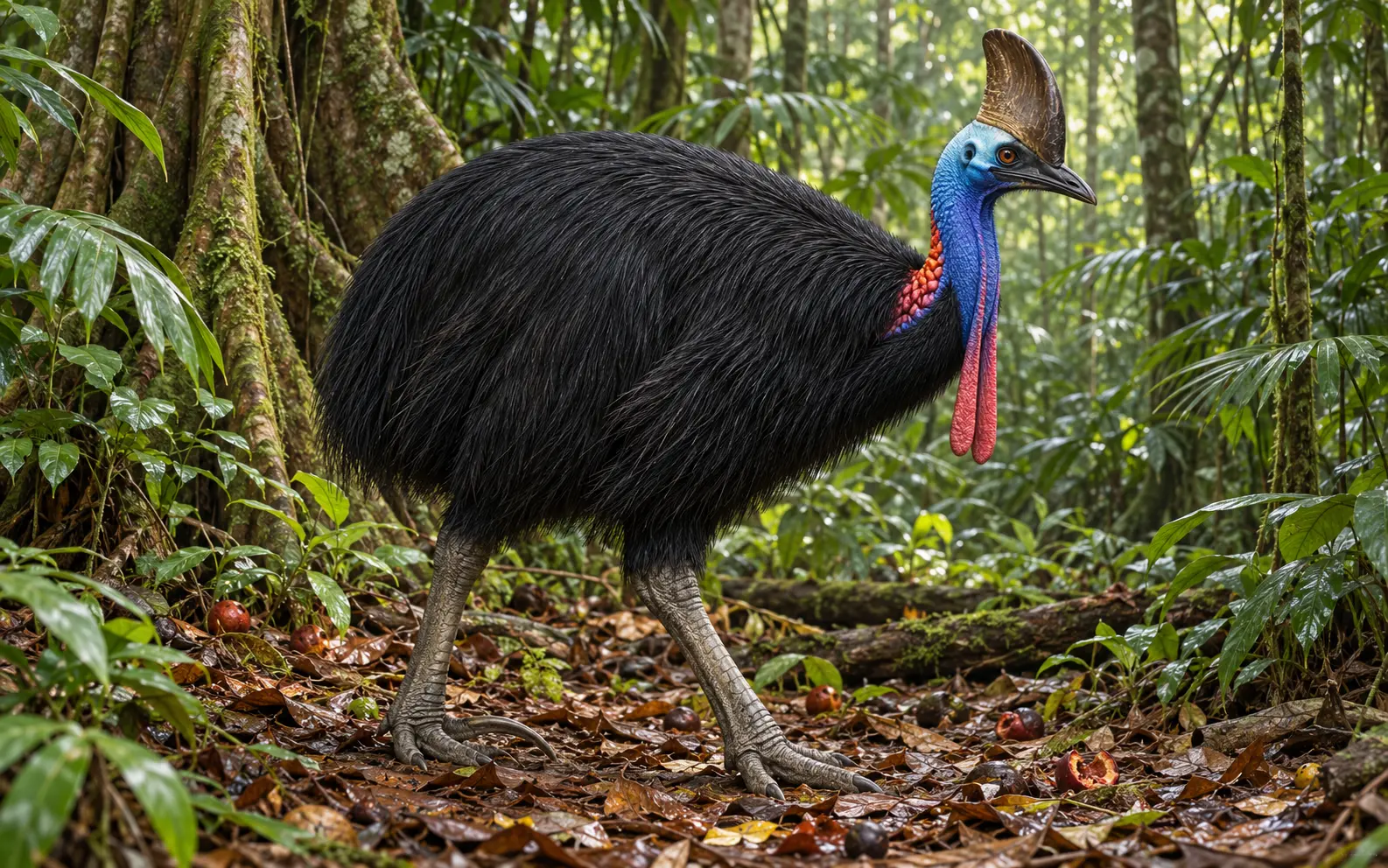
Occupies lowland rainforest, swamp forest, secondary forest and vegetated corridors leading to fruiting areas across New Guinea, the Aru Islands, Seram and north-eastern Australia. Water, canopy connectivity and seasonal fruit shape movements. [1–3]
Commonly about 1.5–1.8 m tall; females are larger and may approach 59 kg, while males are usually lighter. Measurements vary by sex, age and population, so one maximum should not be treated as the norm. [1]
Coarse, hair-like black body feathers contrast with a bare blue head, two red neck wattles and a tall keratinous casque. Each foot has three toes; the long inner claw is defensive anatomy, not a tool for actively hunting prey. [1,2]
A narrow body passes through undergrowth, powerful legs run and clear obstacles, and filamentous feathers shed rain. The casque's exact functions remain under study; signalling, protection and low-frequency sensing are hypotheses rather than one settled fact. [1,2]
Behaviour and ecology
Usually solitary, secretive and diurnal in dense forest, it communicates with low-frequency calls, posture and movement. It can defend itself forcefully when cornered, guarding chicks or habituated to human feeding, so it should never be fed or approached closely. [1–3]
Diet
Fallen fruit dominates the diet, supplemented opportunistically by fungi, invertebrates, small animals and carrion. Digestion leaves many large seeds viable, allowing germination after transport away from the parent tree. [1–3]
Reproduction and life cycle
A female may mate with several males and lays 3–5 large green eggs in a leaf nest on the ground. The male incubates for about 50 days, then alone leads and protects the chicks for months; the female does not care for that brood. [1,2]
Ecosystem role
By swallowing large fruits whole and depositing seeds elsewhere, cassowaries connect forest patches and support tree recruitment. Their loss can reduce dispersal for large-fruited plants that depend on few animal carriers. [1–3]
Threats & conservation
Forest fragmentation, vehicle strikes, dog attacks, food-conditioning and severe cyclones are major Australian risks, with pressures varying across the global range. Management needs forest corridors, low vehicle speeds, dog control and no habituation through feeding. [2,3]
Reviewed 28 September 2026: BirdLife/IUCN records the global species as Least Concern (LC). Australia's C. c. johnsonii population is listed as Endangered under Australian federal law; that regional status does not replace the global category. The species was not located in the CITES Appendices effective 5 March 2026; absence is not permission for unrestricted transport or trade.5 sourced facts
Species in five facts
Females are larger than males and may approach 59 kg. [1]
Males incubate the eggs and raise the chicks. [1,2]
The species has two red wattles, an important identification feature. [1]
Many large seeds remain viable after passing through the gut. [1–3]
Global LC status does not negate the Endangered status of the Australian population. [2,3]
Sources
[1] Australian Museum — Southern cassowary[2] BirdLife DataZone — Casuarius casuarius[3] Australian Government — Recovery plan for the southern cassowary[4] CITES Appendices effective 5 March 2026