
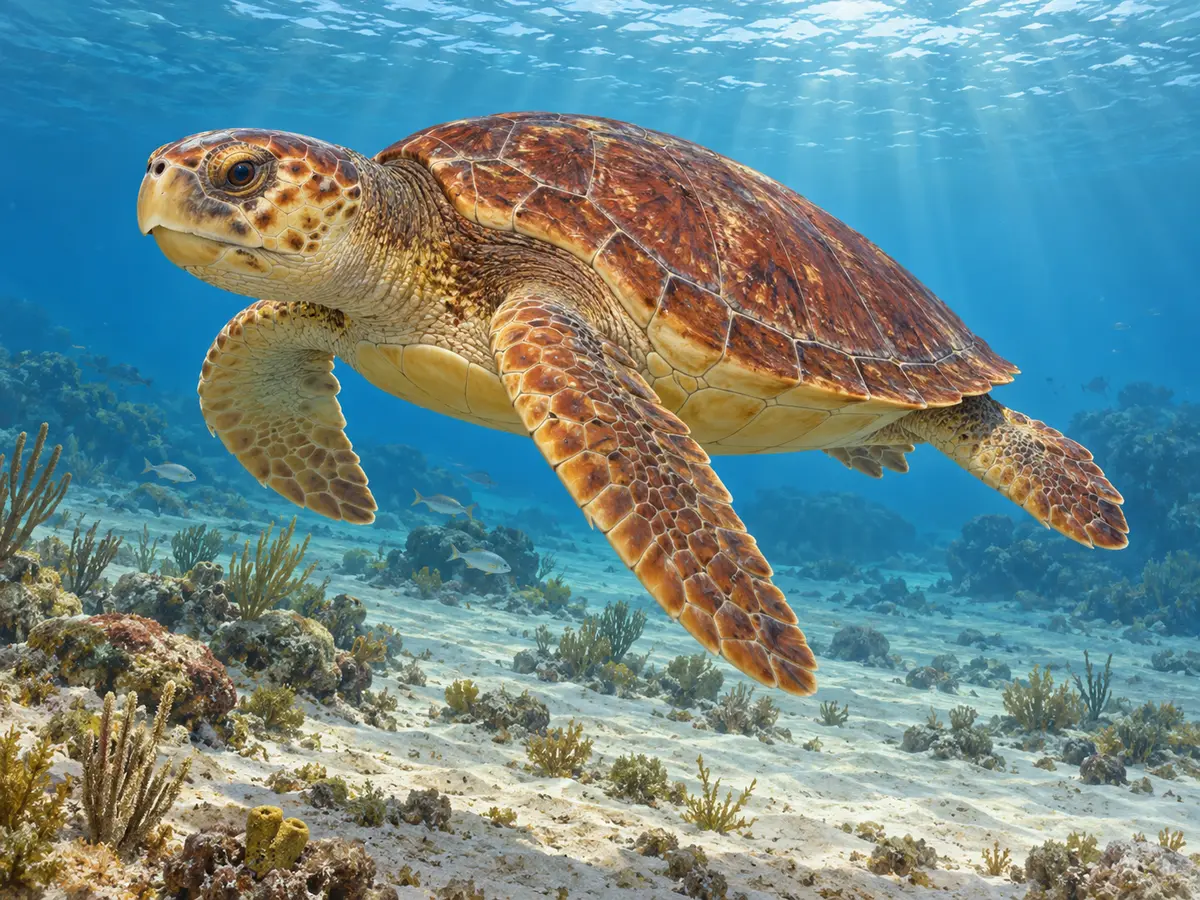
Occurs in the Atlantic, Pacific and Indian oceans and the Mediterranean. Warm sandy beaches serve nesting, while coastal shelves and open ocean are used at different life stages; females often return near their natal region to nest. [1]
NOAA reports adults typically about 76–107 cm in shell length and 91–159 kg. Size varies by population and sex; curved versus straight carapace measurement must be stated for valid comparisons. [1]
Very large head, reddish-brown carapace with five pairs of costal scutes, pale-yellow plastron and relatively short, thick foreflippers compared with a green turtle. The strong beak has no teeth; scute count and head shape are more reliable than underwater colour. [1]
A large head and jaw muscles generate force for hard prey; foreflippers provide thrust while hind flippers steer and excavate nests. Salt glands near the eyes excrete excess salt, making nesting turtles appear to cry. [1]
Behaviour and ecology
Young turtles ride oceanic currents for roughly 7–15 years before recruiting to coastal habitat; adults migrate long distances between feeding and nesting grounds. They must surface to breathe despite prolonged resting dives. [1]
Diet
Large jaws crush crabs, molluscs, snails, crustaceans and horseshoe crabs; jellyfish and other prey are also taken opportunistically. Diet shifts by life stage and sea region, so one prey list should not be assigned to every population. [1]
Reproduction and life cycle
Matures late, at about 35 years according to NOAA. Females commonly nest every 2–3 years, making 3–5 nests in a season with about 100 eggs each; incubation is roughly two months and sand temperature influences hatchling sex. [1]
Ecosystem role
As a benthic predator, it influences mollusc and crustacean communities and disturbs sediment while feeding. Eggs, shells and hatchlings move marine nutrients onto nesting beaches, although the contribution varies among rookeries. [1]
Threats & conservation
Fishing bycatch, egg harvest, nesting-beach loss, artificial light, vessel strikes, plastic debris and climate change are major threats. Rescue requires authority and specialist rehabilitation coordination; sea turtles must not be casually held, moved or released. [1–3]
The global IUCN assessment lists the species as Vulnerable (VU), while regional management units range from LC to CR; the global label must not conceal local risk. Caretta caretta is in CITES Appendix I, tightly restricting international commercial trade in wild-sourced specimens. [1–3]5 sourced facts
Species in five facts
A large head and powerful jaws process hard-shelled prey. [1]
Young turtles may spend 7–15 years in the open ocean. [1]
Maturity occurs at roughly 35 years. [1]
Nest temperature influences hatchling sex. [1]
Regional population status varies markedly. [2]
Sources
[1] NOAA Fisheries — Loggerhead Turtle[2] IUCN Marine Turtle Specialist Group — Statuses[3] CITES Appendices effective 5 March 2026