
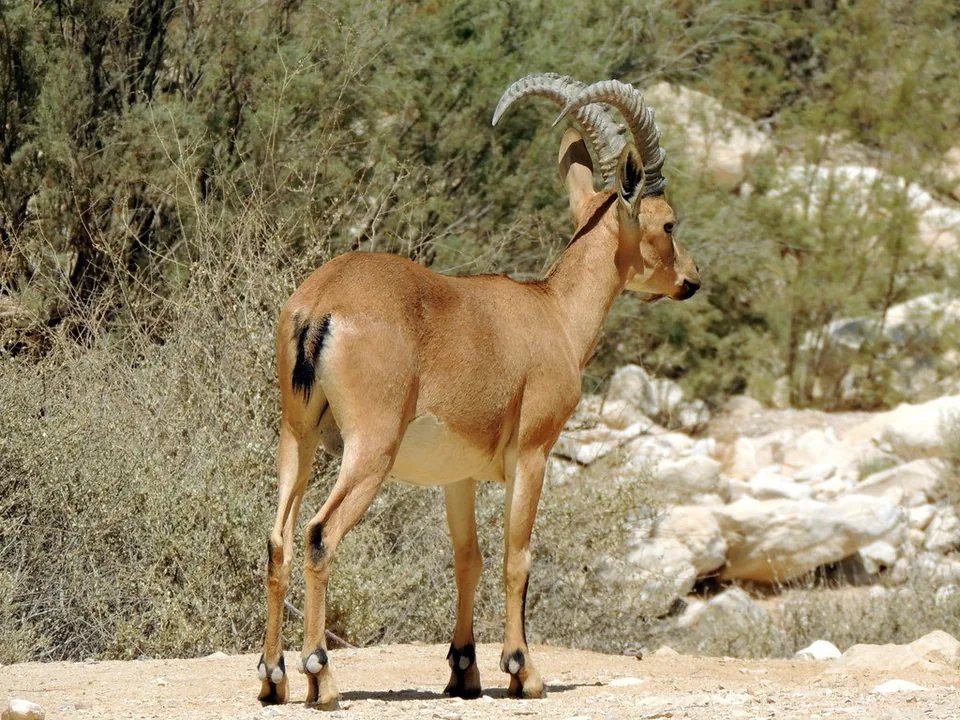
Fragmented populations extend from Red Sea regions of north-eastern Africa through Sinai to the Arabian Peninsula; it occupies gorges, cliffs and scree from near sea level to about 3,000 m. [1]
ADW summarises males at about 62.5 kg and 75 cm at the shoulder, versus females around 26.5 kg and 65 cm at the shoulder. [1]
Sandy-brown coat, white belly and black-white leg markings; both sexes bear horns, but male horns are massive, sweep backwards and may reach about 120 cm. [1]
Split hooves with hard edges and gripping pads aid rock climbing; cool-hour activity and cliff use support survival in hot, water-limited, predator-rich terrain. [1]
Behaviour and ecology
Most active around dawn and dusk, resting in shade during heat. Herds are often sex-segregated; steep escape terrain near feeding sites reduces predation risk. [1]
Diet
Browses grasses, herbs, shrub and tree leaves including Acacia, plus buds and fruit; diet shifts with arid-season availability. [1]
Reproduction and life cycle
Breeding commonly occurs from October to December in the compiled account; gestation is about 150–165 days and usually produces one kid, sometimes two. [1]
Ecosystem role
A dry-mountain herbivore influencing vegetation and serving as prey for large carnivores; ADW also records grackles removing ectoparasites from its body. [1]
Threats & conservation
Hunting, habitat loss and fragmentation, livestock competition and pollution threaten isolated populations. VU status calls for population-specific management rather than reliance on a global label alone. [1,2]
Reviewed 17 September 2026: VU follows the 2020 IUCN assessment indexed by GBIF/ADW. The species name was not found in the CITES Appendices effective 5 March 2026 during cross-checking; this does not exclude national or local controls.5 sourced facts
Species in five facts
Both males and females have horns. [1]
Male horns may reach about 120 cm. [1]
In ADW’s figures, males average more than twice the mass of females. [1]
Activity is concentrated around dawn and dusk. [1]
It commonly remains near steep escape terrain. [1]
Sources
[1] Animal Diversity Web — Capra nubiana[2] IUCN Red List — Capra nubiana assessment[3] CITES Appendices — effective 5 March 2026[Ảnh] iNaturalist observation 8822511 — CC0