
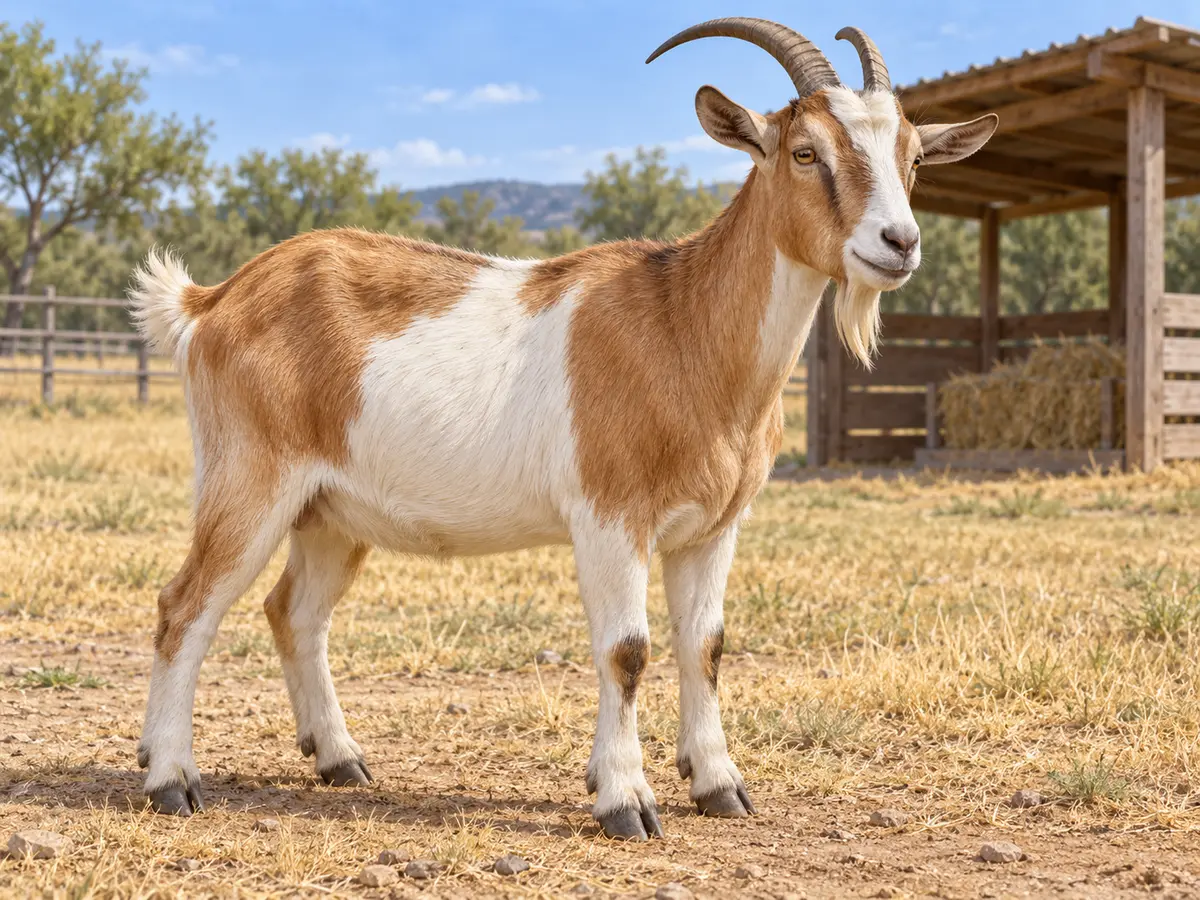
Human-mediated husbandry has spread goats almost worldwide, from pasture, mountains and semi-arid land to intensive farms. This is a domesticated distribution; facilities still need dry footing, ventilation, shade, clean water, suitable feed and social space appropriate to breed, age and climate. [1–3]
Animal Diversity Web summarises mass of roughly 9–113 kg and height of 26–107 cm across breeds, with a typical adult in that source near 45 kg and 64 cm tall. This multi-breed range is descriptive, not a body-condition target. [1]
A robust body, cloven hooves, horizontal pupils and a short often upright tail; the coat may be short, long or underwool-bearing in many colours and patterns. Horns may curve or twist, but horned sex, ear size, beard and nose profile all vary by breed. [1,2]
A multi-chambered stomach processes fibrous forage, while mobile lips and selective browsing exploit patchy vegetation. Cloven hooves and balance aid movement on slopes, but do not replace hoof care and dry footing in managed settings. [1,2]
Behaviour and ecology
Diurnal, social animals that form hierarchies; males may butt heads while competing for rank. Goats climb, explore and select foods, so housing should provide compatible social groups, safe enrichment and enough feeding and resting stations to reduce conflict. [1]
Diet
Goats are browsing and grazing ruminants whose rumen microbes ferment cellulose. Diets require long fibre, energy, protein, minerals and water balanced to breed and physiological stage; feed changes should be gradual to reduce acidosis and digestive disruption. [1–3]
Reproduction and life cycle
Many temperate breeds mate from late summer to early winter, whereas some tropical breeds breed year-round. The oestrous cycle is about 18 days and gestation 145–152 days; twins are very common, although one or three kids also occur. Newborns can stand and follow the dam within hours. [1]
Ecosystem role
Controlled grazing can manage scrub and cycle nutrients, while excessive stocking or duration can remove regeneration, compact soil and drive erosion. Feral goats can strongly affect island vegetation, so programmes must set carrying pressure and prevent escape. [1–3]
Threats & conservation
Management risks include parasites, infectious disease, heat stress, hoof disorders, mineral imbalance, horn injury and inbreeding. DinoJura must check breed, source herd, veterinary, quarantine, welfare and transport records; non-CITES status does not make a transaction automatically lawful. [1–4]
The domestic goat is a domesticated taxon, commonly treated as Capra hircus or Capra aegagrus hircus, and therefore has no global IUCN threat category as a wild species. This name was not located in the CITES Appendices effective 5 March 2026; that does not waive quarantine, veterinary certification, welfare, breed, import or national-law requirements. [1–4]5 sourced facts
Species in five facts
More than 200 domestic goat breeds are recognised worldwide. [2]
Mass across breeds can range roughly from 9 to 113 kg. [1]
The oestrous cycle is reported at about 18 days. [1]
Gestation generally lasts 145–152 days. [1]
Kids can stand and follow their dam within hours of birth. [1]
Sources
[1] Animal Diversity Web — Capra hircus[2] Smithsonian's National Zoo — Goats[3] FAO DAD-IS — Domestic Animal Diversity[4] CITES Appendices effective 5 March 2026