
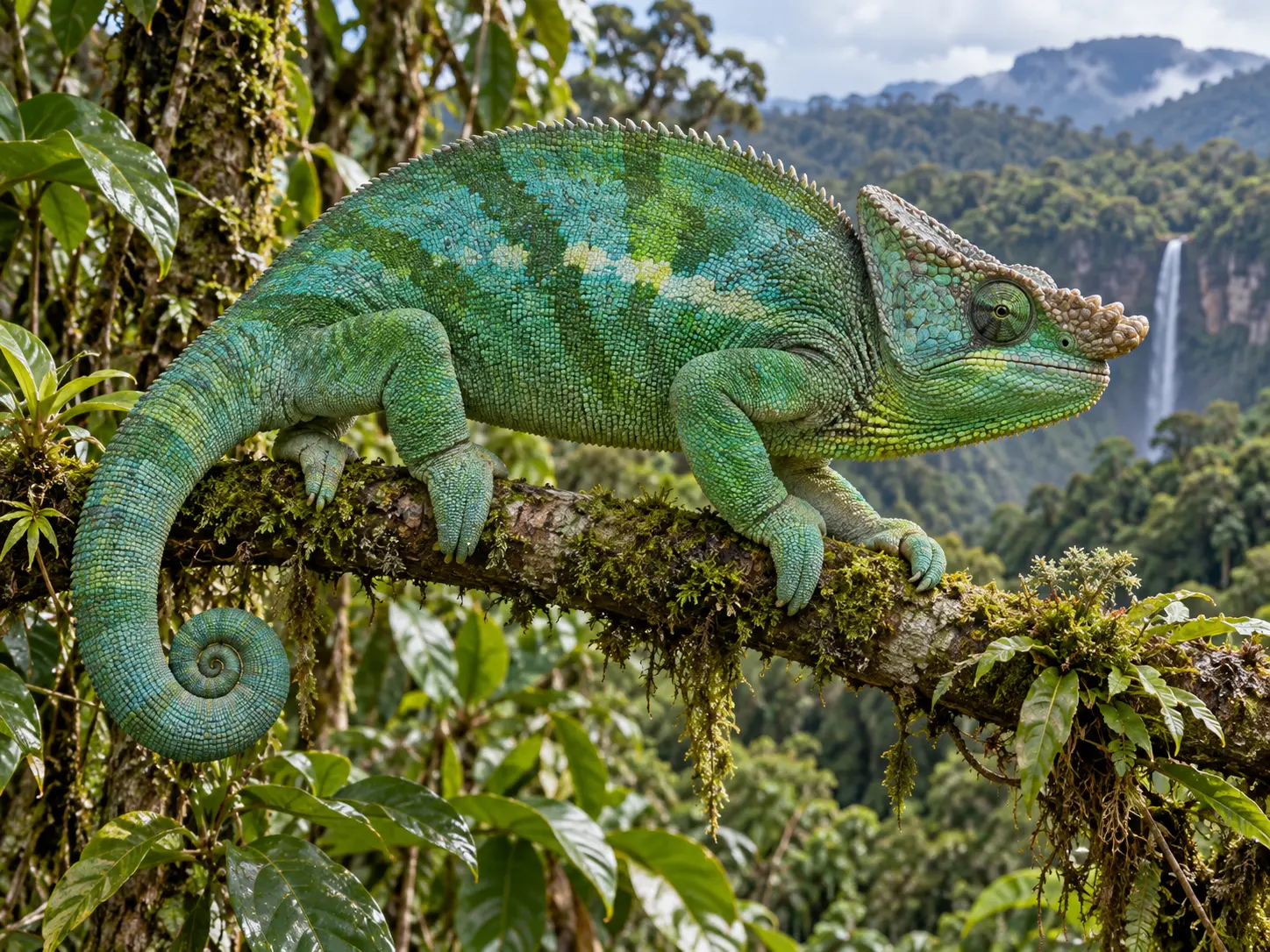
Rainforest and humid wooded habitats of eastern Madagascar from near sea level into uplands, depending on canopy structure and cool, moist microclimates.
Large individuals can exceed 60 cm total length; size varies by subspecies, locality and sex, with males generally larger.
A massive body and head, low casque and ridged snout; males in many populations show blue-green tones, sometimes with yellow or orange eyelids. The long tail coils firmly around branches.
Large size broadens prey choice; opposed toes and a prehensile tail support the heavy body in trees, while specialised eyes and tongue permit capture without close approach.
Behaviour and ecology
Arboreal, diurnal, slow-moving and largely ambush-oriented. It signals with colour, posture and lateral compression; adults require substantial spacing.
Diet
Primarily consumes insects and other invertebrates; large individuals may take small vertebrates. The natural prey spectrum is broader than a few common feeder insects.
Reproduction and life cycle
Oviparous and late-maturing; females bury large clutches in soil. Eggs have an unusually long development period strongly influenced by seasonal temperature and moisture cycles.
Ecosystem role
A canopy predator helping regulate insects and small animals; its presence is associated with structurally complex humid forest.
Threats & conservation
IUCN lists it as NT; forest loss, fragmentation and commercial collection are key risks. CITES Appendix II and Malagasy export controls require rigorous origin verification.
IUCN/CITES status was checked on the profile date; re-verify before any legal or transaction decision.5 sourced facts
Species in five facts
The species honours English physician James Parsons.
It is among the heaviest chameleons.
Eggs may take more than a year to hatch.
It matures slowly and outlives many small chameleons.
Local forms differ noticeably in colour and morphology.
Sources
Chester Zoo — Parson's chameleonAnimal Diversity WebIUCN Red List searchCITES Checklist