
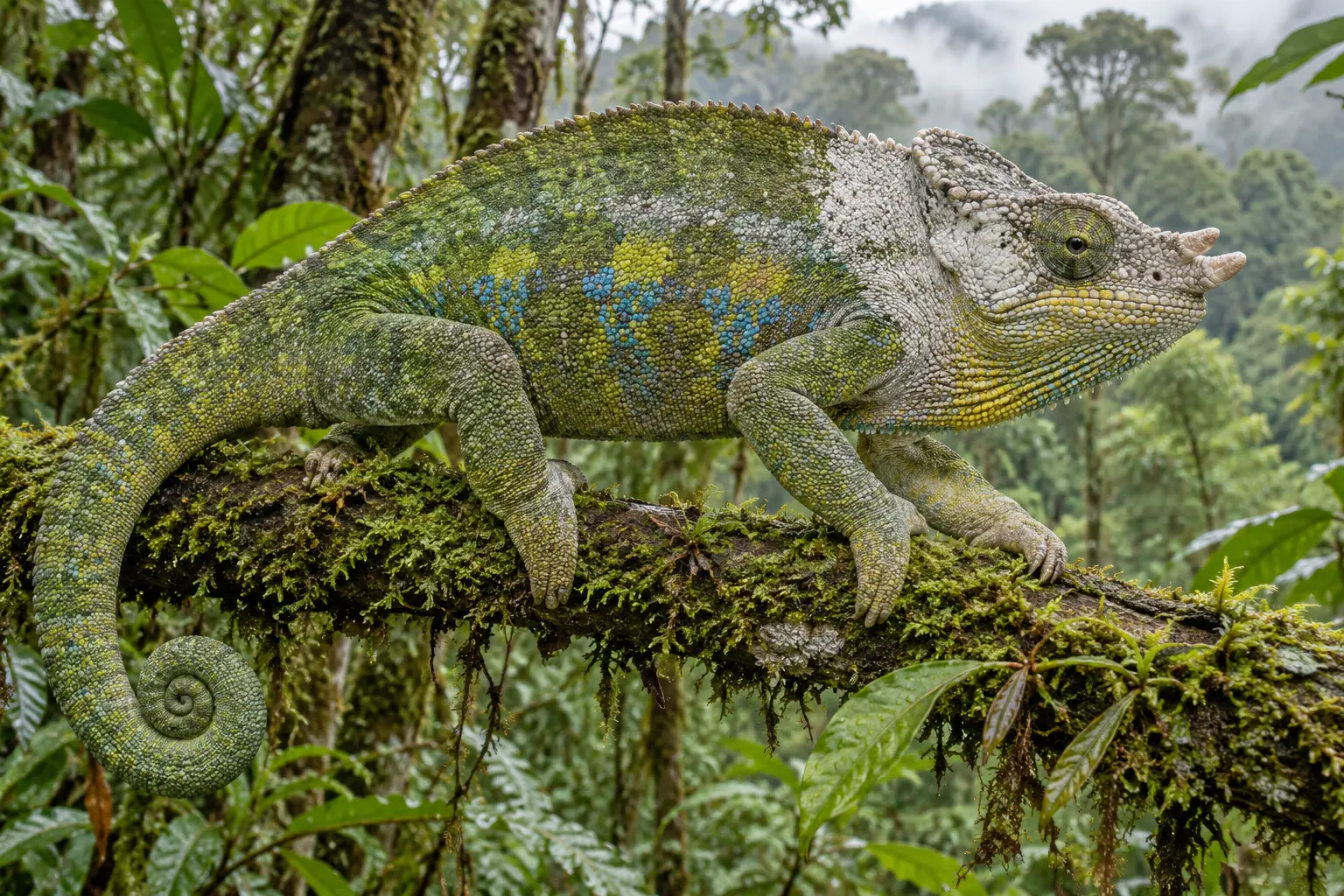
Restricted to Madagascar, from the Ranomafana region south to the northern edge of Andohahela National Park. It favours humid evergreen forest, especially deep primary forest rich in ferns and moss; night surveys often find sleeping animals near branch tips about 2–4 m high. [2,3]
Large individuals are reported at nearly 40 cm total length. That figure includes the long prehensile tail and should not be treated as a default for every sex or population. [2]
A large olive to green-grey body, often with a pale grey-white head and shoulder and blue-yellow flank accents; both sexes have small occipital lobes. Males carry two short blunt rostral processes, absent in females. Colour alone is unsafe because state, light and individuals vary. [1–3]
Opposed toe bundles grip branches, the prehensile tail supplies a third anchor and turreted eyes widen surveillance. A projectile tongue captures prey without a full-body lunge; colour and posture also carry physiological and social signals rather than serving camouflage alone. [2,3]
Behaviour and ecology
Diurnal, arboreal and largely solitary. A field study recorded greater adult activity in the morning and late afternoon; at night they often sleep exposed on slender branches. The eyes scan semi-independently and converge when targeting prey. [2,3]
Diet
A visually guided predator taking mainly insects and other invertebrates with a projectile tongue. Managed care requires varied size-appropriate prey, body-condition monitoring and veterinary oversight of minerals and vitamins rather than copying a formula from another Calumma. [2,3]
Reproduction and life cycle
Oviparous, depositing eggs in soil. Taxonomic sources confirm egg laying, but reliable species-specific clutch and incubation values remain limited, so values from C. parsonii or another chameleon are not substituted. Females need deep diggable substrate with thermal and moisture choice. [1]
Ecosystem role
It is an insect predator in the lower to mid canopy and prey for birds, snakes and small mammals. Dependence on intact humid forest makes it a useful indicator of forest structure, although one sighting cannot establish ecosystem health. [2–4]
Threats & conservation
Forest loss and degradation from logging, agriculture and fragmentation are the main pressures; illegal collection may add local impact. Appendix II is not an absolute ban but requires valid documentation and applicable non-detriment findings; captive-bred claims need separate evidence. [4,5]
Reviewed 2 October 2026: the 2011 IUCN assessment lists the species as Vulnerable (VU); CITES regulates Calumma spp. under Appendix II. The conservation assessment is old, so recent population change must not be inferred from VU alone; every transfer also requires provenance, purpose and national-law checks. [1,4,5]5 sourced facts
Species in five facts
The species honours poet and herpetologist Arthur O’Shaughnessy. [1]
Males have two short rostral processes; females lack them. [2]
Large individuals approach 40 cm in total length. [2]
Sleeping animals may be found near branch tips about 2–4 m high. [2,3]
International trade is controlled under CITES Appendix II. [5]
Sources
[1] The Reptile Database — Calumma oshaughnessyi[2] Madcham — Calumma oshaughnessyi[3] Chameleons.info — Calumma oshaughnessyi[4] IUCN Red List search — Calumma oshaughnessyi (assessment 2011)[5] CITES Appendices effective 5 March 2026