
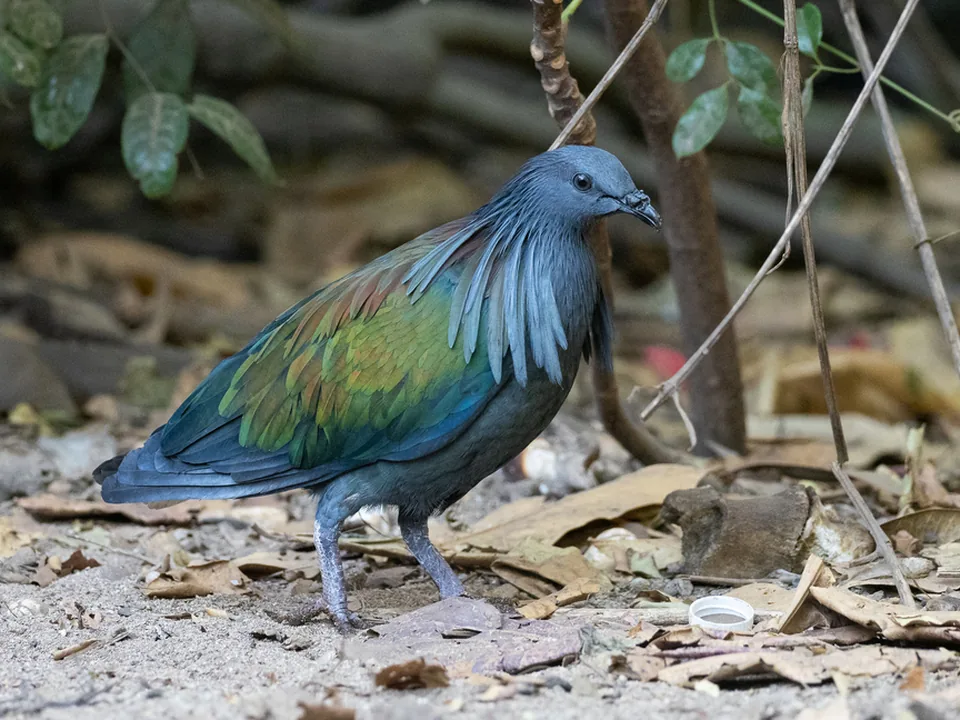
Patchily distributed on small islands from the Andaman–Nicobar chain through maritime Southeast Asia to Palau, New Guinea and the Solomon Islands. It forages in lowland, coastal and mangrove forest and may commute between feeding and breeding islands. [1–3]
About 40 cm long and among the largest living pigeons, with a robust body, broad wings and strong legs suited to the forest floor. Males average larger and have a more pronounced bill knob. [1,2]
Grey head, mane-like neck hackles, dark iridescent green-blue-bronze body, red legs and a contrasting white tail. Juveniles are duller and lack the clean white adult tail. [1,2]
Strong legs support terrestrial foraging, wings enable sea crossings, iridescence shifts with viewing angle and the white tail may aid flock signalling. A muscular gizzard processes hard seeds. [1,2]
Behaviour and ecology
Feeds in daytime ground flocks, turning litter for seeds and fruit, then may fly to safer small islands for roosting or breeding. This commuting links islands into an ecological network. [1,2]
Diet
Consumes fallen fruit, seeds, nuts and some invertebrates. Small stones in the gizzard help grind hard material, so the natural diet cannot be reduced to a single commercial seed type. [1,2]
Reproduction and life cycle
Builds a sparse stick nest in trees on islands with few mammalian predators and usually lays one white egg. Both parents incubate and feed crop secretion before gradually adding solid food. [1,2]
Ecosystem role
By swallowing fruit and moving seeds among islands, it can support forest regeneration and plant connectivity across archipelagos, while also contributing prey and nutrients to island food webs. [1–3; ecological interpretation]
Threats & conservation
Coastal forest loss, hunting, egg collection and introduced island predators drive decline. A broad range spread over small islands leaves individual populations vulnerable; CITES Appendix I applies strict controls. [2–4]
Reviewed 20 September 2026: BirdLife/IUCN records NT; CITES lists Caloenas nicobarica in Appendix I. NT does not mean trade is permitted—CITES controls, origin evidence and national law remain determinative.5 sourced facts
Species in five facts
It is a close living relative of the dodo within the pigeon lineage. [3]
The adult's white tail contrasts sharply with its iridescent body. [1,2]
Birds often commute between feeding and nesting islands. [1,2]
A clutch usually contains just one egg. [1]
Both parents produce crop secretion for the chick. [1]
Sources
[1] Animal Diversity Web — Caloenas nicobarica[2] BirdLife DataZone — Caloenas nicobarica[3] NCBI/PubMed — chromosome-level genome of the Nicobar pigeon[4] CITES Appendices effective 5 March 2026[Ảnh] iNaturalist observation 105024063 — Forest Botial-Jarvis, CC BY