
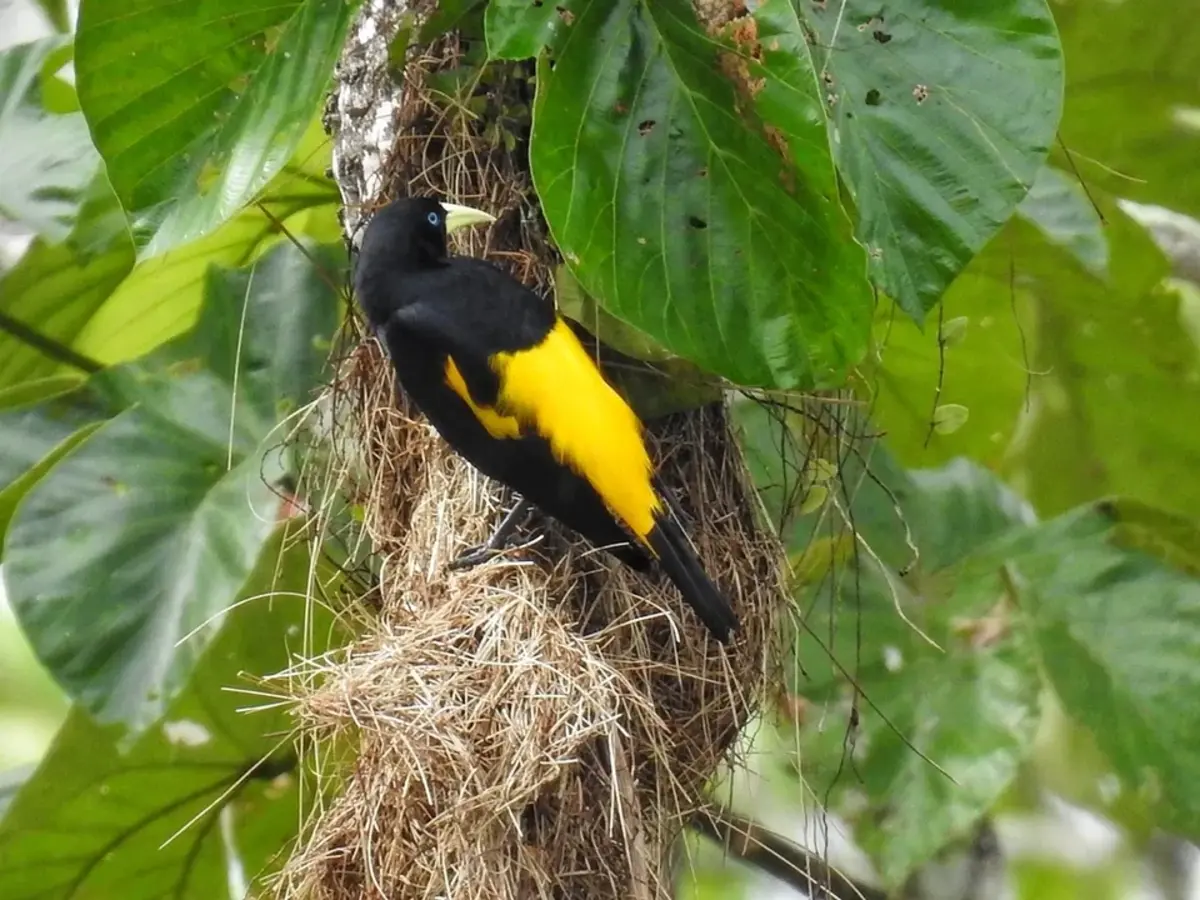
Ranges from Panama and Trinidad through northern South America to Peru, Bolivia and central Brazil. It commonly uses forest edges, open woodland, river corridors, cultivated landscapes with large trees and even towns, rather than deep closed forest. [1,2]
Males are about 27–30 cm long and roughly 100 g; females about 23–25 cm and 60–80 g. Size dimorphism is marked, while the basic colour pattern is similar but usually duller in females. [1,2]
Body and tail are mostly black, contrasting with bright yellow at the wing base and rump; adults have pale blue eyes and a pointed greenish-yellow bill. Young birds have dark eyes and brown at the bill base, with adult colour developing through the third year. [1]
Hanging nests at branch tips are difficult to reach, and nesting near social wasps or on islands can reduce some nest predators. Song learning and shared dialects help recognise colony members, while the pointed bill handles both fruit and insects. [1]
Behaviour and ecology
Diurnal, arboreal and colonial; a colony may contain 2–250 nests, commonly 40–100 active nests. Males compete through size, aerial contests and song matching; colonies share about five to seven song dialects that can change through the season. [1]
Diet
An omnivore taking insects, fruit and nectar. Adults hunt caterpillars, crickets, grasshoppers and other canopy invertebrates and eat figs or chupa-chupa fruit; females provision nestlings with protein-rich arthropods. [1,2]
Reproduction and life cycle
The mating system is polygynous; females build hanging pouch nests about 40–45 cm long, incubate and rear the young. Two eggs of 5–6 g are typical; they hatch after roughly 13–15 days and young begin flying about 25 days after hatching. Males mainly defend territory and nests. [1,2]
Ecosystem role
It consumes many insects, eats fruit and may move seeds among trees; eggs and young support snakes, raptors and brood parasites. Associations with wasp nests and caimans show how nest defence can depend on surrounding community structure. [1]
Threats & conservation
The species remains widespread, but loss of large colony trees, pesticide exposure and local trapping can cause local impacts. DinoJura should consider only traceable specimens after confirming export/import law, veterinary controls, quarantine and transport welfare. [1–4]
BirdLife/IUCN lists Cacicus cela as Least Concern (LC). The name was not located in the CITES Appendices effective 5 March 2026; this is not a finding that possession or trade is unrestricted, because wildlife, veterinary, quarantine and national rules still apply. [1–4]5 sourced facts
Species in five facts
Males are usually 27–30 cm long and clearly larger than females. [1,2]
A colony may contain from two to 250 nests. [1]
The female builds a pouch nest about 40–45 cm long. [2]
Two eggs per clutch is the commonly reported number. [1]
Colonies share roughly five to seven song dialects. [1]
Sources
[1] Animal Diversity Web — Cacicus cela[2] University of the West Indies — Yellow-rumped Cacique[3] BirdLife DataZone — Cacicus cela[4] CITES Appendices effective 5 March 2026Photo record — Esteban Poveda / iNaturalist 102880594